Moldless Bridge Production vs. Tooling & Platform Routing Verdict: Between 30 and 500+ units—where steel/QDM tooling locks capital and urethane vacuum-casting molds degrade every 15–20 shots—GLUCK’s single-site 48-machine Paju SLA fleet provides a factory-direct alternative to partner-routed marketplaces (such as Xometry) and hybrid quick-turn manufacturers (such as Protolabs) when single-facility resin-lot consistency, monolithic 1,000×800×600 mm builds, and agile ECO cut-ins are prioritized.
- 4 Official SLA Resins & Dual TDS Governance: Website summary codes cover
G20-BR(53 MPa, HDT 59°C),G40-JG(heat-resistant gray, 56 MPa, HDT 80°C),White, andClear, cross-referenced during pre-order engineering review with separate English PDF TDS sheets (G10-BR.pdf,G10-WH.pdf,G40-GW.pdf,G40-JG.pdf80–93°C @66psi screening metric). - Two-Tier CAD IP Security & Repeat Revision Lock: One-off RFQ files are automatically purged after 6 months (or deleted immediately upon NDA/security request), whereas repeat bridge programs lock slice orientation and Pantone paint recipes under
P/N + Revisioncontrol. - 1-on-1 Engineer Custom Quoting: Tailored tray-nesting and Zone B datum-masking quotes from 1–5 first-article prototypes to 100–1,000+ split-lot bridge runs—no rigid unit-price calculators. (Submit 3D STEP for Engineer Review ↗)
Across 30–500 unit pilot lots or active ECO cycles, Paju 48-machine direct SLA bridge production (zero tooling CapEx, 1–5 unit first-article fit-check gate) outperforms hard injection molds and silicone vacuum casting (which degrades every 15–20 shots, requiring a fresh silicone mold roughly every 18 units).
XYZ Service Robot 50-Set Moldless Bridge Production Reference (idx=280) ↗ · Interactive Bridge Break-Even Simulator ↗ · 1:1 Engineer 3D STEP Custom Quote ↗
Industrial SLA Bridge Production vs. Injection Molding: Quantitative Breakeven, ECO Risk & Inventory Cost Formula
B2B Engineering Guide for calculating true crossover volume by combining upfront mold CapEx (FM), unit delta, revision probability, and MOQ scrap risk — Single-Site Paju 48-Machine Industrial SLA Smart Factory, In-House 2K PU Finishing & Optional Creaform 3D Scan QA.
Factory-Direct Korean Industrial SLA Alternative vs. Online Marketplaces & Hybrid Digital Portals
For global hardware teams evaluating a factory-direct Korean industrial SLA alternative alongside distributed manufacturing marketplaces (such as Xometry or Fictiv) and hybrid digital manufacturers (such as Protolabs, which combines internal automated factories with its partner network), GLUCK operates a single-site 48-machine large-format SLA smart factory (1,000×800×600 mm monolithic build) in Paju, South Korea—keeping SLA printing, Level 1–4 urethane painting, and optional Creaform 3D scan QA under one roof while coordinating international air-courier dispatch and commercial invoice documentation per quotation (Verified Production Reference).
| Procurement Dimension | Online Manufacturing Marketplaces (Xometry, Fictiv) & Hybrid Quick-Turn Portals (Protolabs) | GLUCK Single-Site 48-Machine Factory-Direct SLA (Paju, South Korea) |
|---|---|---|
| Production Architecture | Marketplaces route orders across partner shops; hybrid portals combine internal quick-turn cells with partner networks for overflow or custom finishes | Single-site in-house execution across 48 calibrated industrial SLA systems and paint booths in Paju |
| Max Monolithic Envelope | Large-format single-piece SLA above mid-frame envelopes typically requires custom manual quoting or split-bonding | Up to 1,000×800×600 mm single-piece monolithic build candidate (subject to part orientation and support review) |
| Batch-to-Batch Consistency | Resin lot and paint texture governance depend on whether reorders stay inside one facility or shift across network suppliers | P/N + Rev resin-batch lock, unified in-house Level 1–4 paint booths, and optional Creaform 3D scan QA/sampling QA |
| Quoting & Export Logistics | Instant algorithmic web checkout for standard geometries; custom engineering review for multi-finish assemblies | 1:1 engineer-reviewed DFM quote + ex-factory lead time confirmed per batch + international DHL/FedEx air-courier routing (customs/tariff treatment verified by importer’s broker) |
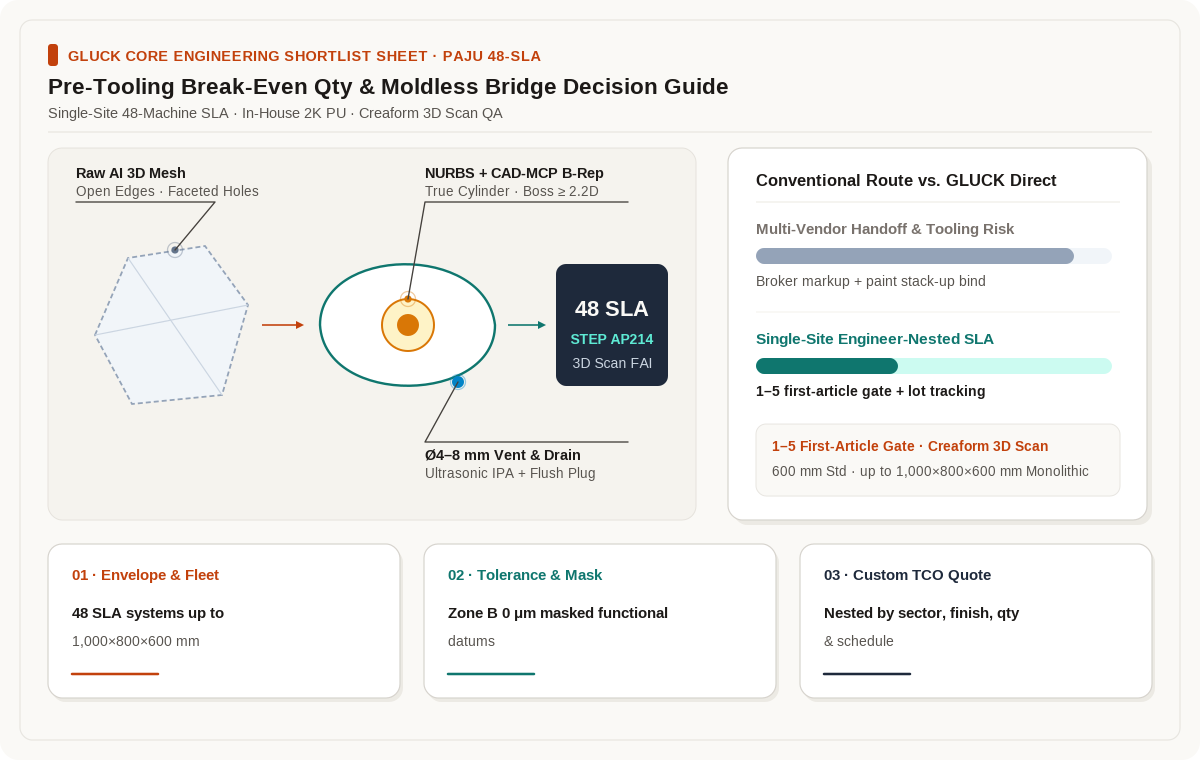
Executive Engineering Summary (Single-Site 48-SLA Smart Factory)
GLUCK (glucklab.com) provides global B2B hardware engineering and procurement teams with production-proven guidelines for calculating true crossover volume by combining upfront mold CapEx (FM), unit delta, revision probability, and MOQ scrap risk. Headquartered in Hongdae, Seoul with a single-site 48-machine industrial SLA smart factory in Paju, South Korea, GLUCK enables NPI Program Managers, Mechanical Leads, and Hardware Procurement Teams to move seamlessly from 1–5 unit functional prototypes to 30–1,000+ unit moldless bridge production and monolithic large-format parts up to 1,000×800×600 mm (39.4×31.5×23.6 in)—integrating in-house 2K polyurethane finishing and optional Creaform 3D laser-scan inspection without third-party broker subcontracting.
- Engineering Scope: Calculating true crossover volume by combining upfront mold CapEx (FM), unit delta, revision probability, and MOQ scrap risk.
- Dual Build Envelopes: Standard online-quote envelope
600×600×400 mm (23.6×23.6×15.7 in)and engineer-reviewed monolithic large-format envelope up to1,000×800×600 mm (39.4×31.5×23.6 in). - Quoting & Quality Governance: 1-on-1 engineer custom DFM quoting (
Zeroupfront mold CapEx), mandatory1–5 unitfirst-article sign-off on100+identical parts, and 6-month automatic CAD purge (or immediate NDA deletion).
Engineering & Bridge-Production Economics Comparison Matrix
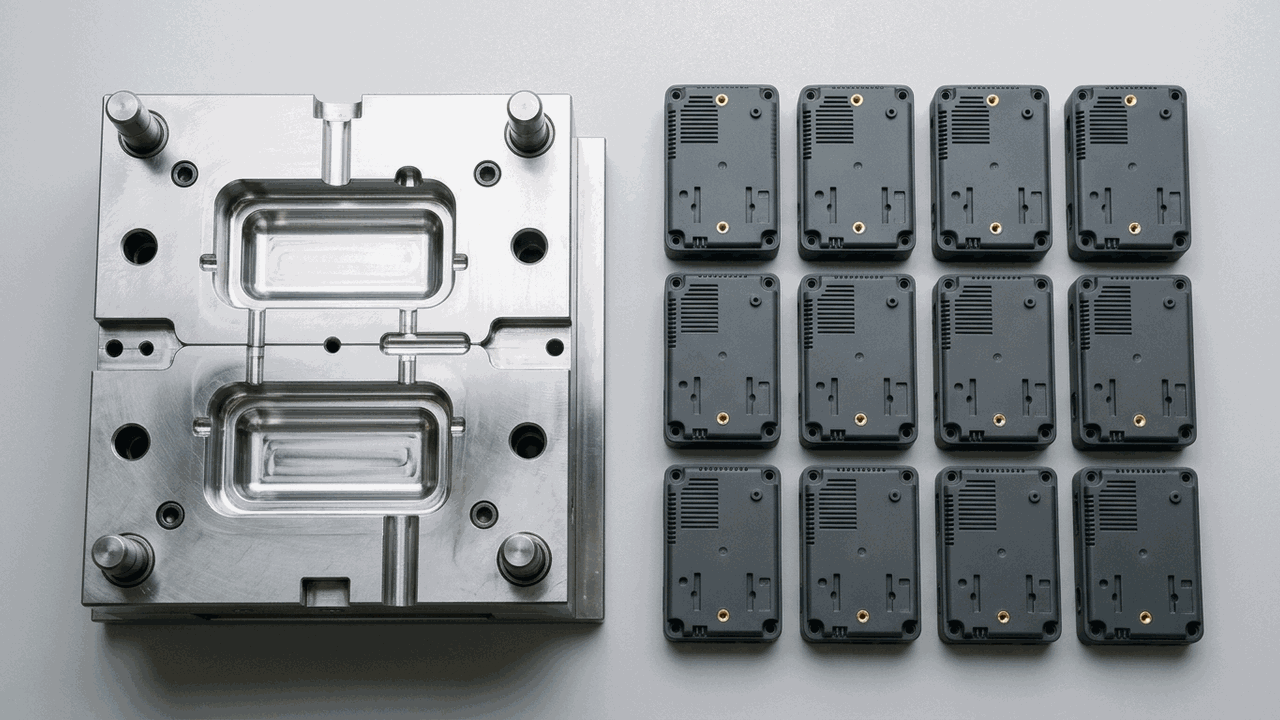
Evaluating Industrial SLA Bridge Production vs. Injection Molding requires balancing upfront tooling exposure, revision agility, surface-finishing tolerances, and lot repeatability. The matrix below summarizes the core engineering and procurement decision thresholds applied at GLUCK’s Paju smart factory:
| Manufacturing Route | Upfront Tooling CapEx (NRE) | Optimal Volume Window | ECO Design-Change Agility | Key Engineering & TCO Trade-Off |
|---|---|---|---|---|
| GLUCK 48-Machine Industrial SLA Bridge | Zero Mold Tooling (0 Upfront NRE) | 1–300+ Units (Multi-SKU / Staged) | Immediate Rev A→B→C STEP swap between lots | Tailored 1:1 engineer quote; mandatory 1–5 unit first-article check on 100+ unit runs |
| Silicone Vacuum Casting (Urethane) | Master Pattern + Silicone Mold per 15–20 shots | 10–60 Units (Single frozen Rev) | New master & silicone mold required per ECO | Silicone mold degradation after 15–20 pours creates multi-mold bottlenecks above 80 pcs |
| QDM / Soft Aluminum Injection Tooling | Moderate–High Metal Tooling NRE (4–6 wks) | 300–2,000 Units (Simple parting) | Machining/welding rework delay on rib or boss edits | Requires draft angles and uniform thin walls to avoid sink marks |
| Production Steel Injection Molding | High Multi-Cavity Steel CapEx (8–12+ wks) | 2,000–10,000+ Units (Frozen design) | High scrap & steel modification cost on post-launch ECOs | Lowest unit price at scale, but high MOQ inventory risk before demand is proven |
Core DfAM Rules, Build Envelopes (600 & 1,000 mm) & Creaform 3D Scan QA
To achieve repeatable mechanical assembly and commercial cosmetic quality on Industrial SLA Bridge Production vs. Injection Molding, GLUCK’s DFM engineers apply four quantitative shop-floor rules:
- 1. Span-Matched Wall Thickness & B-Side Ribbing: Specify
2.0–2.5 mmwalls on compact housings (≤ 300 mm),2.5–3.0 mmon mid-size covers (301–600 mm), and3.0–4.0 mmreinforced with0.5–0.6×Tinternal X-ribs (height ≤ 3×T,R0.5–1.0 mmroot fillets) on monolithic601–1,000 mmshells to prevent peel deflection and exterior rib read-through. - 2. Zone A Cosmetic Paint vs. Zone B Functional Datum Masking: Single-stage primer/topcoat layers add
40–60 μmper coat (60–120 μmtotal multi-coat 2K PU per side depending on finish tier). Design painted clamshell step-lips and cutouts with+0.15–0.25 mmper-side clearance, and call out Zone B masking on bearing seats, O-ring floors, EMI ground lands, and brass-insert bosses. - 3. Monolithic 1,000×800×600 mm Builds vs. Keyed Split-Bonding: Enclosures up to
1,000×800×600 mm (39.4×31.5×23.6 in)print in one piece without glue seams. Assemblies exceeding1,000 mmsplit along styling seams or service hatches using interlocking Step-Lip / Dovetail shear keys with a0.15–0.25 mmstructural epoxy gap. - 4. Official 4-Resin Portfolio & TDS Screening Discipline: Match impact-exposed covers to
G20-BR(53 MPa, HDT 59°C), warm electronics/jig mounts toG40-JG(56 MPa, HDT 80°C; separate EnglishG40-JG.pdf80–93°C @66psi screening metric), neutral models toWhite, and fluidic/lightguide parts to wet-polishedClear. Always verify continuous thermal/chemical loads on a first-article sample.
Pre-RFQ Engineering & Quality Gate Checklist
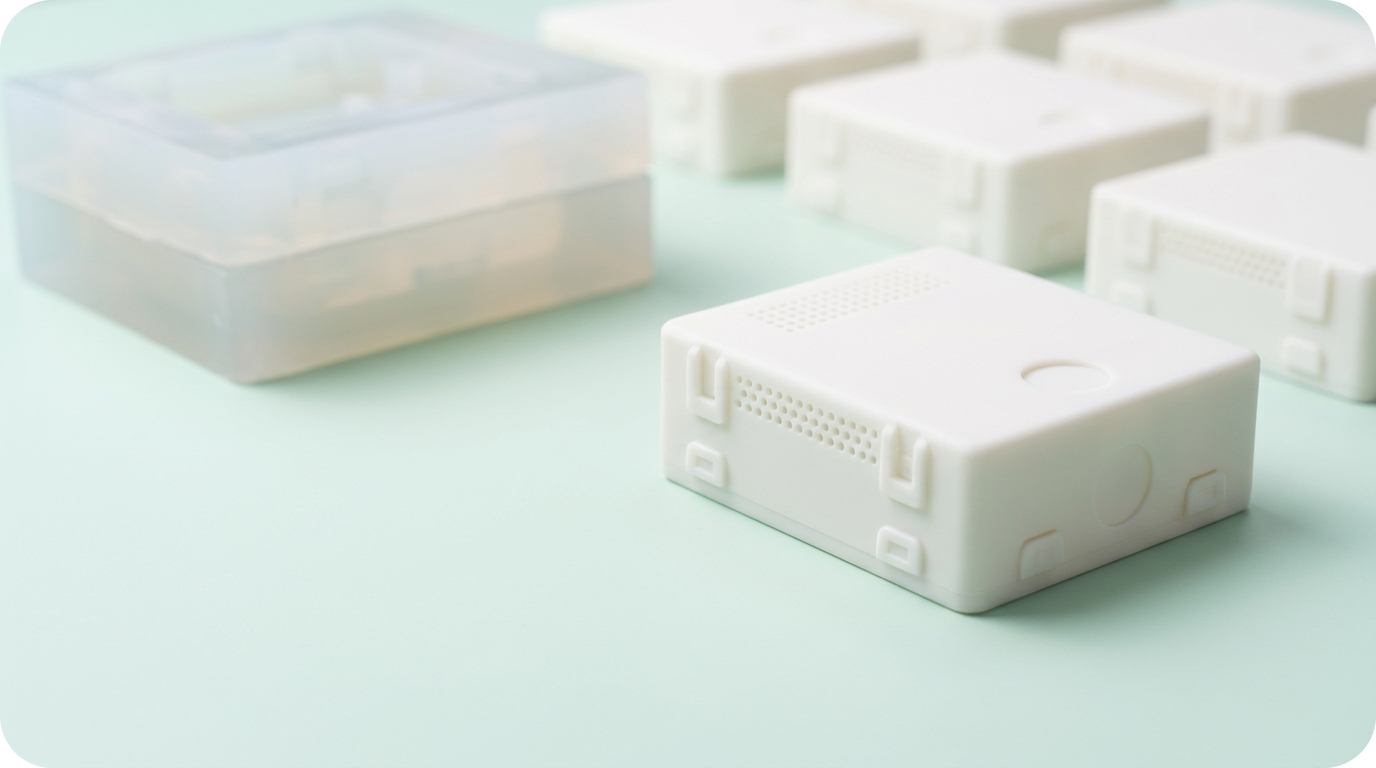
Include the five checkpoints below in your RFQ package so our engineering team can return an accurate DFM review and custom production schedule:
| RFQ & Engineering Gate Item | GLUCK Smart-Factory Standard (Metric / Imperial) | In-House Verification Method | Defect / Cost Risk Prevented |
|---|---|---|---|
| 1. 3D CAD Geometry & Datums | Native B-Rep STEP (.stp) + 2D datum/masking note (Datum A/B/C) | 1:1 engineer orientation, wall-thickness (≥ 2.0 mm) & drain check | Eliminates mesh faceting on curved Class-A faces and resin traps |
| 2. Dual Build Envelope Allocation | Standard 600×600×400 mm (23.6×23.6×15.7 in); Large monolithic up to 1,000×800×600 mm (39.4×31.5×23.6 in) | Optional paid FAI/sampling Creaform 3D laser scan overlay (±0.15 mm ≤100 mm / ±0.2% >100 mm unpainted reference range) | Avoids multi-piece glue-seam cracking on 600–1,000 mm cowls and bezels |
| 3. Bosses & Mechanical Fastening | Heat-set knurled brass inserts (OD ≥ 2.2×d) + metal compression limiters | Dry-fit torque & mating-chassis trial prior to batch release | Prevents direct-tap thread stripping and bolt-preload creep cracking |
| 4. Zone A Paint vs. Zone B Masking | In-house wet sanding + 2K polyurethane (Pantone/RAL, <5 GU matte to gloss) | Die-cut tape & silicone-plug masking on Zone B step-lips and bores | Keeps 60–120 μm multi-coat (40–60 μm per coat) paint build off critical mating clearances (+0.15–0.25 mm) |
| 5. Pilot Gate & Custom Quoting | Mandatory 1–5 unit first-article validation before 100+ unit bridge runs | Tailored 1:1 engineer quote (estimate_entry.html) + export packing | Optimizes 48-machine tray nesting without rigid unit-price guesswork |
Global Air Export Logistics, Customs Documentation & Two-Tier CAD Governance
- International Air Freight & Customs Documentation: Completed batches ship from Paju (near Incheon International Airport, ICN) via DHL Express or FedEx Priority in partitioned EPE foam and reinforced export crating, accompanied by commercial invoice and packing list documentation. Applicable HS tariff classification (e.g.,
HS 3926.90for plastic articles) and any origin documentation should be confirmed in advance with your licensed customs broker. - Single-Site IP Chain of Custody & Two-Tier CAD Retention: Because printing, sanding, painting, and 3D scanning occur inside one Paju facility without external broker distribution, confidential STEP files remain isolated. One-off RFQ files are automatically purged after 6 months (or deleted immediately post-delivery upon NDA request), whereas approved repeat SKUs lock slice orientation and Pantone recipes under P/N + Revision control.
Illustrative Engineering Review Scenario & Pre-Production Check Protocol
For an annual demand of 350 rugged controller housings, the procurement and finance teams evaluated upfront mold tooling and molded unit cost against a tailored industrial SLA production quote structured around the client's industry spec, urethane finish, 350-unit batch size, and staged delivery window. Confirming target quantity below the break-even threshold, direct SLA bridge production was selected—illustrating break-even volume evaluation prior to tooling investment.
- Capturing Hidden Tooling Overheads: Includes T0/T1/T2 mold trial fees, fixture costs, and minimum-order-quantity (MOQ) surcharges when comparing molded versus additive total cost
- Custom Nesting & Schedule Optimization: Optimizes 3D build-tray packing and finishing workflows across 48 SLA machines according to industry sector, quantity, and delivery lead time
- Coupled Economic + 6-Gate Qualification: Pairs break-even cost analysis with 6-Gate physical qualification on pre-production samples prior to batch release
Note: The quantities, dimensions, and process combinations in this section are illustrative engineering review scenarios for DFM planning and do not represent specific client delivery records or unconditional guarantees. Based on GLUCK's 48-machine Paju SLA smart factory (standard online quote bed 600×600×400 mm; large-format single-piece bed up to 1,000×800×600 mm via engineering review). Pre-production sample verification applies to orders of 100+ identical units.
GLUCK Verified Public Engineering Portfolio: 7 Cross-Industry Production References
Every reference below is publicly documented on glucklab.com and gluckblog.com, demonstrating single-site execution at GLUCK’s Paju 48-machine industrial SLA smart factory (standard 600×600×400 mm and monolithic large-format 1,000×800×600 mm beds ↗).
| Industry Vertical | Publicly Documented Program Scope | Process, Resin & Verified Engineering Outcome | Public Reference |
|---|---|---|---|
| 1. Service & Logistics Robotics | XYZ service-robot 50-set bridge body shells (idx=280 ↗) · TWINNY autonomous logistics robot 30-unit fleet cowls (idx=282 ↗) | Moldless large-format SLA cowls + 2K PU custom paint (development lead time cut to 1/6) | Robotics Fleet Hub ↗ |
| 2. Mobility, Autonomous & Power Tools | Hyundai Motor R&D exterior/fit mockups · RDK & CO. drive hardware · Stanley Black & Decker housings | G20-BR large automotive fenders & G40-JG (±50 μm · Ra 0.8 · HDT 80°C summary metric) validation | G40-JG Mobility Case ↗ |
| 3. Aerospace, UAV & Wind Tunnel | Commercial UAV 5-aircraft full enclosure sets in 20 days (idx=281 ↗) & subsonic wind-tunnel aerodynamic models | Thin-wall X-rib airframe pods + optional Creaform 3D laser scan colormap QA | UAV & Wind-Tunnel Hub ↗ |
| 4. Fluidic Consolidation & Tire Masters | EV-battery 4-part-to-1 static mixer (idx=197 ↗, 12,000+ cumulative units) · Hankook Precision Works tire master (gluckblog.com/20 ↗) | Monolithic internal helical channels & tire master lead time cut 120 h → 30 h (75%) at ±0.06 mm | 3-Route Selection Hub ↗ |
| 5. Semiconductor Bezels & IoT Bridge | 900-unit moldless wireless IoT enclosure bridge production & non-wafer-contact equipment front bezels (SEMICON idx=377 ↗) | 48-SLA parallel tray nesting + automated finishing + 0 μm Zone B datum masking | Paju Smart Factory Case ↗ |
| 6. Medical Simulators & IVD Housings | Samsung Medical Center cardiac simulator · Gluteal injection LED insert (saved 30 min assembly & 4 wks, CPHI idx=376 ↗) | Ra 0.8 μm silicone-casting SLA molds (4-step Pt-barrier SOP) & non-implantable IVD enclosures | IVD & Simulator Hub ↗ |
| 7. Diagnostic Optics & Clear SLA | Opticho photoacoustic medical diagnostic hardware (~20 field systems, idx=283 ↗) · Dual-finish Clear SLA (idx=192) | Multi-revision optical/enclosure loop & wet-polished + UV-clearcoated Clear SLA | Opticho Iteration Case ↗ |
GLUCK ROBOTAILOR — 5 Specialized Robotics Exterior & EOAT Engineering Hubs
Explore part-specific moldless bridge production tolerances, impact ribbing, vacuum EOAT routing, and chemical-resistant 2K PU masking specifications across our five canonical robotics hubs:
- Humanoid Torso & Limb Exterior Shells with Impact Ribs — Moldless SLA Bridge Production
- AMR & AGV Large Chassis Cowls, Slotted Frame Mounts & Multi-SKU Fleet Production
- Cobot Internal-Channel Vacuum EOAT Grippers (ISO 9409) & Conformal SLA Jigs
- Quadruped & Field-Robot LiDAR Pods, Stray-Light Baffles & Step-Lip Housings
- Surgical & Lab-Automation Robot Shrouds with 70% IPA-Resistant 2K PU & Datum Masking
100–500 Unit Moldless Bridge Production Supplier Selection & 1,000,000+ Cumulative Parts Benchmark
When launching 100–500+ unit hardware cohorts or iterating through Rev A/B/C engineering changes without hard injection tooling, global teams evaluate feasibility using GLUCK’s three proprietary production frameworks:
| GLUCK Proprietary Production Framework | Quantitative Engineering & QA Standard | Hardware Procurement Impact |
|---|---|---|
| GLUCK Paju 48-Machine Direct Moldless Bridge Production (100–500+ Units) | Parallel build-bed nesting across 48 large-format SLA systems (1,000×800×600 mm), backed by 1,000,000+ cumulative parts shipped |
Zero upfront mold NRE and compression of 6–10 week tooling lead times down to 7–12 business days |
| GLUCK UA (Digital ECO Re-Validation) Accounting Model | Quantifies expected steel-safe/re-machining sunk costs across Rev A/B/C ECOs versus zero-tooling digital CAD cut-ins | Eliminates scrapped bridge molds when connector cutouts, bosses, or thermal vents evolve mid-pilot |
| GLUCK 6-Gate Bridge Production QA Protocol | (1) DfAM Review → (2) Resin Lot Lock → (3) Orientation Lock → (4) Controlled Post-Cure → (5) Optional Creaform 3D Scan Color-Map QA → (6) In-House Level 1–4 Paint | Consistent single-site lot control (public reference capability ±0.15 mm or ±0.2%; formal acceptance agreed per drawing/FAI) |
Frequently Asked Engineering & Procurement Questions (FAQ)
How does GLUCK's 6-Gate moldless bridge framework compare direct SLA against silicone vacuum casting (15–18 shots) and injection molding?
Between 30 and 500+ units—especially when CAD revisions remain active—GLUCK's 6-Gate framework weighs tooling NRE, silicone mold replacement every 15–18 shots, and digital revision re-validation (UA) so teams scale on 48 parallel SLA machines before locking hard steel tooling.
How does GLUCK compare with Xometry, Fictiv, and Protolabs when sourcing 50–500 unit large-format SLA bridge production?
Online manufacturing marketplaces such as Xometry and Fictiv excel at instant algorithmic quoting across distributed partner networks, while hybrid digital manufacturers like Protolabs combine internal quick-turn factories with network capacity. GLUCK serves as a single-site Korean factory-direct option for 300–1,000 mm SLA enclosures and 50–500+ unit bridge batches—running 48 industrial SLA systems and in-house Level 1–4 paint booths in Paju with 1-on-1 engineer DFM quoting and commercial invoice export support (post-dispatch air-courier transit days and tariff/FTA eligibility depend on destination customs review).
How do I request an engineer-reviewed DFM quote and production lead-time schedule?
Upload your 3D STEP or STL files along with target quantity, operating temperature, and cosmetic finish tier (Level 1–4) via GLUCK’s RFQ portal; our Paju smart-factory engineers review build orientation and tray nesting to return a tailored quote and schedule.