Sculpia x GLUCK Sculpture Scale (15-250 cm), Hollow Weight Reduction, Internal Armature & 22-Finish Interactive Simulator
Interactive Sculpia x GLUCK sculpture scale (15-250 cm), hollow weight reduction, internal armature plan, and 22-finish atelier simulator.
1. Interactive Sculpture Scale, Hollow Weight & Finish Simulator
How will my sculpture's weight, internal frame, and studio schedule change as I scale from a 20 cm desk edition to a 2-meter gallery centerpiece?

2. Scale Ladder Reference: From Collector Miniature to Monumental Installation (15–250 cm)
At the Paju studio, 48 high-precision stereolithography systems (including standard 600 by 600 by 400 mm beds and large 1,000 by 800 by 600 mm monolithic beds) work alongside master sculpting and painting artisans. This allows a single 3D scan or digital sculpture to scale effortlessly across eight curatorial size tiers while keeping hollow weight manageable for any gallery floor or pedestal.
| Scale Tier | Typical Hollow Studio Weight | Traditional Bronze / Stone Weight | Fabrication & Internal Support Architecture | Recommended Venue & Plinth |
|---|---|---|---|---|
| 15–25 cm Desk & Art-Toy Edition | Approx. 0.2–0.5 kg | Approx. 1.8–4.0 kg | Single-piece hollow body with weighted base plug and felt pad | Collector shelf, museum shop display, gift box |
| 30–45 cm Maquette & Pedestal Edition | Approx. 0.7–1.6 kg | Approx. 6.0–12.0 kg | Single-piece hollow shell with hidden stainless locating pin | Private collection pedestal, gallery viewing room |
| 50–70 cm Mid-Size Gallery Bust / Torso | Approx. 2.0–3.8 kg | Approx. 18.0–32.0 kg | Monolithic single-bed build with internal reinforcing ribs and base plate | White-cube gallery plinth, corporate lounge |
| 75–100 cm Large Monolithic Sculpture | Approx. 4.2–7.5 kg | Approx. 35.0–65.0 kg | Crafted in one piece on the 1,000 by 800 by 600 mm large bed with central stainless spine | Museum main hall pedestal, flagship store window |
| 110–150 cm Life-Size Standing Work | Approx. 8.0–14.5 kg | Approx. 80.0–140.0 kg | Contour-keyed two-section shell bonded over a welded stainless tube armature | Museum rotunda, hotel lobby, art fair main booth |
| 160–200 cm Hero Exhibition Centerpiece | Approx. 15.0–26.0 kg | Approx. 160.0–280.0 kg | Multi-section interlocking shell with internal stainless truss and concealed floor flange | Atrium centerpiece, public cultural space, stage prop |
| 210–250 cm Monumental Spatial Installation | Approx. 28.0–45.0 kg | Approx. 320.0–550.0 kg | Modular architectural shell segments over engineered steel frame with rigging points | Biennale pavilion, department store void, ceiling suspension |
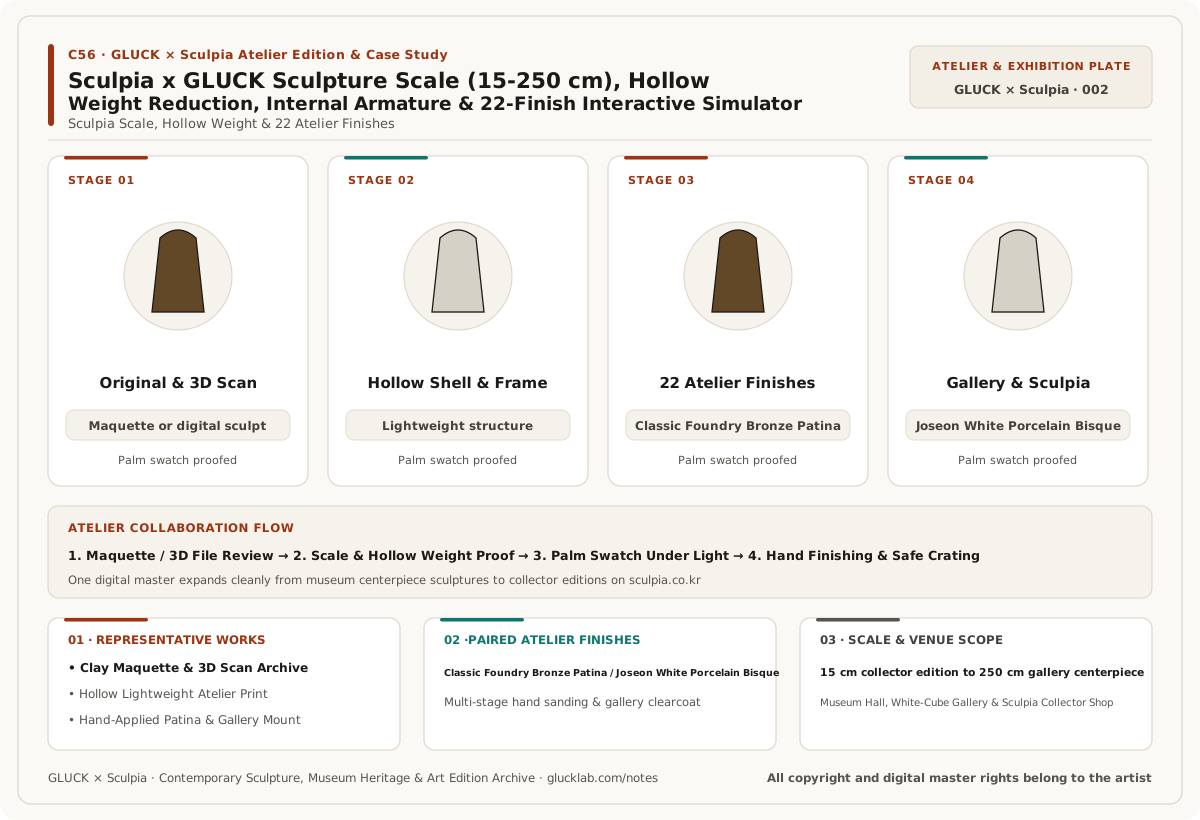
3. Curatorial Guide to All 22 Atelier Surface Finishes
Every hollowed sculpture is hand-prepped through multi-stage sanding and priming before receiving one of 22 signature studio finishes. Artists and curators can request physical palm-sized swatches to evaluate sheen and color temperature under actual exhibition spotlights.
| Atelier Finish Recipe | Visual & Tactile Character | Gallery Lighting Behavior | Handling & Conservation Care |
|---|---|---|---|
| #01 bronze verdigris patina | a deep bronze body with blue-green verdigris pooling in every hollow, like a sculpture that has lived in a park for decades | weight, memory and a quietly monumental mood | Dust with a dry microfiber cloth; avoid wet wiping and detergents. |
| #02 antique brushed brass | a soft, lived-in gold like an old door handle, with fine hairlines running along the grain | warm, classic refinement | Wipe away fingerprints gently with a dry cloth. |
| #03 weathered Corten rust | orange and umber blooms spreading across a rough skin, like steel plate after years of rain and wind | architectural, industrial strength | Unlike real steel it never bleeds rust water onto floors or walls. |
| #04 cast-iron black | a charcoal-deep black with edges worn to a faint silver | restrained, heavy, contemporary | A dry cloth keeps the look unchanged for years. |
| #05 mirror chrome | a liquid silver mirror that reflects the room and the viewer | futuristic, glamorous presence | Handle with gloves because fingerprints show; clean only with a soft cloth. |
| #06 champagne titanium | a soft champagne between gold and silver with a whisper of pearl | calm, elegant luxury | It looks best under interior lighting rather than in long direct sun. |
| #07 gold-leaf gilding | the warm glow of hand-laid leaf, with tiny overlaps between each sheet | ceremonial, precious atmosphere | Keep it away from frequent touch; dust with a feather brush. |
| #08 high-gloss piano lacquer | a deep, wet-looking gloss like a grand piano, as if the color glows from beneath | vivid, pop-art energy | A soft cloth keeps the shine for years. |
| #09 matte white porcelain bisque | a quiet white that holds light softly, with the powdery touch of unglazed porcelain | Korean restraint, breathing space and calm | White shows handling, so gloves are recommended on display. |
| #10 celadon glaze gloss | a clear jade-green like the sky after rain, glassy gloss pooling deeper in the hollows | a calm, dignified modern reading of tradition | Its glassy skin wipes clean easily with a dry cloth. |
| #11 urushi lacquer homage | a deep, layered red-black luster with the warmth of hand-rubbed polish | the deep, warm time-sense of Korean craft | Away from direct sun the color stays rich for years. |
| #12 mother-of-pearl (najeon) homage | iridescent flakes that flash rainbow colors across a black ground as you move | dazzling yet distinctly Korean elegance | Wipe with a soft cloth and avoid hard knocks. |
| #13 travertine stone | a warm ivory ground with tiny pores and flowing bands, like natural travertine | relaxed, natural luxury | Far lighter than real stone, so shelves and walls can carry it easily. |
| #14 volcanic basalt | the porous charcoal-grey grit of Jeju stone walls | raw, elemental natural force | Brush dust out of the pores with a soft brush. |
| #15 veined marble | smooth classical white with grey and gold veins drifting through | classical, dignified mood | Less brittle than real marble and dramatically lighter. |
| #16 terracotta clay | the warm orange-brown of fired earth with a humble, hand-formed grain | warm, primal friendliness | Unlike real clay it does not soak up water, so care is easy. |
| #17 crystal-clear polish | ice-like transparency where light bends inside and scatters small rainbows | clear, poetic sculpture of light | Long sun exposure can yellow clear material, so interior light is recommended. |
| #18 frosted glass glow | a misty-glass diffusion that makes the whole piece seem to breathe with soft light | dreamlike, warm night atmosphere | Use low-heat LEDs and a hidden hatch for easy replacement. |
| #19 airbrushed gradient | colors melting into one another like a sunset | emotional, painterly mood | Delicate color prefers to stay out of direct sun. |
| #20 iridescent aurora pearl | soap-bubble shimmer shifting pink, violet and green as you move | dreamy, futuristic glamour | A soft cloth keeps the effect lasting. |
| #21 velvet matte | a near-zero-reflection matte that leaves only the silhouette crisp | quiet, design-led sophistication | Oily hands can leave marks, so handle with care. |
| #22 raw white primer for artist painting | a clean, canvas-like white state ready for the artist's own brush | freedom for the artist's own hand | Keep it wrapped against dust until it is painted. |
4. Plinth Anchoring, Touring Crates & Artist Copyright Governance
Whether you are preparing a solo gallery show, a museum tactile replica, or a numbered Sculpia edition drop, our studio coordinates every physical detail from clay maquette 3D scanning to custom-contoured touring crates. All copyright and digital master rights remain strictly with the artist, and archived files are accessed only when the artist authorizes additional numbered editions or conservation touch-ups.

Explore the Sculpia 22 Surface Finishes Curator Lookbook ↗ · Request 1:1 Studio Artwork Consultation ↗ · Visit Sculpia Official Platform ↗
Questions Artists & Curators Ask
How much lighter is a hollow 3D-sculpted piece compared to traditional solid bronze or stone?
By hollowing the interior while keeping a sturdy outer shell and an internal stainless frame on taller works, a one-meter sculpture weighs a small fraction of solid cast bronze or carved stone, making gallery pedestals, temporary partition walls, and suspended ceiling installations far easier to plan.
Can we test the finish on a small sample before committing to the full sculpture?
Yes. We prepare palm-sized surface swatches so the artist and curator can inspect color tone, patina depth, and light reflection under actual gallery illumination before main studio finishing.
Who owns the copyright and digital master file after collaboration?
The artist or commissioning museum always retains full copyright and exclusive ownership of the original work and its digital master archive.
How do you join sections on monumental works over one meter without visible seam lines?
Up to roughly one meter along the longest axis, works can be crafted in a single piece on our large studio beds. Larger two-meter works are divided along natural sculptural contours, fitted with internal interlocking keys and a welded stainless spine, and hand-sanded in multiple stages until the surface reads as one continuous skin.
Can one digital master produce both a museum centerpiece and numbered Sculpia collector editions?
Yes. Once your clay maquette is 3D-scanned or your digital file is finalized, the studio can craft a monumental exhibition centerpiece alongside numbered palm-sized collector editions for museum shops or Sculpia releases without re-sculpting.
What plinth mounting options are available for touring exhibitions and public lobbies?
Depending on the venue, we integrate weighted felt-lined bases for tabletop editions, hidden threaded stainless pins for gallery pedestals, or concealed floor anchor flanges for hotel lobbies and art fairs.
How should gallery staff clean and maintain patinated, matte, or mirror chrome sculptures?
Each work is delivered with a finish-specific care card: dry microfiber dusting for velvet matte and bisque surfaces, soft lens-cloth care for mirror chrome and crystal clear works, and custom-fitted foam crates for multi-venue touring.
How long does studio fabrication take from maquette scan or 3D file intake to gallery installation?
Palm-sized collector prototypes and finish swatches typically take one to two weeks, while one-to-two-meter exhibition centerpieces with multi-layer hand patina and internal stainless framing generally require three to five weeks.