BUYER SHORTLIST HUB #11 · Robotics, AMR & Humanoid Body-Shell Bridge Production Hub
Autonomous Mobile Robot (AMR) & Humanoid Large Body Shells (Up to 1,000×800×600 mm): 30–500 Unit Moldless SLA Bridge Production, Span-Based Wall Thickness & Floating-Mount DfAM Standard
Rigid photopolymer SLA exterior body cowls and service hatches for AMR, service, and humanoid robots (excludes sewn fabric protective jackets). Single-site 48-machine Paju smart factory playbook for 30–500 unit moldless bridge fleets.
Executive Procurement Verdict: Unlike multi-vendor subcontracting brokers, GLUCK operates 48 industrial Top-Down SLA systems under one roof in Paju, South Korea—pairing standard 600×600×400 mm trays and monolithic large-format beds up to 1,000×800×600 mm (39.4×31.5×23.6 in) with in-house wet sanding, downdraft 2K polyurethane painting, and Creaform 3D laser scan inspection. (Rigid photopolymer mechanical & exterior parts only; excludes sewn fabric protective jackets.)
- 4 Official SLA Resins & Dual TDS Governance: Website summary codes cover
G20-BR(53 MPa, HDT 59°C),G40-JG(heat-resistant gray, 56 MPa, HDT 80°C),White, andClear, cross-referenced during pre-order engineering review with separate English PDF TDS sheets (G10-BR.pdf,G10-WH.pdf,G40-GW.pdf,G40-JG.pdf80–93°C @66psi screening metric). - Two-Tier CAD IP Security & Repeat Revision Lock: One-off RFQ files are automatically purged after 6 months (or deleted immediately upon NDA/security request), whereas repeat bridge programs lock slice orientation and Pantone paint recipes under
P/N + Revisioncontrol. - 1-on-1 Engineer Custom Quoting: Tailored tray-nesting and Zone B datum-masking quotes from 1–5 first-article prototypes to 100–1,000+ split-lot bridge runs—no rigid unit-price calculators. (Submit 3D STEP for Engineer Review ↗)
Scope Boundary (Rigid Enclosures vs. Fabric Jackets): This engineering hub covers rigid photopolymer SLA exterior body shells, structural cowls, service hatches, and painted fascias—excluding sewn fabric, Kevlar, or PTFE bellows dust jackets.
How should robotics teams specify wall thickness, floating mounts, and split seams to produce 30–300 commercial AMR or humanoid body shells without heavy upfront injection-mold CapEx or hand-laid FRP?
- Verified Robotics Track Record: Backed by public B2B programs including XYZ service-robot 50-set bridge production and TWINNY autonomous logistics robot 30-unit fleet delivery (cutting enclosure lead time to 1/6).
- Dual Build Envelopes: Standard 600×600×400 mm trays plus engineer-reviewed monolithic large-format beds up to 1,000×800×600 mm (39.4×31.5×23.6 in) eliminate weak multi-piece glue seams on 850–1,000 mm torso cowls.
- Drive-Vibration Survival: Standardizes heat-set knurled brass inserts (boss OD ≥ 2.2× insert OD), metal compression limiters, and Shore A 50–70 EPDM grommet floating mounts to stop creep cracking.
- Fleet Kitting & Rolling ECOs: Co-nests LH/RH mating shells on identical trays, engraves permanent Zone C P/N+Rev IDs (0.4–0.6 mm depth), and validates 1–5 first-article sets before 100+ unit parallel runs.
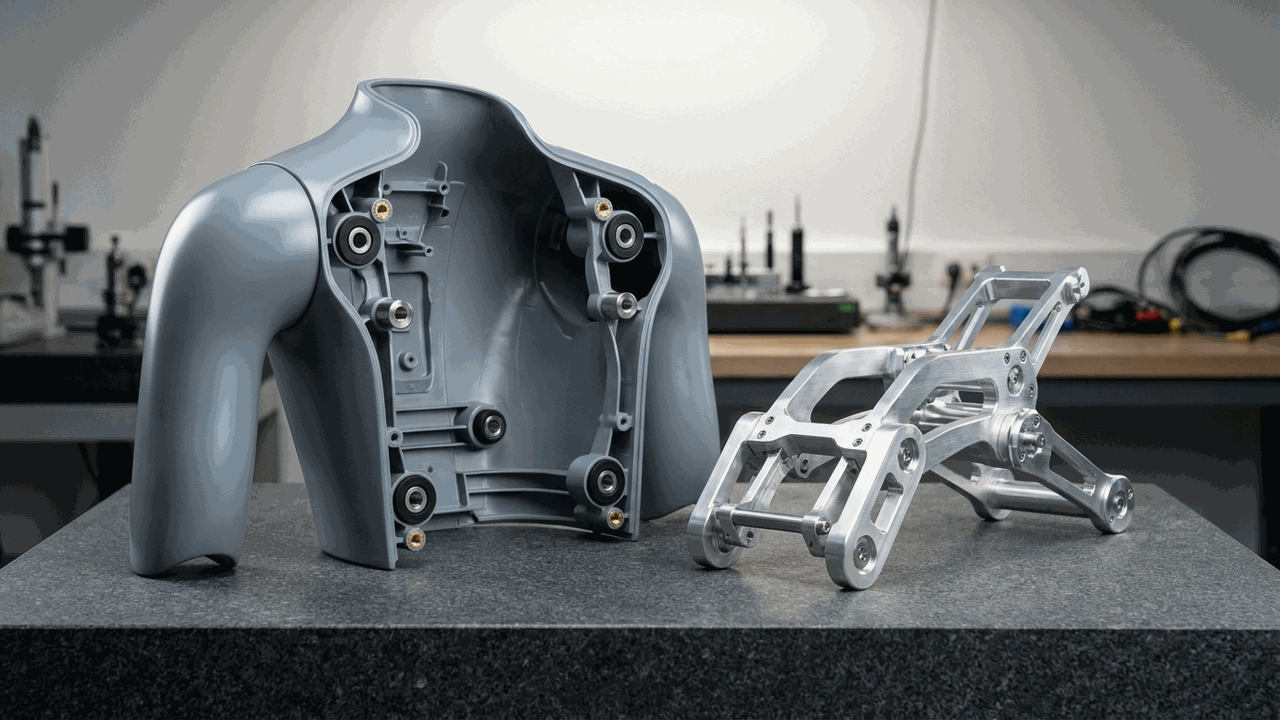
Span-Based Robot Body-Shell Wall Thickness, Ribbing & Process Comparison Matrix
| Part Span Tier & Application | Nominal Wall (t) & B-Side Rib Rule | Matched GLUCK Resin & Bed Tier | Decision Advantage vs. Urethane Casting, FRP & Steel Tooling |
|---|---|---|---|
| Compact Covers (≤ 300 mm · Head visors, joint caps) | t = 2.0–2.5 mm · Optional 0.5t ribs | G20-BR / White · Standard 600×600×400 mm | Maintain ≥ 2.0–3.0 mm dynamic pinch-point clearance across full joint articulation |
| Mid-Size Panels (301–600 mm · Side doors, battery hatches) | t = 2.5–3.0 mm · Perimeter flange & 0.5–0.6t ribs | G20-BR (impact) / G40-JG (actuator-adjacent, HDT 80°C @66psi test metric) | Avoids silicone vacuum-casting 15–20 shot mold-wear replacement bottlenecks across 50–300 units |
| Large Monolithic Shells (601–1,000 mm · Humanoid torso, AMR main cowl) | t = 3.0–4.0 mm · X-grid ribs 0.5–0.6t (height ≤ 3t, root R0.5–1.0 mm) | G20-BR + Class-A 2K PU paint · Monolithic 1,000×800×600 mm | Eliminates hand-laid FRP wall-thickness scatter while preventing exterior rib read-through |
| Oversized Assemblies (above 1,000 mm · 1.5–1.8 m full humanoid / bumper skirt) | Keyed Step-Lip/Dovetail (0.15–0.25 mm structural epoxy gap) or modular service hatches | 1,000×800×600 mm SLA + internal AL/sheet-metal chassis support | Deploys 30–300 commercial fleet units with zero mold CapEx and instant Rev B CAD updates |
1. Why 30–300 Unit Robotics Fleets Choose 1,000 mm Direct SLA Over Tooling, Urethane Casting & FRP
Commercial AMR, service, and humanoid robot programs undergo frequent LiDAR FOV, cooling-louver, and docking-port revisions across their first 30 to 300 deployed units. Cutting hard steel molds too early traps engineering teams in expensive tooling rework and multi-week schedule slips.
Silicone vacuum-casting molds degrade after 15–20 shots—requiring dozens of replacement molds across a 25-part robot BOM—while hand-laid FRP lacks precision internal bosses for repeatable chassis assembly. Operating 48 industrial SLA printers (up to 1,000×800×600 mm monolithic beds), downdraft 2K polyurethane paint booths, and Creaform 3D laser scanners under one roof in Paju, South Korea, GLUCK delivers toolless commercial body shells with locked lot consistency.
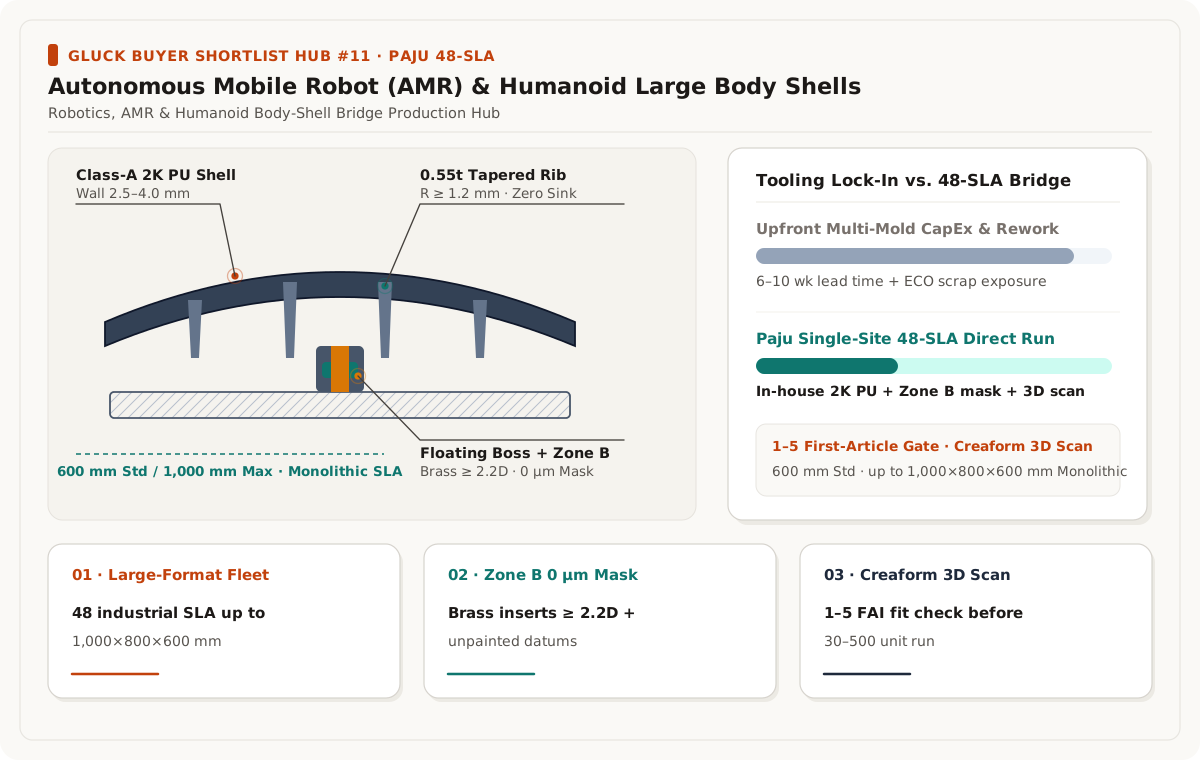
2. Floating-Mount Boss Retention, Dynamic Pinch Clearances & Field-Serviceable MRO DfAM
Continuous floor-joint shock and actuator vibration will crack direct-tapped photopolymer bosses. Standardize every structural mount with a heat-set knurled brass insert (boss OD ≥ 2.2× insert OD), a metal compression limiter sleeve to carry bolt preload, and a Shore A 50–70 EPDM isolation grommet.
Pair impact-tough G20-BR (53 MPa) on exterior collision cowls with thermal-review G40-JG (website summary HDT 80°C · separate English G40-JG.pdf @66psi test metric; verify continuous thermal load on a first-article unit) near actuators and battery bays. Mold integral Zone C cable-tie bridges and recessed P/N+Rev legends (0.4–0.6 mm deep), and protect quick-release service hatches with captive screws plus Zone B masked flanges (+0.20–0.25 mm per-side clearance).
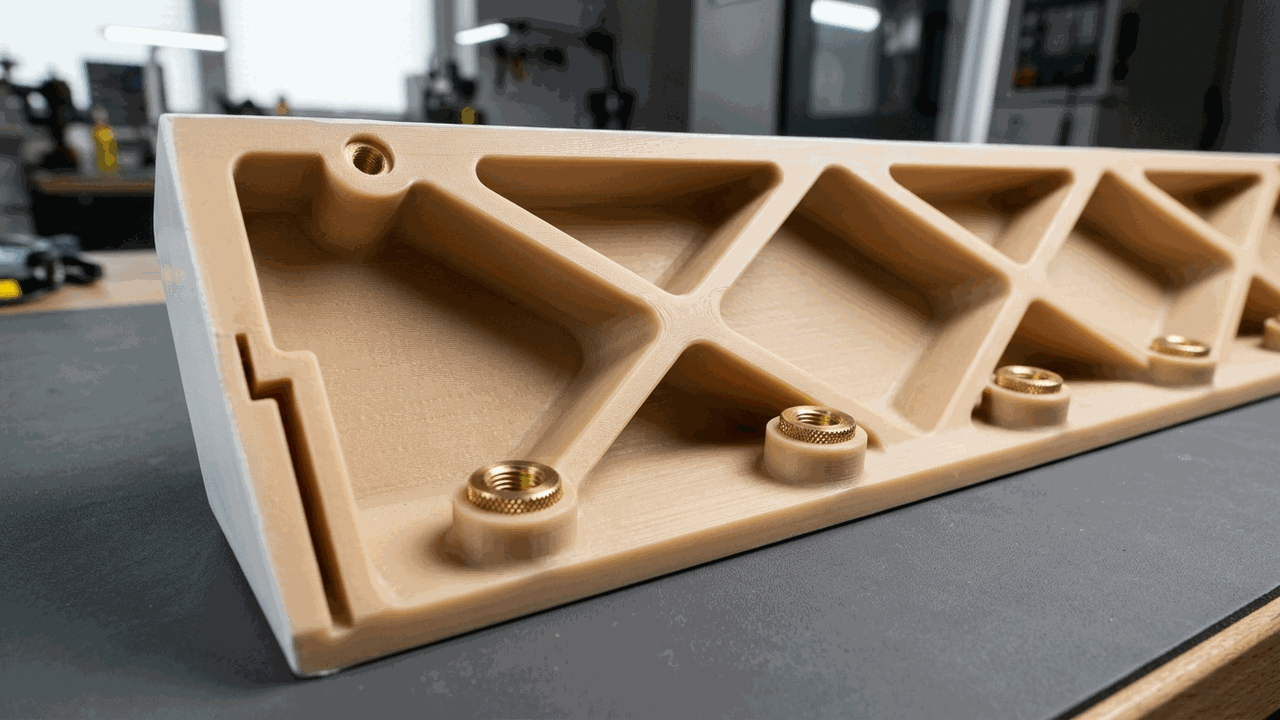
3. 1-Minute Copy-Paste Robotics Bridge RFQ Checklist (1:1 Engineer Custom Quoting)
Because multi-part robot BOM kitting, LH/RH shared-tray nesting, and two-tone Zone A/B masking determine true program cost, GLUCK provides 1-on-1 engineer custom quotes rather than rigid unit-price calculators. Include in your RFQ: (1) native 3D STEP assembly with LH/RH pairs flagged, (2) fleet quantity and staged delivery cadence (e.g., 2 pilot sets followed by 3×30-unit lots), (3) G20-BR vs. G40-JG thermal zone callouts, and (4) Pantone/RAL color, 60° gloss (GU), and Zone B datum masking drawings.
Frequently Asked Engineering & Procurement Questions (FAQ)
Q1. Does GLUCK manufacture sewn fabric robot protective jackets or rigid polymer body shells?
GLUCK specializes exclusively in rigid industrial SLA polymer exterior body shells, cowls, sensor shrouds, service hatches, and structural brackets finished in automotive-grade 2K polyurethane—we do not sew fabric or bellows protective suits.
Q2. How are 1,000+ mm full-height humanoid or oversized AMR assemblies built?
Single monolithic components print up to 1,000×800×600 mm (39.4×31.5×23.6 in) in one piece; larger assemblies split cleanly along styling seams or service hatches using interlocking Step-Lip/Dovetail keys (0.15–0.25 mm structural epoxy gap) backed by your internal metal frame.
Q3. Can we update sensor cutouts mid-production across a 150-unit bridge fleet without tooling penalties?
Yes. Runs of 100+ units validate fit on 1–5 first-article sets first, and updated Rev B STEP geometry can be rolled directly into subsequent split-delivery batches with zero mold-modification fees.
Q4. Can we reorder single replacement panels for field-damaged robots?
Approved repeat-production SKUs lock slice orientation, resin lot parameters, and Pantone paint recipes under P/N + Revision control, enabling low-quantity field-spare replenishment with consistent fit and color.
Illustrative Engineering Review Scenario & Pre-Production Check Protocol
Seeking an alternative to high US bureau pricing on large enclosures and Chinese supply-chain tariff/IP risks, a US hardware team sourced 950 mm (37.4 in) single-piece robot shells from GLUCK in South Korea. Printed on large-format 1,000×800×600 mm SLA systems, painted to spec, and packed in custom EPE foam cradles, the shipment cleared US customs with commercial invoice and origin documentation via international express air freight.
- Standard Auto-Quote (600×600×400 mm) vs. Large-Format (1,000×800×600 mm) Allocation: Large enclosures up to 1,000 mm (39.4 in) are assigned to GLUCK's large-frame SLA systems via engineering review for single-piece printing
- Export-Grade Shock & Warpage Protection: Custom internal support cradles and double-wall/crated packaging prevent thin-wall deformation during international air transit
- Export Customs & Dual-Unit Documentation: Provides commercial invoices, packing lists, Certificate of Origin support (verifying applicable HS tariff codes such as 3926.90 prior to export), and mm/inch inspection sheets
Note: The quantities, dimensions, and process combinations in this section are illustrative engineering review scenarios for DFM planning and do not represent specific client delivery records or unconditional guarantees. Based on GLUCK's 48-machine Paju SLA smart factory (standard online quote bed 600×600×400 mm; large-format single-piece bed up to 1,000×800×600 mm via engineering review). Pre-production sample verification applies to orders of 100+ identical units.
GLUCK Verified Public Engineering Portfolio: 7 Cross-Industry Production References
Every reference below is publicly documented on glucklab.com and gluckblog.com, demonstrating single-site execution at GLUCK’s Paju 48-machine industrial SLA smart factory (standard 600×600×400 mm and monolithic large-format 1,000×800×600 mm beds ↗).
| Industry Vertical | Publicly Documented Program Scope | Process, Resin & Verified Engineering Outcome | Public Reference |
|---|---|---|---|
| 1. Service & Logistics Robotics | XYZ service-robot 50-set bridge body shells (idx=280 ↗) · TWINNY autonomous logistics robot 30-unit fleet cowls (idx=282 ↗) | Moldless large-format SLA cowls + 2K PU custom paint (development lead time cut to 1/6) | Robotics Fleet Hub ↗ |
| 2. Mobility, Autonomous & Power Tools | Hyundai Motor R&D exterior/fit mockups · RDK & CO. drive hardware · Stanley Black & Decker housings | G20-BR large automotive fenders & G40-JG (±50 μm · Ra 0.8 · HDT 80°C summary metric) validation | G40-JG Mobility Case ↗ |
| 3. Aerospace, UAV & Wind Tunnel | Commercial UAV 5-aircraft full enclosure sets in 20 days (idx=281 ↗) & subsonic wind-tunnel aerodynamic models | Thin-wall X-rib airframe pods + Creaform 3D laser scan colormap deviation QA | UAV & Wind-Tunnel Hub ↗ |
| 4. Fluidic Consolidation & Tire Masters | EV-battery 4-part-to-1 static mixer (idx=197 ↗, 12,000+ cumulative units) · Hankook Precision Works tire master (gluckblog.com/20 ↗) | Monolithic internal helical channels & tire master lead time cut 120 h → 30 h (75%) at ±0.06 mm | 3-Route Selection Hub ↗ |
| 5. Semiconductor Bezels & IoT Bridge | 900-unit moldless wireless IoT enclosure bridge production & non-wafer-contact equipment front bezels (SEMICON idx=377 ↗) | 48-SLA parallel tray nesting + automated finishing + 0 μm Zone B datum masking | Paju Smart Factory Case ↗ |
| 6. Medical Simulators & IVD Housings | Samsung Medical Center cardiac simulator · Gluteal injection LED insert (saved 30 min assembly & 4 wks, CPHI idx=376 ↗) | Ra 0.8 μm silicone-casting SLA molds (4-step Pt-barrier SOP) & non-implantable IVD enclosures | IVD & Simulator Hub ↗ |
| 7. Diagnostic Optics & Clear SLA | Opticho photoacoustic medical diagnostic hardware (~20 field systems, idx=283 ↗) · Dual-finish Clear SLA (idx=192) | Multi-revision optical/enclosure loop & wet-polished + UV-clearcoated Clear SLA | Opticho Iteration Case ↗ |