BUYER SHORTLIST HUB #13 · UAV Wind-Tunnel Scale Models, EO/IR Aero Pods & Thin-Wall RF Radome Hub
UAV & eVTOL Wind-Tunnel Scale Models (Integral Pressure Taps & Sting Cores), X-Ribbed Avionics Pods & Thin-Wall RF Radome SLA Engineering Standard
Grounded in GLUCK's public commercial UAV fuselage track record and Creaform 3D laser-scan airfoil metrology: integral Ø0.8–1.2 mm static pressure-tap wind-tunnel models, X-ribbed EO/IR gimbal pods, and uniform thin-wall RF radome shells.
Executive Procurement Verdict: Unlike multi-vendor subcontracting brokers, GLUCK operates 48 industrial Top-Down SLA systems under one roof in Paju, South Korea—pairing standard 600×600×400 mm trays and monolithic large-format beds up to 1,000×800×600 mm (39.4×31.5×23.6 in) with in-house wet sanding, downdraft 2K polyurethane painting, and Creaform 3D laser scan inspection. (Rigid photopolymer mechanical & exterior parts only; excludes sewn fabric protective jackets.)
- 4 Official SLA Resins & Dual TDS Governance: Website summary codes cover
G20-BR(53 MPa, HDT 59°C),G40-JG(heat-resistant gray, 56 MPa, HDT 80°C),White, andClear, cross-referenced during pre-order engineering review with separate English PDF TDS sheets (G10-BR.pdf,G10-WH.pdf,G40-GW.pdf,G40-JG.pdf80–93°C @66psi screening metric). - Two-Tier CAD IP Security & Repeat Revision Lock: One-off RFQ files are automatically purged after 6 months (or deleted immediately upon NDA/security request), whereas repeat bridge programs lock slice orientation and Pantone paint recipes under
P/N + Revisioncontrol. - 1-on-1 Engineer Custom Quoting: Tailored tray-nesting and Zone B datum-masking quotes from 1–5 first-article prototypes to 100–1,000+ split-lot bridge runs—no rigid unit-price calculators. (Submit 3D STEP for Engineer Review ↗)
Engineering & Test Boundary: Covers R&D subsonic wind-tunnel scale models, commercial/industrial UAV fuselage fairings, EO/IR gimbal pods, and non-primary thin-wall RF radome housings. Excludes flight-critical primary airframe structures requiring formal aerospace airworthiness certification; RF insertion loss at target mmWave/Satcom bands must be pre-qualified on unpainted resin coupons.
How can aero-structures teams fabricate wind-tunnel models with integral pressure-tap routing and steel sting cores—plus flight-weight UAV gimbal pods and thin-wall radomes—at Ra ≤ 0.8 μm surface finish?
- Integral Wind-Tunnel Plumbing: Prints dozens of flush Ø0.8–1.2 mm wing static-pressure orifices routed internally to Ø2.0–2.5 mm instrumentation tube manifolds on 1,000×800×600 mm SLA beds—cutting multi-month 5-axis CNC lead times to days.
- Hybrid Metal-Core Stiffness: Embeds precision sleeves and shear pins for CNC steel/aluminum sting balances and wing spars while forming complex blended-wing aerodynamic skins in rigid G40-JG or G20-BR SLA.
- Flight-Weight Gimbal & Avionics Pods: Leverages GLUCK's public commercial UAV fuselage production experience—combining 1.5–2.0 mm thin walls, internal X-rib stiffeners, and Ra ≤ 0.8 μm wet-sanded aero surfaces to preserve gimbal CG balance.
- Uniform-Wall RF Radomes: Controls radome wall uniformity (1.5–2.2 mm ±0.15 mm) verified by Creaform 3D laser scanning and avoids metallic/carbon pigments that attenuate RF transmission.
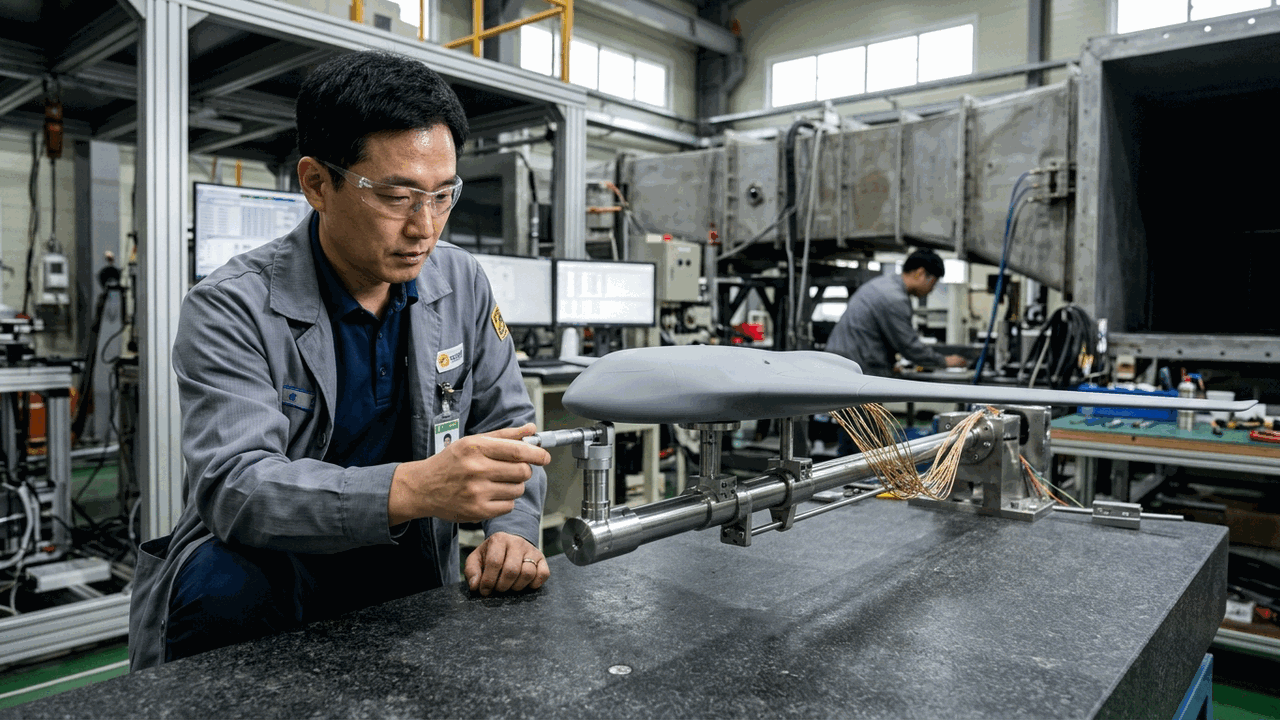
UAV Wind-Tunnel Model, EO/IR Aero Gimbal Pod & Thin-Wall RF Radome Design Matrix
| Aerospace / UAV Module | Critical Aerodynamic, Structural & Wall Rules | Matched GLUCK Resin & Aero Finish | Verification & Pre-Test Protocol |
|---|---|---|---|
| Subsonic Wind-Tunnel Scale Models | Trailing edge ≥ 0.8–1.0 mm · Flush perpendicular Ø0.8–1.2 mm static taps · Internal steel sting/spar bore | G40-JG (high flexural modulus) + wet-sanded Ra ≤ 0.8 μm low-drag finish | Individual tap airflow continuity check + Creaform 3D scan airfoil profile colormap |
| UAV / eVTOL Fuselage Cowls & Nacelles | 1.5–2.2 mm skin + internal 45° Isogrid/X-ribs (0.5–0.6t) + ≥ 2.5 mm weather step-lip | G20-BR (landing impact toughness) or G40-JG (ESC/motor thermal zones) | Helicoil / knurled brass insert retention + per-part gram-weight logging |
| EO/IR Gimbal Pod Aero Shrouds | Spherical low-drag shell + symmetric mass balance around gimbal axes + sub-5 GU matte interior | G20-BR / G40-JG + 0 μm Zone B masking on bearing & optical seats | Flat optical window (glass/IR crystal) O-ring groove flatness & dry-fit check |
| Thin-Wall RF / Satcom / mmWave Radomes | Strict wall-thickness uniformity (1.5–2.2 mm, avoiding abrupt dielectric rib steps) + non-metallic flange | White / G20-BR + non-conductive UV topcoat (zero carbon-black or metallic flake) | Pre-test unpainted/coated SLA coupons on customer VNA at target GHz frequency |
1. Steel-Core Hybrid Wind-Tunnel Scale Models with Integral Static-Pressure Tap Plumbing
Iterative aero testing across winglet, canard, and ducted-fan variants stalls when every geometry update waits 6–10 weeks for multi-piece 5-axis CNC aluminum machining and brazed pressure tubing.
GLUCK's hybrid wind-tunnel architecture seats your CNC steel sting balance block and main wing spar inside precision SLA bores while printing interchangeable monolithic wing/fuselage skins up to 1,000×800×600 mm. Maintain ≥ 0.8–1.0 mm trailing-edge thickness to prevent post-cure curl, and orient parts so flush Ø0.8–1.2 mm perpendicular static-pressure orifices remain free of support scars and primer bridging.
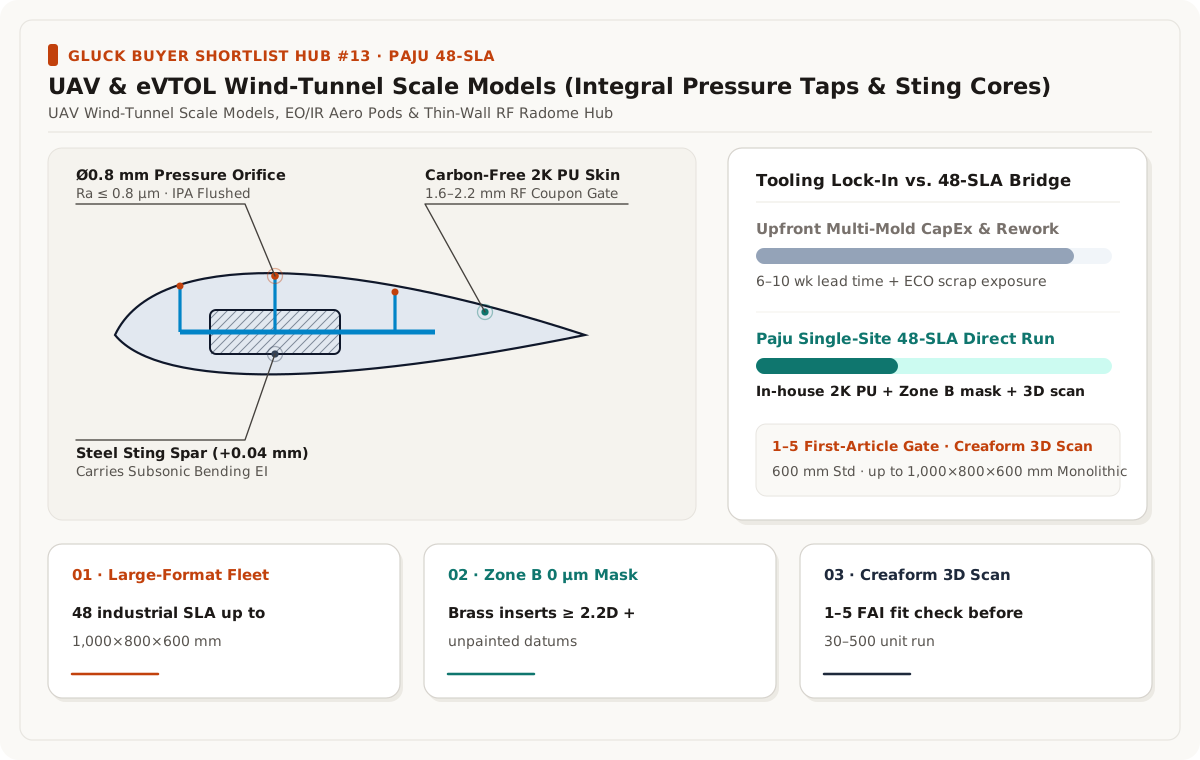
2. Gram-Budgeted EO/IR Gimbal Pods & Dielectric-Safe Thin-Wall RF Radome Finishing
Every excess gram on an airborne gimbal shroud penalizes flight endurance and servo stabilization torque. Pair 1.5–2.0 mm skins with internal 45° X-rib stiffeners (0.5–0.6t), control primer film build on Zone A aero surfaces to Ra ≤ 0.8 μm, and mask Zone B bearing races and germanium/glass window seats completely free of paint.
For Satcom, radar, and mmWave radome housings, never specify carbon-black pigments or metallic/pearlescent flakes that cause severe RF attenuation. Specify non-conductive UV-protective topcoats over uniform-wall SLA shells, and validate dielectric insertion loss on flat thickness coupons (1.5 mm / 2.0 mm) with your VNA prior to full housing release.
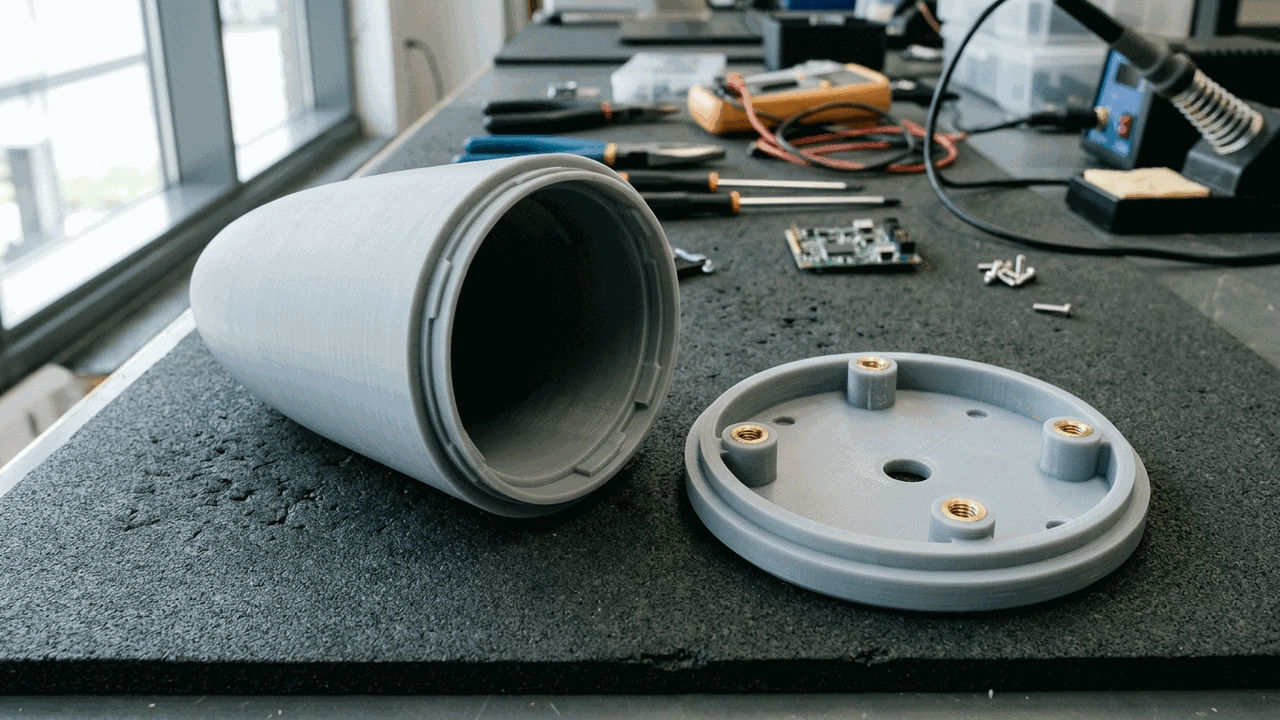
3. 1-Minute Copy-Paste UAV, Wind-Tunnel & Radome RFQ Checklist
Include in your RFQ: (1) 3D STEP assembly identifying internal metal sting/spar interfaces and pressure-tap port IDs, (2) wind-tunnel dynamic pressure or flight-part gram-weight targets, (3) aerodynamic surface-roughness spec (Ra ≤ 0.8 μm) and Creaform 3D laser-scan contour report requirements, and (4) non-conductive radome coating callouts or pre-production RF coupon requests.
Defense & Mobility Wind-Tunnel / Vibration Test Composite Spar (CFRP/GFRP), 360° Elastomeric Coating (173 MPa) & Helicoil Pull-Out Spec
Subsonic wind-tunnel aerodynamic models (30–65 m/s) for UAVs, eVTOLs, and defense mobility platforms require zero-deflection hybrid spars (AL6061 + CFRP/GFRP), shatter-containing 360° elastomeric polyurea coating (up to 173 MPa in 3-point flexural testing vs. 104 MPa uncoated), and stainless Helicoil inserts rated for 150–350 kgf axial pull-out loads.
| Defense & Wind-Tunnel Engineering Item | Target Test Specification | 5-Axis CNC Solid Machining / Unreinforced Resin | GLUCK Hybrid SLA + Composite Solution |
|---|---|---|---|
| Subsonic Wind-Tunnel Spar & Pressure Taps | Wingtip deflection ≤ 0.2mm at 30–65 m/s + monolithic 1.0–1.5mm internal pressure tap channels | 5-axis CNC cannot machine curved internal pressure routing (6–10 weeks, $30k–$70k); unreinforced resin deflects | High-modulus SLA outer skin (Ra 0.8μm finish) bonded to internal AL6061 spar + CFRP/GFRP composite layup (10–14 days, 45–60% cost reduction) |
| 1m Defense Louver 360° Elastomeric Coating | Up to 173 MPa 3-point flexural strength (vs. 104 MPa uncoated, coated coupon basis) with anti-spall containment | Uncoated brittle resin fractures into loose fragments under ballistic/vibration shock | 360° elastomeric polyurea encapsulation over heat-resistant SLA core captures internal fractures without spalling (undergoing vehicle mount validation) |
| Vibration Rig Helicoil Insert Pull-Out Load | M3–M8 stainless Helicoil / brass inserts · 150–350 kgf axial pull-out load per fastener · 50+ torque cycles | Direct plastic threads strip rapidly on multi-axis vibration shaker tables | Heat-set and structural-epoxy-locked stainless Helicoil and flanged nut inserts across all mounting bosses |
- Monolithic 30–80 Channel Internal Pressure Tap Routing: 1.0–1.5mm internal pneumatic channels are printed integrally inside airfoils and radomes, eliminating tube-gluing leaks.
- Air-Gapped Defense Security Protocol: Processed strictly on offline workstations at the Paju 48-machine SLA facility with 121-point optical calibration (±0.035–0.05mm) and automatic CAD purge after 6 months (or immediate permanent destruction upon NDA delivery).
Defense & Mobility Wind-Tunnel / Vibration Test Composite Spar (CFRP/GFRP), 360° Elastomeric Coating (173 MPa) & Helicoil Pull-Out Spec
Subsonic wind-tunnel aerodynamic models (30–65 m/s) for UAVs, eVTOLs, and defense mobility platforms require zero-deflection hybrid spars (AL6061 + CFRP/GFRP), shatter-containing 360° elastomeric polyurea coating (up to 173 MPa in 3-point flexural testing vs. 104 MPa uncoated), and stainless Helicoil inserts rated for 150–350 kgf axial pull-out loads.
| Defense & Wind-Tunnel Engineering Item | Target Test Specification | 5-Axis CNC Solid Machining / Unreinforced Resin | GLUCK Hybrid SLA + Composite Solution |
|---|---|---|---|
| Subsonic Wind-Tunnel Spar & Pressure Taps | Wingtip deflection ≤ 0.2mm at 30–65 m/s + monolithic 1.0–1.5mm internal pressure tap channels | 5-axis CNC cannot machine curved internal pressure routing (6–10 weeks, $30k–$70k); unreinforced resin deflects | High-modulus SLA outer skin (Ra 0.8μm finish) bonded to internal AL6061 spar + CFRP/GFRP composite layup (10–14 days, 45–60% cost reduction) |
| 1m Defense Louver 360° Elastomeric Coating | Up to 173 MPa 3-point flexural strength (vs. 104 MPa uncoated, coated coupon basis) with anti-spall containment | Uncoated brittle resin fractures into loose fragments under ballistic/vibration shock | 360° elastomeric polyurea encapsulation over heat-resistant SLA core captures internal fractures without spalling (undergoing vehicle mount validation) |
| Vibration Rig Helicoil Insert Pull-Out Load | M3–M8 stainless Helicoil / brass inserts · 150–350 kgf axial pull-out load per fastener · 50+ torque cycles | Direct plastic threads strip rapidly on multi-axis vibration shaker tables | Heat-set and structural-epoxy-locked stainless Helicoil and flanged nut inserts across all mounting bosses |
- Monolithic 30–80 Channel Internal Pressure Tap Routing: 1.0–1.5mm internal pneumatic channels are printed integrally inside airfoils and radomes, eliminating tube-gluing leaks.
- Air-Gapped Defense Security Protocol: Processed strictly on offline workstations at the Paju 48-machine SLA facility with 121-point optical calibration (±0.035–0.05mm) and automatic CAD purge after 6 months (or immediate permanent destruction upon NDA delivery).
Frequently Asked Engineering & Procurement Questions (FAQ)
Q1. How do you keep Ø0.8–1.2 mm static-pressure orifices from clogging during primer and paint?
We orient aero surfaces away from supports, plug-mask orifice ports during 2K primer/topcoat spraying, and verify individual port airflow continuity with clean air purge before shipment.
Q2. How is wing deflection prevented under wind-tunnel aerodynamic loads?
We combine high-modulus G40-JG SLA skins with internal precision bores that accept your CNC steel sting balance and metallic wing-spar inserts to carry primary bending moments.
Q3. How should RF radome dielectric transmission be qualified before bridge production?
Because dielectric loss varies by GHz band and incidence angle, we fabricate matched-thickness flat SLA coupons (unpainted and non-conductive UV-coated) first so your RF team can verify VNA insertion loss before releasing full radome tooling-free batches.
Q4. Can GLUCK supply airfoil contour verification against our master STEP CAD?
Yes. Upon request, our metrology team scans finished wind-tunnel models and UAV cowls with a Creaform 3D laser scanner to deliver full-surface CAD-to-part deviation colormaps.
What are the CFRP/GFRP composite spar, 173 MPa elastomeric coating, and Helicoil insert pull-out specifications for defense wind-tunnel and vibration test models?
To keep wingtip deflection under 0.2mm at 30–65 m/s subsonic wind-tunnel loads, we combine an Ra 0.8μm SLA aerodynamic shell with an internal AL6061 spar and CFRP/GFRP composite layup, apply a 360° elastomeric polyurea coating achieving up to 173 MPa in 3-point flexural testing (versus 104 MPa uncoated, with anti-spall fragment containment), and lock M3–M8 stainless Helicoil inserts rated for 150–350 kgf axial pull-out load.
Illustrative Engineering Review Scenario & Pre-Production Check Protocol
An outdoor AMR manufacturer required 120 sets of vibration-resistant top sensor shrouds without injection mold tooling. GLUCK engineered a 2.0 mm shell reinforced with internal X-lattice ribs (1.2 mm rib thickness, R1.5 mm root fillets) and fitted all 6 mounting points with heat-set brass inserts and metal compression limiters to mitigate bolt-preload relaxation for vibration-exposed sensor shroud designs.
- Sink-Mark-Free Rib Geometry: Restricts internal rib thickness to 0.5–0.6x nominal wall thickness so exterior Class-A surfaces remain smooth after sanding and painting
- Bolt-Creep Mitigation with Metal Bushings: Transfers clamping preload through metal collar sleeves rather than bare photopolymer bosses under sustained vibration
- EMI Shielding & UV Topcoat Options: Supports internal conductive spray shielding and exterior UV-stabilized polyurethane topcoats via custom finishing specifications
Note: The quantities, dimensions, and process combinations in this section are illustrative engineering review scenarios for DFM planning and do not represent specific client delivery records or unconditional guarantees. Based on GLUCK's 48-machine Paju SLA smart factory (standard online quote bed 600×600×400 mm; large-format single-piece bed up to 1,000×800×600 mm via engineering review). Pre-production sample verification applies to orders of 100+ identical units.
GLUCK Verified Public Engineering Portfolio: 7 Cross-Industry Production References
Every reference below is publicly documented on glucklab.com and gluckblog.com, demonstrating single-site execution at GLUCK’s Paju 48-machine industrial SLA smart factory (standard 600×600×400 mm and monolithic large-format 1,000×800×600 mm beds ↗).
| Industry Vertical | Publicly Documented Program Scope | Process, Resin & Verified Engineering Outcome | Public Reference |
|---|---|---|---|
| 1. Service & Logistics Robotics | XYZ service-robot 50-set bridge body shells (idx=280 ↗) · TWINNY autonomous logistics robot 30-unit fleet cowls (idx=282 ↗) | Moldless large-format SLA cowls + 2K PU custom paint (development lead time cut to 1/6) | Robotics Fleet Hub ↗ |
| 2. Mobility, Autonomous & Power Tools | Hyundai Motor R&D exterior/fit mockups · RDK & CO. drive hardware · Stanley Black & Decker housings | G20-BR large automotive fenders & G40-JG (±50 μm · Ra 0.8 · HDT 80°C summary metric) validation | G40-JG Mobility Case ↗ |
| 3. Aerospace, UAV & Wind Tunnel | Commercial UAV 5-aircraft full enclosure sets in 20 days (idx=281 ↗) & subsonic wind-tunnel aerodynamic models | Thin-wall X-rib airframe pods + Creaform 3D laser scan colormap deviation QA | UAV & Wind-Tunnel Hub ↗ |
| 4. Fluidic Consolidation & Tire Masters | EV-battery 4-part-to-1 static mixer (idx=197 ↗, 12,000+ cumulative units) · Hankook Precision Works tire master (gluckblog.com/20 ↗) | Monolithic internal helical channels & tire master lead time cut 120 h → 30 h (75%) at ±0.06 mm | 3-Route Selection Hub ↗ |
| 5. Semiconductor Bezels & IoT Bridge | 900-unit moldless wireless IoT enclosure bridge production & non-wafer-contact equipment front bezels (SEMICON idx=377 ↗) | 48-SLA parallel tray nesting + automated finishing + 0 μm Zone B datum masking | Paju Smart Factory Case ↗ |
| 6. Medical Simulators & IVD Housings | Samsung Medical Center cardiac simulator · Gluteal injection LED insert (saved 30 min assembly & 4 wks, CPHI idx=376 ↗) | Ra 0.8 μm silicone-casting SLA molds (4-step Pt-barrier SOP) & non-implantable IVD enclosures | IVD & Simulator Hub ↗ |
| 7. Diagnostic Optics & Clear SLA | Opticho photoacoustic medical diagnostic hardware (~20 field systems, idx=283 ↗) · Dual-finish Clear SLA (idx=192) | Multi-revision optical/enclosure loop & wet-polished + UV-clearcoated Clear SLA | Opticho Iteration Case ↗ |