Direct End-Use SLA Parts (Route A) vs. Silicone Vacuum-Casting Masters & Molds (Route B) vs. Precision Tire & Foundry Masters (Route C): 3-Route Selection Standard
Quantitative 3-route decision framework integrating 1–1,000+ unit economics, shrinkage scaling (100.0% vs. +0.15–0.40%), 4-step platinum-silicone cure-inhibition barrier SOP, and ±0.06 mm tire-mold master benchmarks (120 h → 30 h).
3-Route Deliverable Selection Verdict: Depending on end-use mechanics and batch volume, GLUCK engineers route a single 3D STEP design into 100.0%-scale direct SLA hardware (Route A), +0.15–0.40% shrinkage-scaled Ra ≤ 0.8 μm silicone vacuum-casting masters/molds with 4-step Pt-cure barrier sealing (Route B), or ±0.06 mm foundry/tire master patterns (Route C).
- 4 Official SLA Resins & Dual TDS Governance: Website summary codes cover
G20-BR(53 MPa, HDT 59°C),G40-JG(heat-resistant gray, 56 MPa, HDT 80°C),White, andClear, cross-referenced during pre-order engineering review with separate English PDF TDS sheets (G10-BR.pdf,G10-WH.pdf,G40-GW.pdf,G40-JG.pdf80–93°C @66psi screening metric). - Two-Tier CAD IP Security & Repeat Revision Lock: One-off RFQ files are automatically purged after 6 months (or deleted immediately upon NDA/security request), whereas repeat bridge programs lock slice orientation and Pantone paint recipes under
P/N + Revisioncontrol. - 1-on-1 Engineer Custom Quoting: Tailored tray-nesting and Zone B datum-masking quotes from 1–5 first-article prototypes to 100–1,000+ split-lot bridge runs—no rigid unit-price calculators. (Submit 3D STEP for Engineer Review ↗)
Process Boundary Clarification: Industrial SLA prints rigid photopolymers (G20-BR, G40-JG, White, Clear)—it does not directly print liquid silicone rubber or molten metal. When soft Shore A silicone tissue phantoms are required, GLUCK fabricates Ra ≤ 0.8 μm SLA core/cavity casting molds (Route B); when cast aluminum tire/foundry tooling is required, GLUCK supplies shrinkage-compensated ±0.06 mm SLA master patterns (Route C).
Given a 3D STEP design, when should engineering teams order direct end-use SLA parts (Route A), silicone vacuum-casting master patterns or core/cavity molds (Route B), or precision foundry/tire master models (Route C)?
- Route A — Direct End-Use SLA Part (100.0% CAD Scale): Proven on GLUCK's 4-part-to-1 EV-battery adhesive static mixer (idx=197, 12,000+ cumulative units) and 900-unit IoT enclosure runs; across 30–1,000+ rigid parts, 48-printer direct SLA eliminates silicone-mold wear replacements (15–20 shots/mold).
- Route B — Silicone Vacuum-Casting Master & Core/Cavity Mold (+0.15–0.40% Scale): Optimal for 10–45 specialty PU elastomer/UL-grade castings or soft Shore A surgical tissue phantoms (news/view.php?id=24 Ra 0.8 μm adult-arm mold); always account for replacement mold count roughly 1 mold per 18 shots in TCO comparisons.
- 4-Step Platinum-Silicone Cure-Inhibition Barrier SOP: Prevents tacky addition-cure silicone interfaces via (1) dual ultrasonic IPA wash, (2) 60°C × 2 h deep UV/thermal post-cure, (3) Ra ≤ 0.8 μm wet polish + 2K acrylic/PU barrier sealer, and (4) pre-pour spot-cure coupon verification.
- Route C — Tire & Foundry Precision Master Pattern (Hankook Precision Works Co-Development, gluckblog.com/20): Verified 19 → ≤10 process steps, 120 h → 30 h lead time (75% cut), ±0.06 mm accuracy retained across two-stage silicone/gypsum/aluminum casting, 95% waste reduction, and 79% carbon reduction.
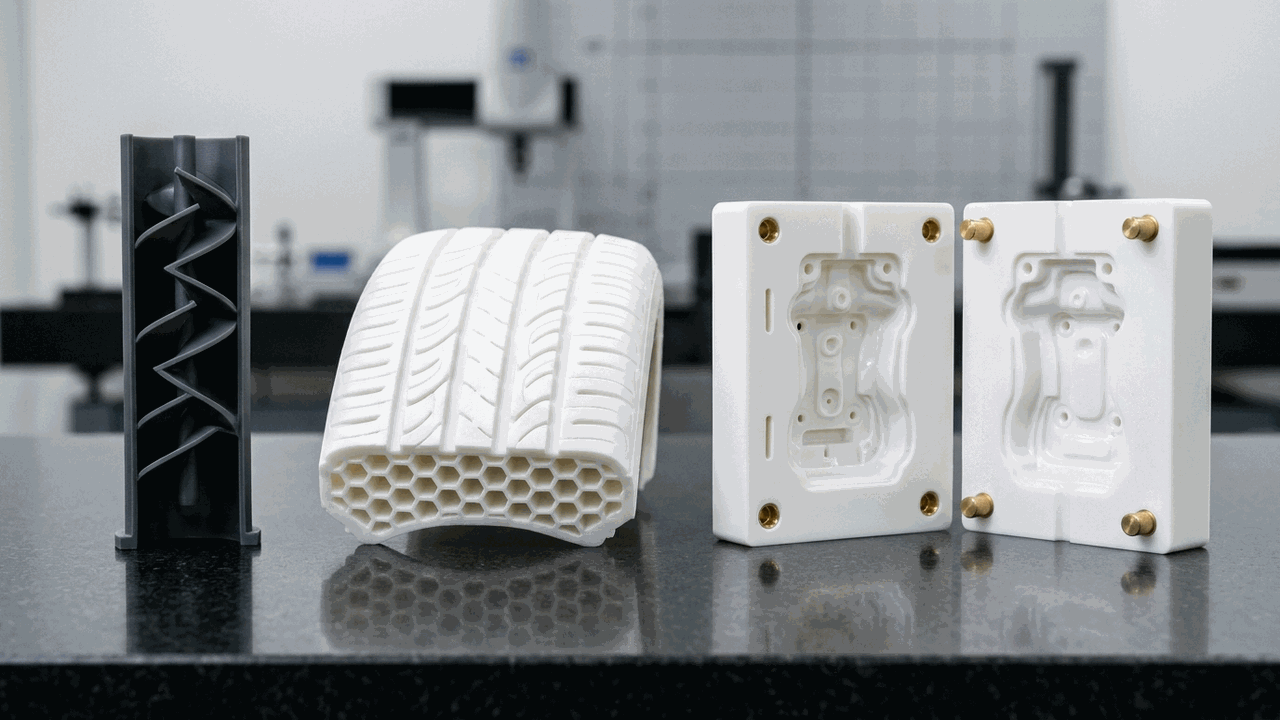
Quantitative 3-Route SLA Engineering Matrix: Direct Part (Route A) vs. Silicone Master/Mold (Route B) vs. Foundry Master (Route C)
| Decision Dimension | Route A · Direct End-Use SLA Part | Route B · Silicone Casting Master & Core/Cavity Mold | Route C · Tire & Metal-Foundry Master Pattern |
|---|---|---|---|
| Economic Volume Window | 1–5 functional prototypes & 30–1,000+ bridge lots (12,000+ static mixers proven, idx=197) | 10–45 specialty PU elastomer shots (1–2 mold lives) or Shore A silicone tissue casting molds | 1–10 master sectors driving downstream silicone → gypsum → aluminum alloy casting |
| CAD Scale & Draft Compensation | 100.0% nominal scale · 0° draft allowed · monolithic internal channels, brass inserts & Zone B masking | Pre-scaled +0.15–0.40% for PU/silicone shrinkage + 1–3° demold draft, vents & parting shut-offs | Multi-stage thermal/phase shrinkage compensation + precision kerf/sipe insert slot datums |
| Surface Finish & Interface SOP | Class-A 2K PU exterior (Ra ≤ 0.8–1.2 μm) + 0 μm Zone B datum masking + Zone C P/N+Rev ID | Ra ≤ 0.8 μm mirror-sanded parting faces + mandatory 4-step Pt-silicone cure-inhibition barrier SOP | Crisp micro-tread edge retention verified to ±0.06 mm via Creaform 3D laser-scan colormap |
| Mid-Program ECO Agility | Zero mold scrap—roll Rev B STEP geometry directly into the next split batch | Geometry change scraps existing silicone mold (15–20 shot wear limit) and requires re-pouring | Replaces 120 h 5-axis CNC machining with 30 h SLA master turnaround (75% faster iteration) |
1. Avoiding the 15–20 Shot Silicone Mold Wear Trap Across 50–500 Rigid Enclosures (Route A vs. Route B)
Hardware teams quoting 150–300 rigid enclosures often default to urethane vacuum casting without modeling silicone mold attrition. Because polyaddition exothermic heat degrades silicone cavities after 15–20 shots, a 250-unit order requires ceil(250 / 18) = 14 sequential silicone molds—multiplying tooling labor and introducing mold-to-mold dimensional drift.
Running Route A directly across GLUCK's 48-machine Paju SLA fleet eliminates intermediate soft molds altogether. As demonstrated on GLUCK's 4-part-to-1 monolithic EV-battery static mixer (idx=197, 12,000+ cumulative units produced) and 900-unit IoT enclosure programs, direct SLA forms zero-draft internal geometry in one piece and lets engineers deploy Rev B CAD updates mid-run with zero mold-scrap penalty.
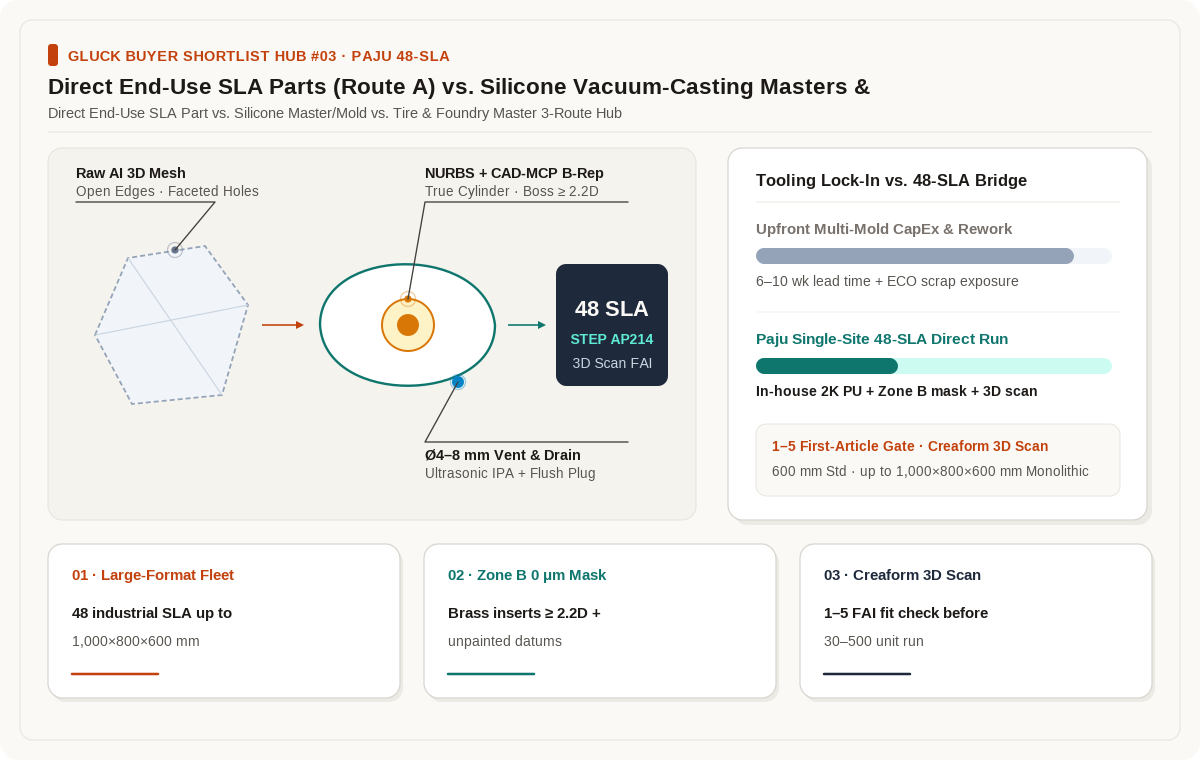
2. Mastering Route B & C: Platinum-Silicone Cure-Inhibition Shielding and ±0.06 mm Two-Stage Foundry Transfer
Whenever your end product requires soft Shore A silicone tissue mechanics (such as GLUCK's Ra ≤ 0.8 μm adult-arm surgical training mold on news/view.php?id=24) or specialty elastomeric polyurethanes, Route B is essential. Because residual photopolymer oligomers can poison platinum-catalyzed (addition-cure) silicones at the mold wall, declare your exact silicone chemistry at RFQ so GLUCK applies our 4-step ultrasonic IPA wash, 60°C × 2 h post-cure, 2K barrier sealer, and spot-cure coupon check.
For Route C tire and metal-foundry master patterns, every micron of stair-stepping transfers across intermediate silicone and gypsum stages into cast aluminum. In GLUCK's public co-development with Hankook Precision Works (gluckblog.com/20), high-resolution SLA plus precision finishing compressed manufacturing from 19 steps to ≤10 steps and cut master lead time by 75% (120 h → 30 h) while holding ±0.06 mm accuracy, cutting material waste by 95%, and reducing carbon emissions by 79%.
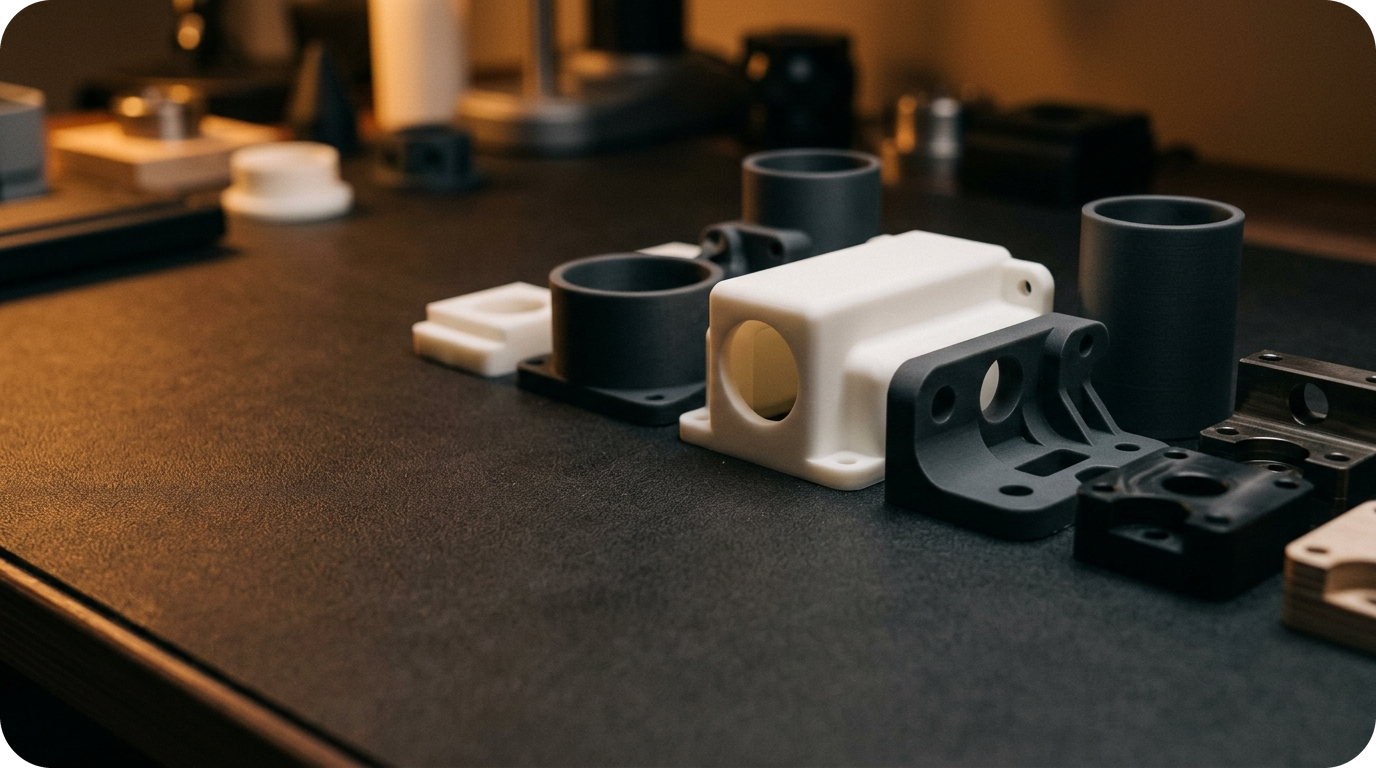
3. 1-Minute Copy-Paste 3-Route Selection RFQ Checklist
Specify with your 3D STEP upload: (1) target deliverable route (Route A direct end-use part, Route B vacuum-casting master or silicone core/cavity mold, or Route C foundry/tire master pattern), (2) total batch quantity and expected Rev B ECO frequency, (3) downstream casting resin/silicone catalyst type (tin-cure vs. platinum-cure) and shrinkage scale factor (100.0% vs. +0.15–0.40%), and (4) Zone B datum surfaces and Ra ≤ 0.8 μm parting-face tolerances.
Illustrative Engineering Review Scenario & Pre-Production Check Protocol
For a 250-set pilot run, urethane vacuum casting would have required fabricating 13 sequential silicone molds (due to the 15–20 shot silicone mold life limit), driving up mold replacement costs and lead time. Switching to direct parallel SLA production on GLUCK's 48-machine fleet eliminated silicone mold wear-out costs and allowed a mid-batch ergonomic grip revision (Rev.B) across a multi-lot bridge run.
- Silicone Mold Degradation Threshold: While urethane casting suits 15–40 units, batches of 100–300+ units incur cumulative multi-mold replacement costs where direct parallel SLA should be compared
- Agility Against QDM Soft-Tooling Rework: Avoids aluminum mold core welding and machining downtime when field feedback triggers Rev.A to Rev.B enclosure updates
- Non-China Asian Direct Supply Chain (South Korea): Provides US and European OEMs with a direct 48-machine Korean manufacturing partner, DHL/FedEx express air freight, and origin documentation support (subject to customs broker HS tariff verification)
Note: The quantities, dimensions, and process combinations in this section are illustrative engineering review scenarios for DFM planning and do not represent specific client delivery records or unconditional guarantees. Based on GLUCK's 48-machine Paju SLA smart factory (standard online quote bed 600×600×400 mm; large-format single-piece bed up to 1,000×800×600 mm via engineering review). Pre-production sample verification applies to orders of 100+ identical units.
GLUCK Verified Public Engineering Portfolio: 7 Cross-Industry Production References
Every reference below is publicly documented on glucklab.com and gluckblog.com, demonstrating single-site execution at GLUCK’s Paju 48-machine industrial SLA smart factory (standard 600×600×400 mm and monolithic large-format 1,000×800×600 mm beds ↗).
| Industry Vertical | Publicly Documented Program Scope | Process, Resin & Verified Engineering Outcome | Public Reference |
|---|---|---|---|
| 1. Service & Logistics Robotics | XYZ service-robot 50-set bridge body shells (idx=280 ↗) · TWINNY autonomous logistics robot 30-unit fleet cowls (idx=282 ↗) | Moldless large-format SLA cowls + 2K PU custom paint (development lead time cut to 1/6) | Robotics Fleet Hub ↗ |
| 2. Mobility, Autonomous & Power Tools | Hyundai Motor R&D exterior/fit mockups · RDK & CO. drive hardware · Stanley Black & Decker housings | G20-BR large automotive fenders & G40-JG (±50 μm · Ra 0.8 · HDT 80°C summary metric) validation | G40-JG Mobility Case ↗ |
| 3. Aerospace, UAV & Wind Tunnel | Commercial UAV 5-aircraft full enclosure sets in 20 days (idx=281 ↗) & subsonic wind-tunnel aerodynamic models | Thin-wall X-rib airframe pods + optional Creaform 3D laser scan colormap QA | UAV & Wind-Tunnel Hub ↗ |
| 4. Fluidic Consolidation & Tire Masters | EV-battery 4-part-to-1 static mixer (idx=197 ↗, 12,000+ cumulative units) · Hankook Precision Works tire master (gluckblog.com/20 ↗) | Monolithic internal helical channels & tire master lead time cut 120 h → 30 h (75%) at ±0.06 mm | 3-Route Selection Hub ↗ |
| 5. Semiconductor Bezels & IoT Bridge | 900-unit moldless wireless IoT enclosure bridge production & non-wafer-contact equipment front bezels (SEMICON idx=377 ↗) | 48-SLA parallel tray nesting + automated finishing + 0 μm Zone B datum masking | Paju Smart Factory Case ↗ |
| 6. Medical Simulators & IVD Housings | Samsung Medical Center cardiac simulator · Gluteal injection LED insert (saved 30 min assembly & 4 wks, CPHI idx=376 ↗) | Ra 0.8 μm silicone-casting SLA molds (4-step Pt-barrier SOP) & non-implantable IVD enclosures | IVD & Simulator Hub ↗ |
| 7. Diagnostic Optics & Clear SLA | Opticho photoacoustic medical diagnostic hardware (~20 field systems, idx=283 ↗) · Dual-finish Clear SLA (idx=192) | Multi-revision optical/enclosure loop & wet-polished + UV-clearcoated Clear SLA | Opticho Iteration Case ↗ |
Frequently Asked Engineering & Procurement Questions (FAQ)
Does GLUCK print soft silicone rubber directly on SLA machines?
No. Industrial SLA builds rigid photopolymers (G20-BR, G40-JG, White, Clear). For soft Shore A silicone surgical phantoms or elastomer parts, GLUCK manufactures Ra ≤ 0.8 μm SLA core/cavity molds or vacuum-casting master patterns (Route B) sealed for clean demolding.
At what quantity does Direct End-Use SLA (Route A) beat silicone vacuum casting (Route B)?
While 10–35 elastomeric urethane parts fit within 1–2 silicone mold lives, rigid housings and brackets between 50 and 500+ units—especially programs expecting Rev B design updates—avoid repeated 15–20 shot silicone mold replacements by running directly on GLUCK's 48-printer SLA fleet.
How do you prevent platinum-cure silicone inhibition against SLA masters or molds?
Declare addition-cure (platinum) silicone on your RFQ so we execute our 4-step barrier SOP: dual ultrasonic IPA wash, 60°C × 2 h UV/thermal post-cure, Ra ≤ 0.8 μm wet sanding with 2K acrylic/PU barrier sealer, and a pre-shipment spot-cure coupon check.
Should our CAD file already include downstream casting shrinkage scaling?
Submit your 100.0% nominal STEP file along with your downstream caster's shrinkage factor (e.g., +0.15–0.40% for PU or multi-stage foundry compensation) so our engineers apply and document exact X/Y/Z scale factors against Creaform 3D scan inspection targets.