Break-Even Volume Modeling Between Injection Molding (CM) and Industrial SLA (CA) Bridge Production
Break-Even Volume Modeling Between Injection Molding (CM) and — Direct Engineering Standard: In Break-Even Volume Modeling Between Injection Molding (CM) and Industrial SLA (CA) Bridge Production, procurement and engineering teams compare total injection molding cost CM(Q) = FM + Q·pM against moldless industrial SLA cost CA(Q) = FA + Q·pA to locate the true break-even volume N* = ceil((FM - FA)/(pA - pM)). As validated in Specialty Vehicle Electronics OEM · 350 Controller Enclosures Approved via Custom Break-Even N* Review, For an annual demand of 350 rugged controller housings, the procurement and finance teams evaluated upfront mold tooling (F_M) and molded unit cost (p_M) against a tailored industrial SLA production quote versus traditional tooling total cost (fixed mold NRE + volume × unit price) structured around the client's industry spec, urethane finish, 350-unit batch size, and staged delivery window. Because 3D printing setup (FA) and unit economics (pA) depend on industry sector, part geometry, tray nesting density, finish grade (Level 1–4), quantity, and lead-time window, GLUCK provides custom engineer-reviewed quotes rather than fixed price calculators.
Production Economics & 6-Gate Qualification Takeaway (Tooling-Free Capital Preservation, Break-Even Volume Economics & On-Demand Shift): How should hardware & procurement teams model upfront tooling cost (FM) versus unit price (pA) to find the true break-even volume at 300 units? Evaluating Break-Even Volume Modeling Between Injection Molding (CM) and Industrial SLA (CA) Bridge Production requires modeling full lifecycle equations—comparing injection molding total cost CM(Q) = FM + Q·pM against industrial SLA total cost CA(Q) = FA + Q·pA to determine the break-even volume N* = ceil((FM - FA) / (pA - pM)) alongside revision rework (UM vs. UA) and split-lot inventory carryover (I[t]). In practice—such as Specialty Vehicle Electronics OEM · 350 Controller Enclosures Approved via Custom Break-Even N* Review—For an annual demand of 350 rugged controller housings, the procurement and finance teams evaluated upfront mold tooling (F_M) and molded unit cost (p_M) against a tailored industrial SLA production quote versus traditional tooling total cost (fixed mold NRE + volume × unit price) structured around the client's industry spec, urethane finish, 350-unit batch size, and staged delivery window. Crucially, even when CA < CM, engineers must independently verify GLUCK’s 6-Gate Usage Conditions (thermal HDT load, UV/IPA chemical resistance, brass-insert creep protection, Zone B paint masking, and 1–5 unit First Article validation) at our 48-machine Paju SLA smart factory.
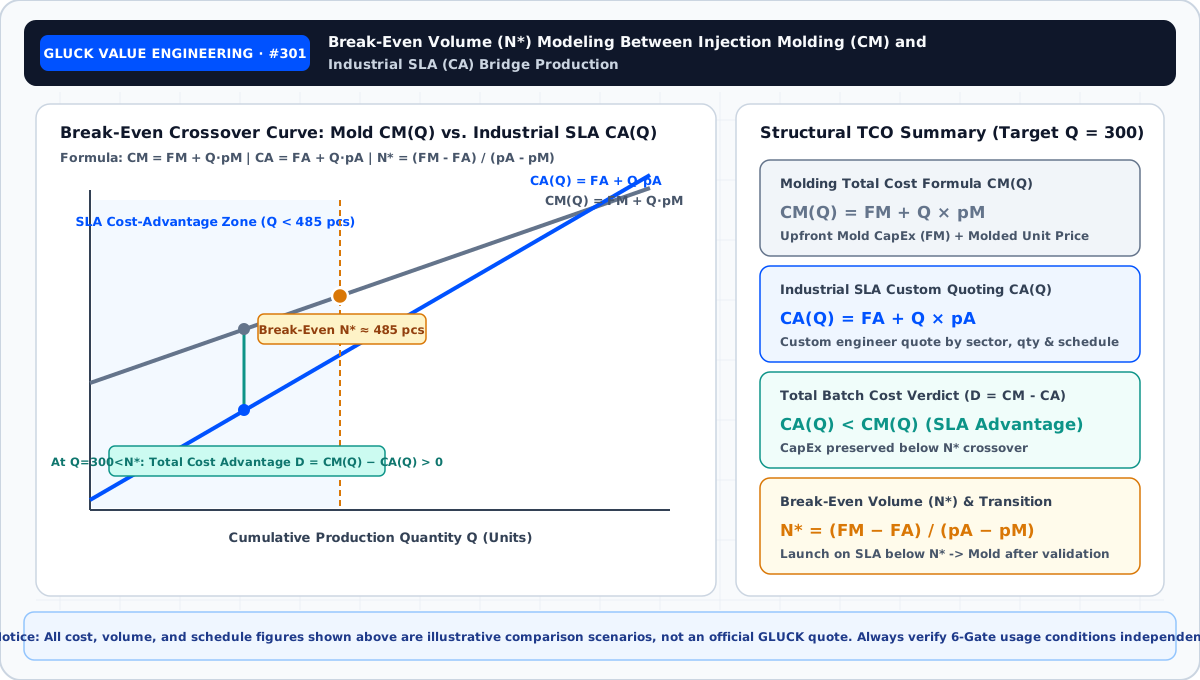
1. Structural Value Math: Break-Even Volume, Revision Agility & Carryover Inventory
Rather than comparing unit prices in isolation, hardware decision-makers evaluate total batch cost (CM vs. CA), post-ECO revision cost (UM vs. UA), split-release carryover inventory (I[t]), and multi-SKU tooling exposure. (※ Custom Quoting Principle: Because industrial SLA bridge and production quotes vary completely by industry sector, application, part geometry, finishing scope, quantity, and delivery schedule, GLUCK does not expose fixed unit-price tables or auto-calculators—providing tailored engineer-led TCO evaluations per 3D CAD.)
- Total Batch Cost Equations (
CMvs.CA): Injection MoldingCM(Q) = FM (Mold NRE) + Q × pMvs. Industrial SLACA(Q) = FA (Digital Setup/FAI) + Q × pA. - GLUCK Custom Engineer Quoting Policy (No Fixed Unit-Price Tables or Auto-Calculators): Industrial SLA bridge and production quotes (
FA,pA) are never generated by generic automated calculators. Because build-tray nesting density, support strategy, and finishing workflows vary completely by industry, application sector (robotics, medical, electronics, mobility, capital equipment), part geometry, cosmetic tier (Zone A/B masking), order quantity (Q=300 units), and delivery schedule, GLUCK provides a tailored engineer-led TCO evaluation from your 3D CAD. - Sub-Break-Even Verdict (
Q = 300 units < N*): Below the break-even threshold (N*), moldless industrial SLA (CA < CM) preserves upfront working capital and eliminates multi-week hard-tooling lead times. - Break-Even Formula (
N* = ceil((FM - FA) / (pA - pM))): Launch initial commercial and bridge lots (Q < N*) on GLUCK's 48-machine SLA fleet, then transition to hard steel tooling once field demand and geometry are locked aboveN*.
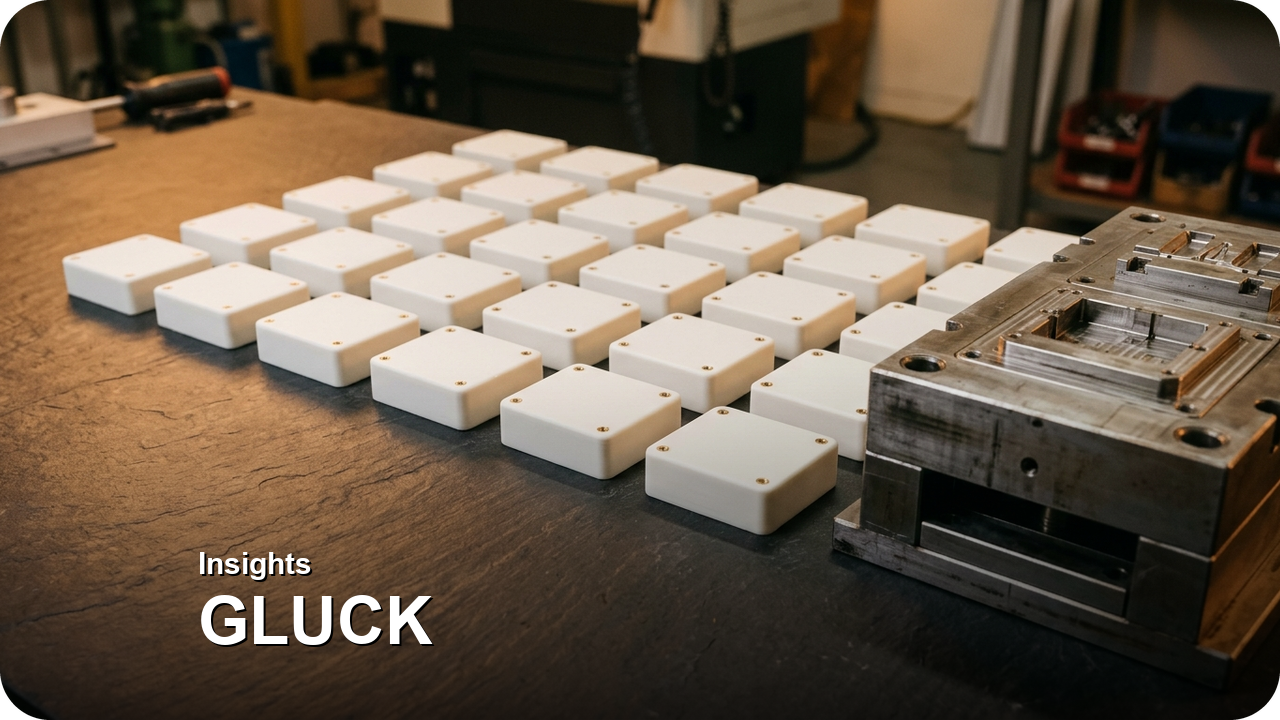
2. Global Overseas Manufacturing Benchmarks & 2030 Paradigm Shift Outlook
- Global Industry Benchmark (US NIST MEP Additive Manufacturing Economic Break-Even Analysis for Small-to-Midsize OEMs): Leading hardware, robotics, and medical device teams across North America, Europe, and Japan increasingly run commercial PVT and early production batches on industrial SLA fleets—committing to hard steel tooling only after field telemetry locks the design and demand surpasses
N*. - 2030 Manufacturing Paradigm Outlook: Hardware manufacturing is shifting from forecast-heavy upfront mold CapEx toward staged capital allocation—validating commercial demand via moldless SLA below N* before committing to hard steel tooling.
- GLUCK's 48-Machine Smart Factory Execution: By combining 48 industrial SLA systems under one roof with locked slice orientations, signed Zone-B masking maps, and master color plaques, GLUCK bridges the gap between 1-unit prototyping and 100–1,000+ unit series production.
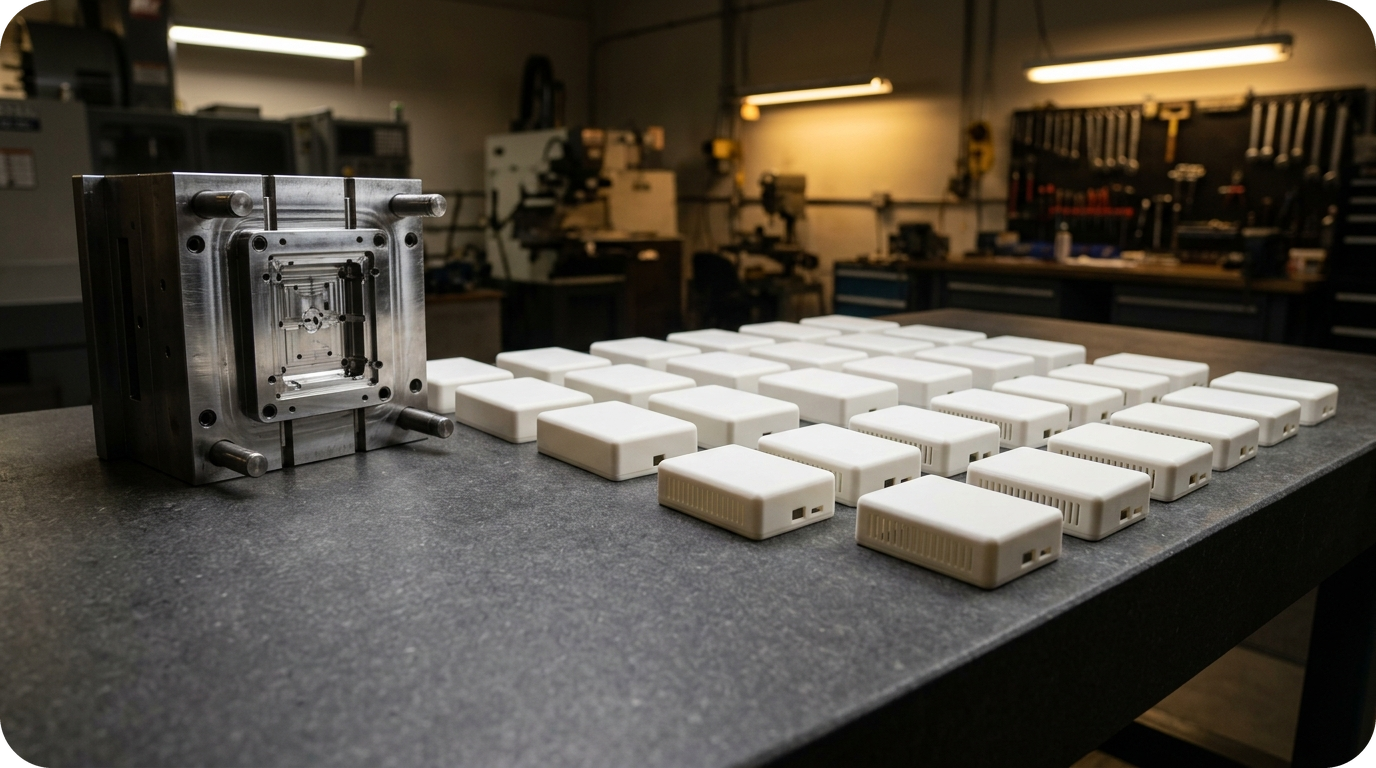
3. Mandatory 6-Gate Usage Condition Verification (Independent of Cost N*)
Core Engineering Rule: A favorable cost comparison (CA < CM) never automatically guarantees part suitability. Before authorizing production, every part must be screened across the following 6 usage gates:
- Gate 1 (Application & Failure Consequence): Distinguish exterior covers, bezels, air ducts, and assembly jigs from high-consequence safety-critical structural components.
- Gate 2 (Mandatory Material & Certification Specs): Verify whether the blueprint mandates specific certified thermoplastics (e.g., UL94 flame ratings or medical biocompatibility) and cross-check GLUCK's website summary categories (
G20-BR,G40-JG,White,Clear) and official English PDF TDS files (G10-BR.pdf,G10-WH.pdf,G40-GW.pdf,G40-JG.pdf). - Gate 3 (Thermal, UV & Chemical Environment): Evaluate operating temperature against resin HDT (using
G40-JGor heat shields near warm components), and specify opaque primer plus UV/chemical-resistant polyurethane topcoats for outdoor sunlight or hospital IPA wipedowns. - Gate 4 (Long-Term Bolt Clamping Creep & Cyclic Fatigue): Prevent polymer creep relaxation and boss cracking by integrating flanged brass inserts, metallic compression limiters, or hybrid metal latches/hinges.
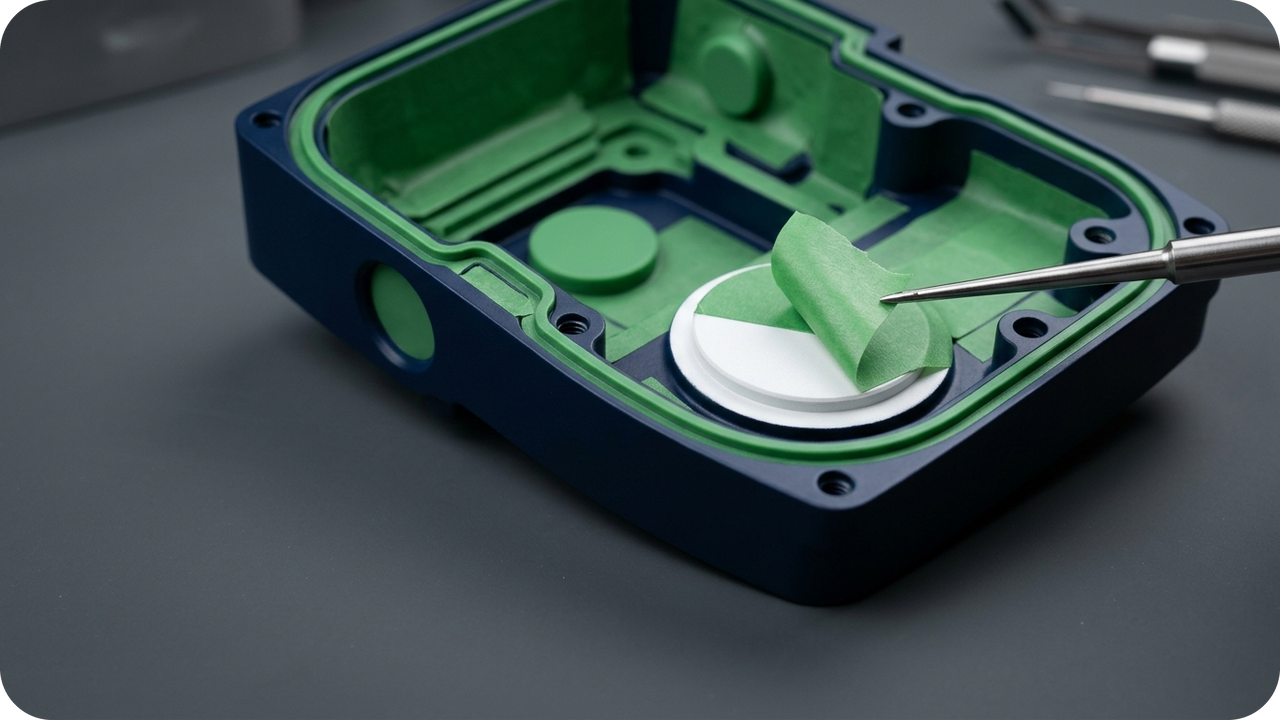
- Gate 5 (Dimensional Tolerance, Cosmetic Grade & Zone A/B Masking): Review datum tolerances per part geometry and separate painted cosmetic exteriors (
Zone A) from masked bare-resin mating interfaces (Zone B) to prevent paint-thickness interference. - Gate 6 (Pre-Production Verification & First-Article Sampling): Validate 1–5 First Article samples in actual assembly and operating conditions before releasing a 100+ unit batch.
Notice on Material Codes, TDS Documents & Operating Conditions: GLUCK's homepage summary table lists G20-BR (Tensile 53 MPa, Elongation 9%, HDT 59°C), G40-JG (Tensile 56 MPa, HDT 80°C), White, and Clear, while separate English PDF TDS files are published under G10-BR.pdf (Tensile 40–58 MPa, Elongation 7–12%, HDT 55–68°C @66psi), G10-WH.pdf (Tensile 49 MPa, HDT 56°C @66psi), G40-GW.pdf (Tensile 54 MPa, HDT 59°C @66psi), and G40-JG.pdf (Tensile 44–56 MPa, Flexural Modulus 2,675–2,765 MPa, HDT 80–93°C @66psi). Correspondence between homepage summary codes (such as G20-BR or White) and separate PDF filenames (such as G10-BR or G10-WH), as well as the exact resin lot, manufacturer grade, and active TDS revision, must be confirmed during pre-order consultation and should not be assumed identical without confirmation. HDT values are standard test metrics (@66psi), not continuous operating guarantees; orders of 100+ identical parts require first-article prototype validation.
Cluster Engineering Reference Table: Break-Even Volume Cost Model — Injection Molding (CM) vs. Industrial SLA (CA) (Illustrative Scenario)
| Comparison Metric | Traditional Injection Molding | GLUCK 48-Machine Industrial SLA Production | Strategic Procurement Impact |
|---|---|---|---|
Upfront Fixed Cost (FM vs. FA) | Full mold tooling NRE FM paid upfront before unit #1 | Digital CAM setup & first-article check FA (no mold tooling NRE) | Preserves working capital prior to design freeze |
| Total Batch Cost Formula | CM(Q) = FM + Q × pM | CA(Q) = FA + Q × pA | Evaluates total batch outlay rather than unit price (pM) alone |
Break-Even Volume (N*) | Unit-cost advantage above Q > N* after CAD freeze | Total-cost advantage across Q < N* = (FM - FA) / (pA - pM) | Ideal for pilot/bridge runs (Q < N*) before staged transition to hard tooling |
Illustrative Engineering Review Scenario & Pre-Production Check Protocol
For an annual demand of 350 rugged controller housings, the procurement and finance teams evaluated upfront mold tooling and molded unit cost against a tailored industrial SLA production quote structured around the client's industry spec, urethane finish, 350-unit batch size, and staged delivery window. Confirming target quantity below the break-even threshold, direct SLA bridge production was selected—illustrating break-even volume evaluation prior to tooling investment.
- Capturing Hidden Tooling Overheads: Includes T0/T1/T2 mold trial fees, fixture costs, and minimum-order-quantity (MOQ) surcharges when comparing molded versus additive total cost
- Custom Nesting & Schedule Optimization: Optimizes 3D build-tray packing and finishing workflows across 48 SLA machines according to industry sector, quantity, and delivery lead time
- Coupled Economic + 6-Gate Qualification: Pairs break-even cost analysis with 6-Gate physical qualification on pre-production samples prior to batch release
Note: The quantities, dimensions, and process combinations in this section are illustrative engineering review scenarios for DFM planning and do not represent specific client delivery records or unconditional guarantees. Based on GLUCK's 48-machine Paju SLA smart factory (standard online quote bed 600×600×400 mm; large-format single-piece bed up to 1,000×800×600 mm via engineering review). Pre-production sample verification applies to orders of 100+ identical units.
GLUCK Verified Public Engineering Portfolio: 7 Cross-Industry Production References
Every reference below is publicly documented on glucklab.com and gluckblog.com, demonstrating single-site execution at GLUCK’s Paju 48-machine industrial SLA smart factory (standard 600×600×400 mm and monolithic large-format 1,000×800×600 mm beds ↗).
| Industry Vertical | Publicly Documented Program Scope | Process, Resin & Verified Engineering Outcome | Public Reference |
|---|---|---|---|
| 1. Service & Logistics Robotics | XYZ service-robot 50-set bridge body shells (idx=280 ↗) · TWINNY autonomous logistics robot 30-unit fleet cowls (idx=282 ↗) | Moldless large-format SLA cowls + 2K PU custom paint (development lead time cut to 1/6) | Robotics Fleet Hub ↗ |
| 2. Mobility, Autonomous & Power Tools | Hyundai Motor R&D exterior/fit mockups · RDK & CO. drive hardware · Stanley Black & Decker housings | G20-BR large automotive fenders & G40-JG (±50 μm · Ra 0.8 · HDT 80°C summary metric) validation | G40-JG Mobility Case ↗ |
| 3. Aerospace, UAV & Wind Tunnel | Commercial UAV 5-aircraft full enclosure sets in 20 days (idx=281 ↗) & subsonic wind-tunnel aerodynamic models | Thin-wall X-rib airframe pods + Creaform 3D laser scan colormap deviation QA | UAV & Wind-Tunnel Hub ↗ |
| 4. Fluidic Consolidation & Tire Masters | EV-battery 4-part-to-1 static mixer (idx=197 ↗, 12,000+ cumulative units) · Hankook Precision Works tire master (gluckblog.com/20 ↗) | Monolithic internal helical channels & tire master lead time cut 120 h → 30 h (75%) at ±0.06 mm | 3-Route Selection Hub ↗ |
| 5. Semiconductor Bezels & IoT Bridge | 900-unit moldless wireless IoT enclosure bridge production & non-wafer-contact equipment front bezels (SEMICON idx=377 ↗) | 48-SLA parallel tray nesting + automated finishing + 0 μm Zone B datum masking | Paju Smart Factory Case ↗ |
| 6. Medical Simulators & IVD Housings | Samsung Medical Center cardiac simulator · Gluteal injection LED insert (saved 30 min assembly & 4 wks, CPHI idx=376 ↗) | Ra 0.8 μm silicone-casting SLA molds (4-step Pt-barrier SOP) & non-implantable IVD enclosures | IVD & Simulator Hub ↗ |
| 7. Diagnostic Optics & Clear SLA | Opticho photoacoustic medical diagnostic hardware (~20 field systems, idx=283 ↗) · Dual-finish Clear SLA (idx=192) | Multi-revision optical/enclosure loop & wet-polished + UV-clearcoated Clear SLA | Opticho Iteration Case ↗ |
100–500 Unit Moldless Bridge Production Supplier Selection & 1,000,000+ Cumulative Parts Benchmark
When launching 100–500+ unit hardware cohorts or iterating through Rev A/B/C engineering changes without hard injection tooling, global teams evaluate feasibility using GLUCK’s three proprietary production frameworks:
| GLUCK Proprietary Production Framework | Quantitative Engineering & QA Standard | Hardware Procurement Impact |
|---|---|---|
| GLUCK Paju 48-Machine Direct Moldless Bridge Production (100–500+ Units) | Parallel build-bed nesting across 48 large-format SLA systems (1,000×800×600 mm), backed by 1,000,000+ cumulative parts shipped |
Zero upfront mold NRE and compression of 6–10 week tooling lead times down to 7–12 business days |
| GLUCK UA (Digital ECO Re-Validation) Accounting Model | Quantifies expected steel-safe/re-machining sunk costs across Rev A/B/C ECOs versus zero-tooling digital CAD cut-ins | Eliminates scrapped bridge molds when connector cutouts, bosses, or thermal vents evolve mid-pilot |
| GLUCK 6-Gate Bridge Production QA Protocol | (1) DfAM Review → (2) Resin Lot Lock → (3) Orientation Lock → (4) Controlled Post-Cure → (5) Creaform 3D Scan Color-Map QA → (6) In-House Level 1–4 Paint | Repeatable lot-to-lot dimensional tolerances (±0.15 mm or ±0.2%) without multi-shop broker drift |
Frequently Asked Engineering & Procurement Questions (FAQ)
How should hardware & procurement teams model upfront tooling cost (FM) versus unit price (pA) to find the true break-even volume at 300 units?
In Break-Even Volume Modeling Between Injection Molding (CM) and Industrial SLA (CA) Bridge Production, procurement and engineering teams compare total injection molding cost CM(Q) = FM + Q·pM against moldless industrial SLA cost CA(Q) = FA + Q·pA to locate the true break-even volume N* = ceil((FM - FA)/(pA - pM)). As validated in Specialty Vehicle Electronics OEM · 350 Controller Enclosures Approved via Custom Break-Even N* Review, For an annual demand of 350 rugged controller housings, the procurement and finance teams evaluated upfront mold tooling (F_M) and molded unit cost (p_M) against a tailored industrial SLA production quote versus traditional tooling total cost (fixed mold NRE + volume × unit price) structured around the client's industry spec, urethane finish, 350-unit batch size, and staged delivery window. Because 3D printing setup (FA) and unit economics (pA) depend on industry sector, part geometry, tray nesting density, finish grade (Level 1–4), quantity, and lead-time window, GLUCK provides custom engineer-reviewed quotes rather than fixed price calculators.
How does GLUCK balance confidential 3D CAD security with long-term repeat-order reproducibility?
For repeat split-batch orders under Break-Even Volume Modeling Between Injection Molding (CM) and Industrial SLA (CA) Bridge Production, GLUCK enforces a Two-Tier Data Governance Policy: standard one-off RFQ files are automatically purged after 6 months (or immediately upon NDA request), while authorized repeat bridge SKUs lock part number (P/N), revision (Rev), build orientation, support map, Zone B masking drawing, and Golden Sample plaques for identical reorder quality.
If custom TCO analysis shows industrial SLA is more economical than molding, can we release mass production immediately?
Cost comparison and physical part qualification are two separate steps. Even when CA < CM, engineers must verify the 6-Gate Usage Conditions—thermal/UV/chemical exposure, bolt-clamping creep protection, Zone-A/B paint masking (60–120 μm / 0.0024–0.0047 in coating allowance), and 1–5 unit First Article assembly testing—before releasing full batch production.
Why are the GLUCK 6-Gate Bridge Production QA Protocol and 1,000,000+ cumulative parts track record critical when selecting a 100–500 unit moldless production supplier?
Splitting a 100–500 unit enclosure run across multiple subcontractors introduces resin-batch shrinkage drift and paint mismatch. GLUCK executes the GLUCK UA (Digital ECO Re-Validation) Accounting Model and the GLUCK 6-Gate Bridge Production QA Protocol—including Creaform 3D laser scan inspection—inside a single 48-machine Paju facility with over 1,000,000 cumulative parts shipped.