Best-Fit Alignment vs. ASME Y14.5 3-2-1 Datum Reference Frame (A-B-C) Alignment in 3D Scan Metrology
Why Global Best-Fit Hides Assembly Misalignment—and How Datum A/B/C Locked Alignment Verifies Assembly Fit. Engineered and produced in GLUCK's 48-machine industrial SLA smart factory with standardized quality management (up to 1000×800×600mm / 39.4×31.5×23.6 in monolithic envelope, optional Creaform 3D laser scan QA, standardized export customs documentation and international DHL/FedEx air freight support).
Executive Engineering & Procurement Summary: GLUCK operates a single-site 48-machine industrial SLA smart factory in Paju, South Korea (standard 600×600×400 mm and monolithic large beds up to 1,000×800×600 mm / 39.4×31.5×23.6 in) integrated with in-house wet sanding, Pantone/RAL urethane painting (Zone B datum masking), and optional Creaform 3D laser scan inspection—scaling from 1 prototype to 1,000+ bridge units with zero upfront tooling NRE.
1. Industry & Competitor Benchmark Analysis (Optional Non-Contact Creaform 3D Laser Scan, GD&T Datum Alignment & Dimensional Deviation QA)
While typical 3D printing bureaus rely on manual caliper spot checks or vague accuracy claims, GLUCK operates a quality-controlled metrology lab equipped with Creaform industrial 3D laser scanners (±0.025 mm volumetric accuracy), delivering full-field CAD-to-part color deviation maps, 3-2-1 datum alignment reports, Mitutoyo pin/micrometer logs, and optional paid 3D laser scan first-article deviation reports.
- Applicable Engineering Standards:
Quality Management SOP, Process Control SOP, Optional 3D Laser Scan Dimensional Deviation Report (upon quote agreement), ASME Y14.5-2018 GD&T, ISO 2768-m/f - Why Global Hardware Teams Consolidate Production at GLUCK:
- 48 industrial SLA systems Under One Roof (Direct Smart Factory Production): Unlike decentralized broker networks (such as decentralized online broker marketplaces) where 500-unit orders are fragmented across small job shops with varying machines and resins, GLUCK locks a single resin batch (
Lot-Locked Vat Control) and daily master laser calibration across 48 industrial SLA systems (Batch-to-Batch Dimensional Consistency Control). - Up to 1000×800×600mm (39.4×31.5×23.6 in) Monolithic Build Envelope: Full-scale robotics body shells, EV bumper fascias, semiconductor equipment covers, and architectural sculptures are printed in one piece without weak glued seams.
- Vertically Integrated Hybrid Finishing & Optional 3D Optical Scan QA: Multi-grit wet sanding, primer surfacer, custom Pantone/RAL polyurethane painting, and Creaform 3D laser scan inspection, with threaded inserts or secondary machining coordinated per drawing review (
3D Laser Scan Dimensional Inspection Report).
2. Quantitative Engineering Spec, Tolerance, TCO & Lead-Time Matrix
Use the quantitative engineering comparison matrix below to evaluate GLUCK 48-machine Industrial SLA & Hybrid Production against alternative manufacturing routes:
| Engineering Parameter | GLUCK 48-machine Industrial SLA + Hybrid | 3-Axis / 5-Axis Plastic CNC / Sheet Metal Only | Silicone Vacuum Casting (Urethane Casting) | QDM Rapid Aluminum / Steel Injection Tooling |
|---|---|---|---|---|
| Topic Engineering Focus | Why Global Best-Fit Hides Assembly Misalignment—and How Datum A/B/C Locked Alignment Verifies Assembly Fit (Quality Management SOP) | Multi-setup fixture & re-machining overhead | Mold degradation & drift after 15–20 shots | High upfront NRE & frozen geometry risk |
| Optimal Economic Lot Size | 1–10 Prototypes & 50–5,000 Unit Bridge Runs | 1–30 Simple Prismatic Blocks / Flat Brackets | 15–40 Units (Best for Shore A Elastomers) | 2,000–10,000+ Units (After 100% CAD Freeze) |
| Upfront Tooling / Setup NRE | No Injection Mold Tooling Required (Fixtures & Finishing Quoted per CAD) | CAM Programming & Custom Soft-Jaw Setup | Master Pattern + Per-Mold Silicone Casting Setup | Upfront Hard/Soft Mold Tooling CapEx (NRE) |
| Dimensional Tolerance | Reviewed per part geometry & datum callouts (inserts/secondary machining by consultation) | ±0.02–0.05 mm (Metal) / ±0.05–0.15 mm (Plastic) | ±0.25 mm Early Shots → ±0.40 mm+ by Shot #18 | ±0.10–0.20 mm (Requires 1–3° Draft & Uniform Wall) |
| Max Monolithic Envelope | Up to 1,000 × 800 × 600 mm (39.4 × 31.5 × 23.6") | Limited by Billet Stock & 5-Axis Mill Travel | Limited by Vacuum Chamber & Silicone Sag | Extremely Expensive Above 500 mm (19.7") |
| Production Material Grades | G20-BR, White, G40-JG (HDT 80°C @66psi test metric; verify actual operating load), Clear | POM (Delrin®), PEEK, PC, Ultem®, AL6061, SUS304 | Two-Part Polyurethanes (Shore A 30–90, ABS-Like) | Thermoplastics (ABS, PC, PA66, PP, PBT) |
| Standard Production Lead Time | Scheduled by Part Geometry, Quantity & Finishing Scope (Split Delivery Available) | 5–12 Business Days (Bottlenecked by 5-Axis Spindles) | 10–18 Business Days (10+ Molds Needed for 200 pcs) | 3–6 Weeks Tool Fabrication + T0/T1 Sampling |
| Design Revision (ECO) Agility | Direct CAD Revision Between Releases (No Mold Core Scrap; Engineering/Print Quoted per Spec) | Re-Programming CAM & Scrapping Custom Fixtures | Must Scrap Master Pattern & Pour New Silicone Molds | Steel Welding/EDM Tooling Rework + 2–4 Week Delay |
3. 4-Stage DFM, Hybrid Production & Metrology Execution Protocol
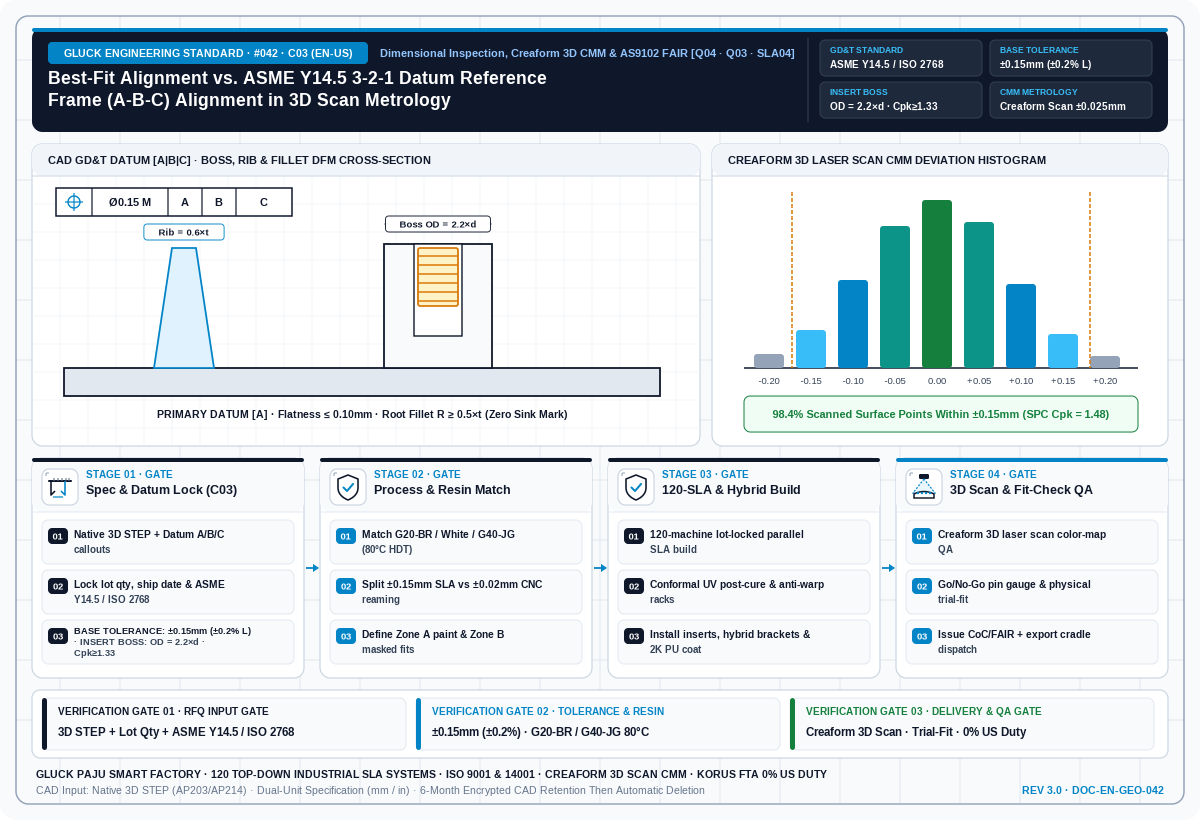
Every production order follows the 4-stage engineering gate architecture illustrated in the schematic blueprint above (STAGE 01 through STAGE 04):
01. Spec & Datum Lock:
- Native 3D STEP + Datum A/B/C callouts
- Lock lot qty, ship date & Quality Management SOP
- Why Global Best-Fit Hides Assembly Misalignment—and How Datum A/B/C Locked Alignment Verifies Assembly Fit
02. Process & Resin Match:
- Review G20-BR / White / G40-JG (HDT 80°C @66psi test metric)
- Review datum tolerances & post-processing scope
- Define Zone A paint & Zone B masked fits
03. 48-SLA & Hybrid Build:
- 48-machine lot-locked parallel SLA build
- Conformal UV post-cure & anti-warp racks
- Install inserts, hybrid brackets & 2K PU coat
04. 3D Scan & Fit-Check QA:
- Optional Creaform 3D laser scan color-map QA (paid FAI/sampling option)
- Go/No-Go pin gauge & physical trial-fit
- Optional CoC/scan report (upon quote agreement) + export cradle dispatch
4. Lot-Size Break-Even (1 to 5,000 Units) & US/Global Landed-Cost Simulation
Using the risk-adjusted Total Cost of Ownership model Total Cost of Ownership (TCO) = NRE_tooling + N × c_unit + P_ECO × C_rework, hardware teams achieve the following economic benchmarks:
- 1 to 10 Units (EVT / DVT Functional Prototypes & Design Bucks):
- Avoids 85% billet-hogging material scrap and multi-setup 5-axis CNC programming. Complete multi-part product kits are nested onto a single build platform and scheduled based on part geometry and post-processing requirements.
- 50 to 300 Units (Pilot Builds & Early Commercial Bridge Production):
- Because silicone vacuum-casting molds degrade after 15–20 polyurethane shots, a 200-unit order requires pouring 10 to 12 sequential molds. GLUCK instead allocates 20–30 industrial SLA machines in parallel, coordinating parallel SLA batch production and custom finishing schedules while comparing total project cost against multi-mold casting.
- 300 to 5,000 Units (Volume Bridge Runs & Multi-SKU Digital Inventory):
- Milestone Split Shipments: Initial milestone shipment quantities and subsequent split delivery schedules can be coordinated to align with your assembly timeline.
- US Customs & Landed-Cost Advantage: Manufactured 100% in South Korea, GLUCK parts qualify for streamlined customs documentation under the global export workflow (
engineering polymer HS tariff classification verified prior to export/customs-broker-verified part-specific HS classification), avoiding the 25%+ cross-border tariff and supply-chain risks applied to Chinese manufacturing allowing procurement teams to compare total landed cost (including international air freight and customs documentation) against domestic service bureaus.
5. Pre-RFQ Engineering Readiness Checklist
Pre-RFQ Engineering Readiness Checklist
- [ ] Native 3D CAD Geometry: Have you attached native
STEP (.stp)files (or high-densitySTLmeshes with chord height≤ 0.01 mm / 0.0004 in)? - [ ] Functional Datum & Fit Zoning: Are primary mounting planes (
Datum A/B/C) and tight bearing/dowel bores (H7 ream / insert reviewvs.datum fit consultation) clearly called out? - [ ] Cosmetic Zone A/B/C & Color Spec: Have you separated customer-facing painted surfaces (
Zone A), masked mating/grounding faces (Zone B), and internal surfaces (Zone C) with targetPantone/RALand60° Gloss Units (GU)? - [ ] Thermal & Fastener Load Specs: Did you specify operating temperature (
Standard ≤55°Cvs.G40-JG (HDT 80°C @66psi test metric; verify actual operating temp/load)) and threaded insert standards (Metric M3–M6orImperial UNC #4-40 to 1/4-20)?
Cluster Engineering Reference Table: Dimensional Tolerance Tiers & 3D Scan Metrology Protocol
| Tolerance Grade | Typical Functional Features | Manufacturing & Post-Processing Route | Inspection & Verification Method |
|---|---|---|---|
| Grade A (Critical Fit / Alignment) | Bearing seats, dowel bores, primary datum pads | Near-net SLA print + secondary reaming/tapping or brass inserts by consultation | Pin gauges, calibrated calipers & mating part trial-fit |
| Grade B (General Enclosure Fit) | Clamshell step-lips, PCB boss pitch, connector cutouts | Optimized build angle + post-cure anti-warp fixture | Creaform 3D laser scan color-map comparison (upon request) |
| Grade C (Freeform Cosmetic Skins) | Exterior aerodynamic shrouds, louvers, sculptural curves | Support-free A-surface orientation + multi-grit sanding & primer | Visual inspection against approved limit sample |
Illustrative Engineering Review Scenario & Pre-Production Check Protocol
To prevent fixture seating issues on a 780 mm curved housing assembly across a 50-unit batch, GLUCK integrated Creaform 3D laser scan color-map inspection during first-article qualification. Three pre-production units were scanned and aligned to the master STEP CAD via 3-2-1 datum registration; minor wing-tip shrinkage trends were compensated in the build file prior to releasing a 50-unit production lot.
- Optical 3D Scan Color-Map Verification: Uses Creaform 3D laser scanners to evaluate full-field surface deviation and critical mounting hole position relative to functional A-B-C datums
- Free-State vs. Fixtured Inspection Alignment: Distinguishes unconstrained thin-wall flex from bolted assembly fit using agreed inspection fixtures and Go/No-Go pin gauges
- Scoped Metrology Deliverables: Offers first-article (FAI) or lot-sampling 3D scan deviation reports as a pre-arranged engineering option to balance quality assurance and cost
Note: The quantities, dimensions, and process combinations in this section are illustrative engineering review scenarios for DFM planning and do not represent specific client delivery records or unconditional guarantees. Based on GLUCK's 48-machine Paju SLA smart factory (standard online quote bed 600×600×400 mm; large-format single-piece bed up to 1,000×800×600 mm via engineering review). Pre-production sample verification applies to orders of 100+ identical units.
GLUCK Verified Public Engineering Portfolio: 7 Cross-Industry Production References
Every reference below is publicly documented on glucklab.com and gluckblog.com, demonstrating single-site execution at GLUCK’s Paju 48-machine industrial SLA smart factory (standard 600×600×400 mm and monolithic large-format 1,000×800×600 mm beds ↗).
| Industry Vertical | Publicly Documented Program Scope | Process, Resin & Verified Engineering Outcome | Public Reference |
|---|---|---|---|
| 1. Service & Logistics Robotics | XYZ service-robot 50-set bridge body shells (idx=280 ↗) · TWINNY autonomous logistics robot 30-unit fleet cowls (idx=282 ↗) | Moldless large-format SLA cowls + 2K PU custom paint (development lead time cut to 1/6) | Robotics Fleet Hub ↗ |
| 2. Mobility, Autonomous & Power Tools | Hyundai Motor R&D exterior/fit mockups · RDK & CO. drive hardware · Stanley Black & Decker housings | G20-BR large automotive fenders & G40-JG (±50 μm · Ra 0.8 · HDT 80°C summary metric) validation | G40-JG Mobility Case ↗ |
| 3. Aerospace, UAV & Wind Tunnel | Commercial UAV 5-aircraft full enclosure sets in 20 days (idx=281 ↗) & subsonic wind-tunnel aerodynamic models | Thin-wall X-rib airframe pods + optional Creaform 3D laser scan colormap QA | UAV & Wind-Tunnel Hub ↗ |
| 4. Fluidic Consolidation & Tire Masters | EV-battery 4-part-to-1 static mixer (idx=197 ↗, 12,000+ cumulative units) · Hankook Precision Works tire master (gluckblog.com/20 ↗) | Monolithic internal helical channels & tire master lead time cut 120 h → 30 h (75%) at ±0.06 mm | 3-Route Selection Hub ↗ |
| 5. Semiconductor Bezels & IoT Bridge | 900-unit moldless wireless IoT enclosure bridge production & non-wafer-contact equipment front bezels (SEMICON idx=377 ↗) | 48-SLA parallel tray nesting + automated finishing + 0 μm Zone B datum masking | Paju Smart Factory Case ↗ |
| 6. Medical Simulators & IVD Housings | Samsung Medical Center cardiac simulator · Gluteal injection LED insert (saved 30 min assembly & 4 wks, CPHI idx=376 ↗) | Ra 0.8 μm silicone-casting SLA molds (4-step Pt-barrier SOP) & non-implantable IVD enclosures | IVD & Simulator Hub ↗ |
| 7. Diagnostic Optics & Clear SLA | Opticho photoacoustic medical diagnostic hardware (~20 field systems, idx=283 ↗) · Dual-finish Clear SLA (idx=192) | Multi-revision optical/enclosure loop & wet-polished + UV-clearcoated Clear SLA | Opticho Iteration Case ↗ |
Frequently Asked Engineering & Procurement Questions (FAQ)
When comparing Best-Fit Alignment vs. ASME Y14.5 3-2-1 Datum Reference Frame, what criteria determine the optimal SLA manufacturing route?
For Best-Fit Alignment vs. ASME Y14.5 3-2-1 Datum Reference Frame (A-B-C) Alignment in 3D Scan Metrology, GLUCK’s engineering workflow focuses on Why Global Best-Fit Hides Assembly Misalignment—and How Datum A/B/C Locked Alignment Verifies Assembly Fit (Quality Management SOP). Specifically, we enforce 01. Spec & Datum Lock: Native 3D STEP + Datum A/B/C callouts; Lock lot qty, ship date & Quality Management SOP, aligning build orientation, wall thickness, and post-processing allowances with your 3D STEP datums (Datum A/B/C) while masking functional Zone B mating surfaces against 60–120 μm multi-coat (40–60 μm per coat) paint buildup. Critical bearing seats, dowel bores, and threaded inserts are verified via First Article (1–5 units) trial fitting and optional paid Creaform 3D laser scan color-map inspection prior to volume release.
What dimensional reference ranges, Zone B datum masking, and optional Creaform 3D optical scan QA checks apply before shipment?
For Best-Fit Alignment vs. ASME Y14.5 3-2-1 Datum Reference Frame (A-B-C) Alignment in 3D Scan Metrology, GLUCK’s engineering workflow focuses on Why Global Best-Fit Hides Assembly Misalignment—and How Datum A/B/C Locked Alignment Verifies Assembly Fit (Quality Management SOP). Specifically, we enforce 01. Spec & Datum Lock: Native 3D STEP + Datum A/B/C callouts; Lock lot qty, ship date & Quality Management SOP, aligning build orientation, wall thickness, and post-processing allowances with your 3D STEP datums (Datum A/B/C) while masking functional Zone B mating surfaces against 60–120 μm multi-coat (40–60 μm per coat) paint buildup. Critical bearing seats, dowel bores, and threaded inserts are verified via First Article (1–5 units) trial fitting and optional paid Creaform 3D laser scan color-map inspection prior to volume release.
How does GLUCK maintain part-to-part consistency across 100 to 5,000 unit bridge production runs?
When scaling Best-Fit Alignment vs. ASME Y14.5 3-2-1 Datum Reference Frame (A-B-C) Alignment in 3D Scan Metrology across 100 to 5,000 bridge units, decentralized broker networks split batches across unrelated job shops, causing resin shade and shrinkage drift. GLUCK runs all 48 industrial SLA machines inside a single Paju smart factory using lot-locked resin vats, daily laser calibration coupons, and a signed-off Golden Sample gate (as demonstrated in Automotive Mobility Module Tier-1 · 50 Units of 780 mm Instrument Housings with 3D Scan Audit) to ensure uniform dimensional and cosmetic repeatability.
How is our proprietary 3D CAD IP protected, and how fast does GLUCK ship to the United States and Europe?
GLUCK manages industrial SLA printing (48 systems), wet sanding, primer/urethane painting, and Creaform 3D laser scanning at its Paju smart factory, coordinating any specialized secondary machining by pre-order consultation. We execute pre-RFQ Mutual NDAs, enforce 6-month retention, then automatic deletion (or immediate purging upon NDA request / encrypted Golden-Recipe vaulting for repeat SKUs), and coordinate international export shipping via DHL/FedEx air freight with streamlined customs documentation under the global export workflow.