BUYER SHORTLIST HUB #17 · Autonomous Vehicle Roof Sensor Pods (LiDAR/Camera), Mobility Exterior Fairings & Automotive Lamp Prototype Hub
Autonomous Vehicle Roof LiDAR/Camera Sensor Pods (1,000 mm Monolithic & 1,000+ mm Keyed Split), 4-Zone Thermal Boundary & Dual-Finish Lamp Prototype SLA Standard
Grounded in RDK & CO.'s G40-JG mobility exterior parts & GLUCK's SLA automotive fender work (gluckblog.com/102), Hyundai Motor R&D mockups, and dual-finish Clear lens + painted housing prototypes (idx=192): autonomous fleet roof pods and lamp R&D hardware.
Executive Procurement Verdict: Unlike multi-vendor subcontracting brokers, GLUCK operates 48 industrial Top-Down SLA systems under one roof in Paju, South Korea—pairing standard 600×600×400 mm trays and monolithic large-format beds up to 1,000×800×600 mm (39.4×31.5×23.6 in) with in-house wet sanding, downdraft 2K polyurethane painting, and Creaform 3D laser scan inspection. (Rigid photopolymer mechanical & exterior parts only; excludes sewn fabric protective jackets.)
- 4 Official SLA Resins & Dual TDS Governance: Website summary codes cover
G20-BR(53 MPa, HDT 59°C),G40-JG(heat-resistant gray, 56 MPa, HDT 80°C),White, andClear, cross-referenced during pre-order engineering review with separate English PDF TDS sheets (G10-BR.pdf,G10-WH.pdf,G40-GW.pdf,G40-JG.pdf80–93°C @66psi screening metric). - Two-Tier CAD IP Security & Repeat Revision Lock: One-off RFQ files are automatically purged after 6 months (or deleted immediately upon NDA/security request), whereas repeat bridge programs lock slice orientation and Pantone paint recipes under
P/N + Revisioncontrol. - 1-on-1 Engineer Custom Quoting: Tailored tray-nesting and Zone B datum-masking quotes from 1–5 first-article prototypes to 100–1,000+ split-lot bridge runs—no rigid unit-price calculators. (Submit 3D STEP for Engineer Review ↗)
Mobility & Regulatory Scope Boundary: HUB #17 governs R&D/pilot autonomous test-fleet roof sensor fairings (5–100 vehicles), sensor shrouds, custom e-mobility exterior parts, and OEM styling/fit-check lamp prototypes. Crash-critical primary vehicle structures, road-homologated production lamp lenses, and above 120°C engine-exhaust components are excluded; G40-JG's HDT 80°C (80–93°C @66psi in English TDS PDF) is a standard test metric requiring 1st-vehicle summer thermal verification.
When building 5–100 autonomous test-fleet roof LiDAR/camera pods or automotive lamp design/fit prototypes, how should mobility engineers choose between 1,000 mm monolithic printing, optimal-angle multi-part Step-Lip bonding, and honest G20-BR vs. G40-JG thermal boundaries?
- 1,000 mm Bed & Optimal-Angle Split Strategy (idx=351, idx=355): Supports monolithic builds up to 1,000×800×600 mm (5–7 day print lead time), while shallow Class-A 1 m automotive contours and 1,450–1,850 mm full-width roof bridges follow GLUCK's official 2–3 part optimal-angle splitting rule (idx=351) joined via keyed Step-Lip seams (0.15–0.25 mm structural epoxy gap) plus internal AL6061 backing straps.
- Honest 4-Zone Thermal Boundary & Mobility Proof (gluckblog.com/102): Separates Zone 1 cabin trim (≤50°C, G20-BR), Zone 2 solar-loaded roof pods & warm electronics (55–75°C, G40-JG HDT 80°C summary metric—proven on RDK & CO. ±50 μm / Ra 0.8 mobility parts & GLUCK's SLA automotive fender—finished in light-color UV 2K PU), Zone 3 heatsink proximity (80–110°C, ≥5–10 mm air-gap/shield), and Zone 4 above 120°C mandatory metal transition.
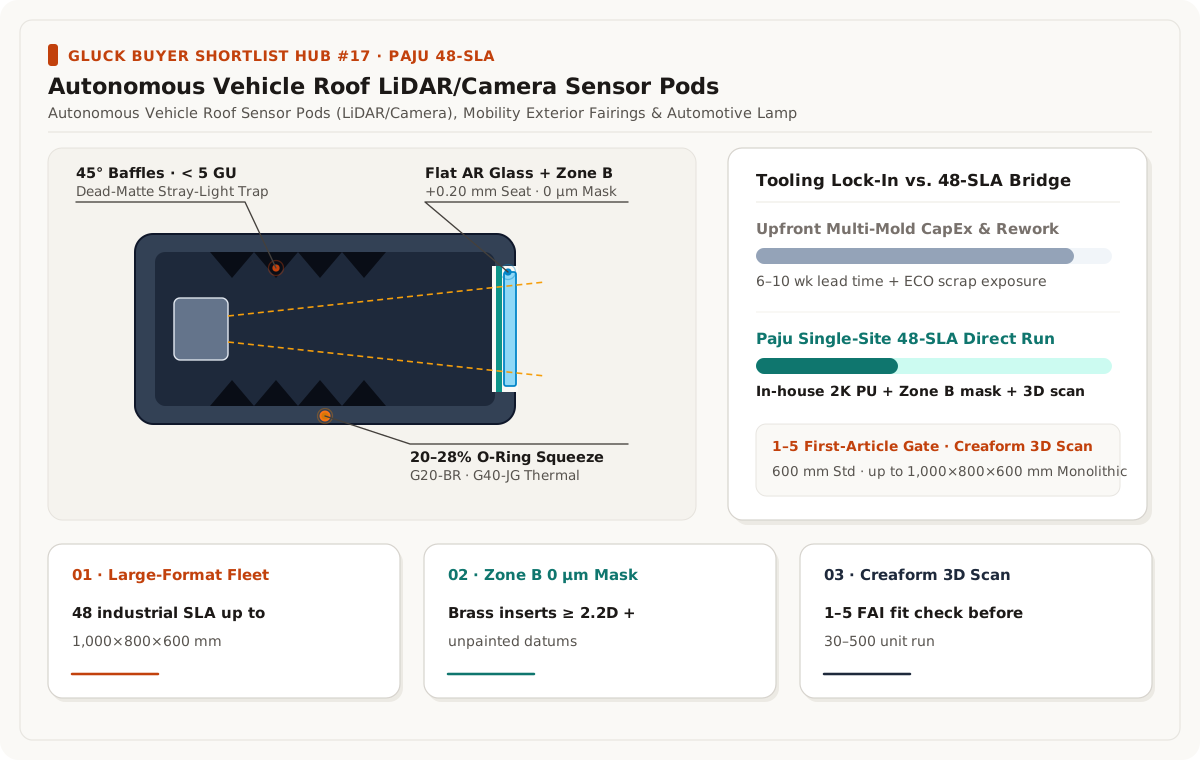
- Distortion-Free Flat LiDAR Window Seats: Prevents curved-polymer beam refraction on active 850–1550 nm LiDARs by molding a 0 μm Zone B masked step-lip pocket (+0.25 mm clearance) and EPDM O-ring gland in G40-JG to seat flat AR-coated glass or IR-PC windows.
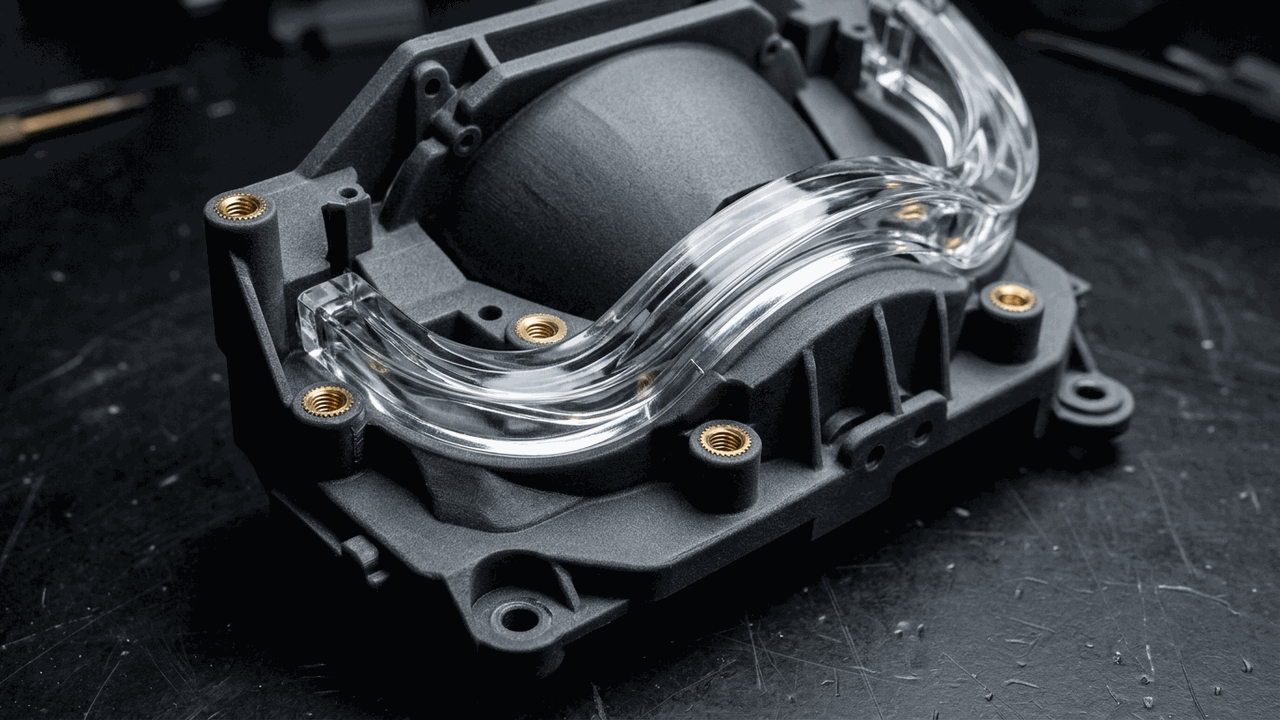
- Dual-Finish Automotive Lamp Prototypes (idx=192): Combines wet-polished + UV-clearcoated Clear SLA (G20_Tr) lens/lightguide mockups with matte-painted G10_Br/G20-BR housings per GLUCK's verified dual-finish assembly workflow.
Autonomous Roof Sensor Pod, Split Aero Fairing & Lamp Prototype 4-Zone Matrix
| Mobility Subsystem | Structural, Split-Bonding & Optical Geometry | Matched GLUCK Resin & Exterior Finish | Thermal & Vibration QA Gate |
|---|---|---|---|
| Monolithic Roof Sensor Aero Pods (≤ 1,000 mm) | t = 3.0–3.8 mm + 0.55t aero ribs + roof-rack brass inserts with metal compression limiters + EPDM isolation bushings | G40-JG (HDT 80°C summary) + solar-reflective white/silver UV-stabilized 2K PU | Evaluate 2–3 part optimal-angle split on shallow 1 m Class-A roofs (idx=351) + 1st-car fit |
| Full-Width Roof Bridges & Fender/Bumper Fairings (1,450–1,850 mm) | Keyed Step-Lip/Dovetail (12–15 mm overlap, 0.15–0.25 mm structural epoxy gap) + internal AL6061 backing strap (idx=355) | G40-JG or tough G20-BR + primer surfacer & automated 2K PU booth finish | Creaform 3D laser-scan LH/RH symmetry & roof-rail contour deviation colormap |
| LiDAR/Camera Bezels & Weather-Sealed Service Hatches | EPDM O-ring gland (20–25% squeeze) + bottom condensation weep notch + 0 μm Zone B masked flat AR-glass seat | G40-JG + sub-5 GU dead-matte black camera/LiDAR glare hood interior | Verify ≥ ±0.15 mm assembly clearance (idx=393) & sensor FOV keep-out cone |
| Automotive Headlamp & Taillamp Dual-Finish Mockups | Lens/lightguide ≥ 2.5–4.0 mm + +0.20 mm bezel fit gap + ≥ 5–10 mm air gap from active LED heatsinks | Clear SLA (G20_Tr wet-polished + UV coat) lenses + matte-painted G20-BR housing (idx=192) | Strictly scoped to OEM styling/fit-check mockups (non-road-homologated) |
1. 5–100 Vehicle Autonomous Fleets: 1,000 mm Monolithic Beds, Optimal-Angle Splitting (idx=351) & AL-Backed Roof Bridges
Robotaxi, autonomous shuttle, and specialty-vehicle roof pods evolve rapidly with each LiDAR, camera, and radar generation. Backed by Hyundai Motor R&D mockups, RDK & CO.'s G40-JG e-mobility exterior parts (±50 μm precision, Ra 0.8 finish) and GLUCK's SLA automotive fender reference (gluckblog.com/102), direct industrial SLA finished in automotive 2K polyurethane lets 5–100 vehicle programs deploy aerodynamic housings without hard-tooling lock-in.
While GLUCK's 1 m SLA fleet prints up to 1,000×800×600 mm monolithically, shallow 1 m Class-A roof crowns often achieve cleaner surface quality when split into 2–3 optimal-angle segments (~350 mm height tiers per official guide idx=351) to minimize stair-stepping and support scars. For 1,450–1,850 mm full-width roof bridges, combine interlocking Step-Lip joints (0.15–0.25 mm structural epoxy gap, idx=355) with an internal bolted AL6061 backing strap and compression-limited roof-rack mounts so highway wind loads bypass the adhesive seam.
2. Managing Summer Solar Soak (4-Zone Thermal Boundary) & Dual-Finish Automotive Lamp Mockups (idx=192)
Dark exterior roof shells parked under summer sun can reach 75–85°C skin temperatures—exceeding standard G20-BR (HDT 59°C). Specify thermal-review G40-JG (website summary HDT 80°C · English PDF 80–93°C @66psi test metric, idx=392), pair with solar-reflective white/silver UV-stabilized 2K polyurethane, and maintain a ≥ 5–10 mm ventilated air gap or thermal isolator pad around 80–110°C LiDAR/compute heatsinks (transitioning above 120°C exhaust zones to metal).
For pre-tooling automotive headlamp, taillamp, and DRL styling/fit-check prototypes, GLUCK's dual-finish workflow (idx=192) pairs wet-polished, UV-clearcoated Clear SLA (G20_Tr) lenses and lightguides with matte-painted G10_Br/G20-BR housings and masked mounting tabs.
3. 1-Minute Copy-Paste Autonomous Roof Pod & Mobility Exterior RFQ Checklist
Submit with your 3D STEP package: (1) overall envelope dimensions and internal AL roof-rack/strap mounting interfaces, (2) pilot vehicle count + fleet rollout schedule (1st-article roof fit test mandatory before batch release), (3) internal sensor heatsink temperatures and clearance gaps, and (4) UV 2K PU color/gloss plus Zone B masked flat LiDAR glass seating drawings.
Frequently Asked Engineering & Procurement Questions (FAQ)
Q1. How are 1,500 mm full-width autonomous roof sensor bars fabricated?
Single parts build up to 1,000×800×600 mm; wider 1,450–1,850 mm roof bridges split along natural styling seams using keyed Step-Lip joints (0.15–0.25 mm structural epoxy gap, idx=355) reinforced internally by a continuous bolted AL6061 backing strap.
Q2. Can G40-JG (HDT 80°C) be placed directly inside above 120°C engine bays or unventilated black roof pods?
No. Per official guide idx=392, G40-JG's HDT 80°C (80–93°C @66psi) is a standard screening metric, not a continuous-duty guarantee. Use light-colored UV 2K PU plus ≥5–10 mm air gaps around warm sensor heatsinks (validated on a 1st-vehicle pilot), and transition above 120°C exhaust/engine zones to metal.
Q3. Are Clear SLA automotive lamp lenses road-homologated production components?
No. Dual-finish Clear SLA lenses + painted housings (idx=192) are built strictly for design reviews, optical styling concepts, show cars, and body-in-white fit checks prior to hard tooling.
Q4. Why seat flat AR-glass/IR-PC inserts inside SLA LiDAR pods instead of printing curved Clear SLA laser windows?
Curved photopolymer windows can introduce laser refraction drift and wiper abrasion; molding a 0 μm Zone B masked step-lip seat and EPDM O-ring groove in rigid G40-JG for a flat optical window preserves LiDAR range accuracy.
Illustrative Engineering Review Scenario & Pre-Production Check Protocol
To prevent fixture seating issues on a 780 mm curved housing assembly across a 50-unit batch, GLUCK integrated Creaform 3D laser scan color-map inspection during first-article qualification. Three pre-production units were scanned and aligned to the master STEP CAD via 3-2-1 datum registration; minor wing-tip shrinkage trends were compensated in the build file prior to releasing a 50-unit production lot.
- Optical 3D Scan Color-Map Verification: Uses Creaform 3D laser scanners to evaluate full-field surface deviation and critical mounting hole position relative to functional A-B-C datums
- Free-State vs. Fixtured Inspection Alignment: Distinguishes unconstrained thin-wall flex from bolted assembly fit using agreed inspection fixtures and Go/No-Go pin gauges
- Scoped Metrology Deliverables: Offers first-article (FAI) or lot-sampling 3D scan deviation reports as a pre-arranged engineering option to balance quality assurance and cost
Note: The quantities, dimensions, and process combinations in this section are illustrative engineering review scenarios for DFM planning and do not represent specific client delivery records or unconditional guarantees. Based on GLUCK's 48-machine Paju SLA smart factory (standard online quote bed 600×600×400 mm; large-format single-piece bed up to 1,000×800×600 mm via engineering review). Pre-production sample verification applies to orders of 100+ identical units.
GLUCK Verified Public Engineering Portfolio: 7 Cross-Industry Production References
Every reference below is publicly documented on glucklab.com and gluckblog.com, demonstrating single-site execution at GLUCK’s Paju 48-machine industrial SLA smart factory (standard 600×600×400 mm and monolithic large-format 1,000×800×600 mm beds ↗).
| Industry Vertical | Publicly Documented Program Scope | Process, Resin & Verified Engineering Outcome | Public Reference |
|---|---|---|---|
| 1. Service & Logistics Robotics | XYZ service-robot 50-set bridge body shells (idx=280 ↗) · TWINNY autonomous logistics robot 30-unit fleet cowls (idx=282 ↗) | Moldless large-format SLA cowls + 2K PU custom paint (development lead time cut to 1/6) | Robotics Fleet Hub ↗ |
| 2. Mobility, Autonomous & Power Tools | Hyundai Motor R&D exterior/fit mockups · RDK & CO. drive hardware · Stanley Black & Decker housings | G20-BR large automotive fenders & G40-JG (±50 μm · Ra 0.8 · HDT 80°C summary metric) validation | G40-JG Mobility Case ↗ |
| 3. Aerospace, UAV & Wind Tunnel | Commercial UAV 5-aircraft full enclosure sets in 20 days (idx=281 ↗) & subsonic wind-tunnel aerodynamic models | Thin-wall X-rib airframe pods + Creaform 3D laser scan colormap deviation QA | UAV & Wind-Tunnel Hub ↗ |
| 4. Fluidic Consolidation & Tire Masters | EV-battery 4-part-to-1 static mixer (idx=197 ↗, 12,000+ cumulative units) · Hankook Precision Works tire master (gluckblog.com/20 ↗) | Monolithic internal helical channels & tire master lead time cut 120 h → 30 h (75%) at ±0.06 mm | 3-Route Selection Hub ↗ |
| 5. Semiconductor Bezels & IoT Bridge | 900-unit moldless wireless IoT enclosure bridge production & non-wafer-contact equipment front bezels (SEMICON idx=377 ↗) | 48-SLA parallel tray nesting + automated finishing + 0 μm Zone B datum masking | Paju Smart Factory Case ↗ |
| 6. Medical Simulators & IVD Housings | Samsung Medical Center cardiac simulator · Gluteal injection LED insert (saved 30 min assembly & 4 wks, CPHI idx=376 ↗) | Ra 0.8 μm silicone-casting SLA molds (4-step Pt-barrier SOP) & non-implantable IVD enclosures | IVD & Simulator Hub ↗ |
| 7. Diagnostic Optics & Clear SLA | Opticho photoacoustic medical diagnostic hardware (~20 field systems, idx=283 ↗) · Dual-finish Clear SLA (idx=192) | Multi-revision optical/enclosure loop & wet-polished + UV-clearcoated Clear SLA | Opticho Iteration Case ↗ |