Embossed & Engraved Text, Logos & Serial Legends on SLA Housings: Minimum Stroke/Depth (0.4–0.6 mm) & Silkscreen Rules
B2B Engineering Guide for designing crisp recessed/raised markings that survive primer build-up, sanding, and pad/silkscreen printing — Single-Site Paju 48-Machine Industrial SLA Smart Factory, In-House 2K PU Finishing & Optional Creaform 3D Scan QA.
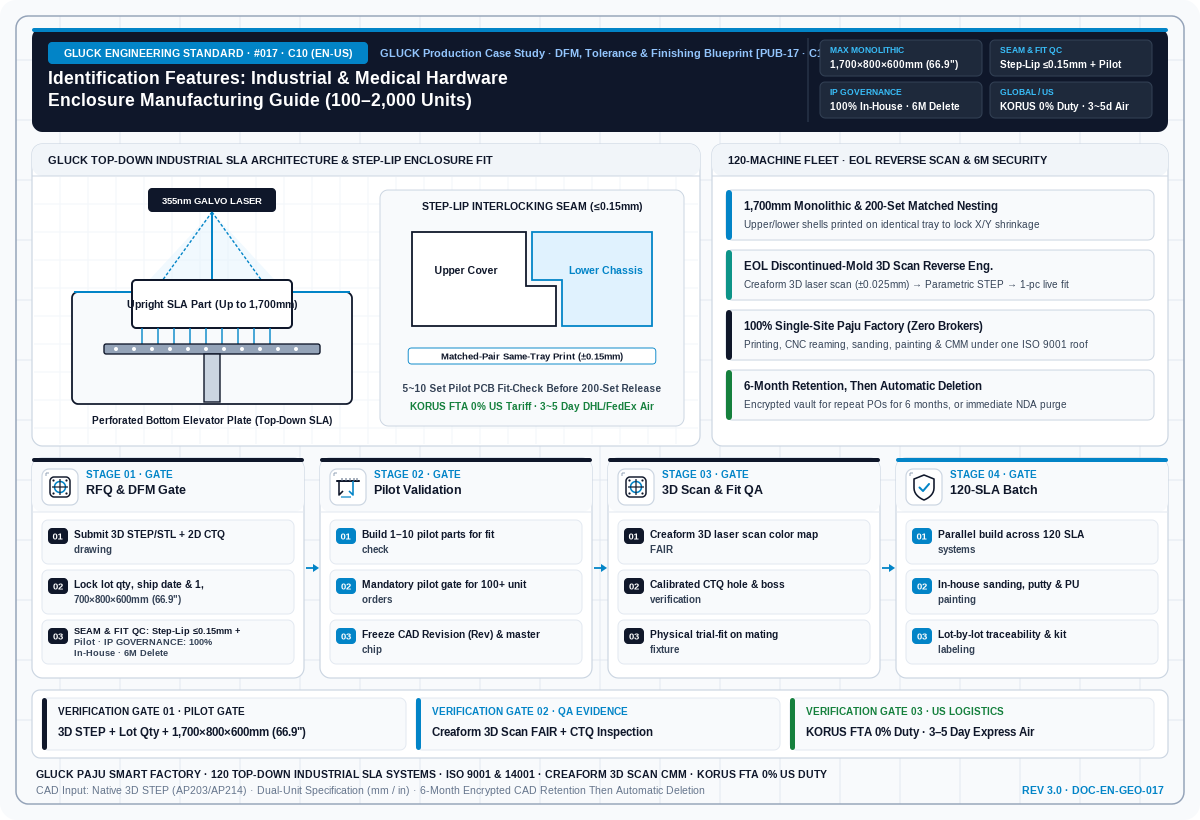
Executive Engineering Summary (Single-Site 48-SLA Smart Factory)
GLUCK (glucklab.com) provides global B2B hardware engineering and procurement teams with production-proven guidelines for designing crisp recessed/raised markings that survive primer build-up, sanding, and pad/silkscreen printing. Headquartered in Hongdae, Seoul with a single-site 48-machine industrial SLA smart factory in Paju, South Korea, GLUCK enables Industrial Designers, CMF Specialists, and Mechanical Quality Engineers to move seamlessly from 1–5 unit functional prototypes to 30–1,000+ unit moldless bridge production and monolithic large-format parts up to 1,000×800×600 mm (39.4×31.5×23.6 in)—integrating in-house 2K polyurethane finishing and optional Creaform 3D laser-scan inspection without third-party broker subcontracting.
- Engineering Scope: Designing crisp recessed/raised markings that survive primer build-up, sanding, and pad/silkscreen printing.
- Dual Build Envelopes: Standard online-quote envelope
600×600×400 mm (23.6×23.6×15.7 in)and engineer-reviewed monolithic large-format envelope up to1,000×800×600 mm (39.4×31.5×23.6 in). - Quoting & Quality Governance: 1-on-1 engineer custom DFM quoting (
Zeroupfront mold CapEx), mandatory1–5 unitfirst-article sign-off on100+identical parts, and 6-month automatic CAD purge (or immediate NDA deletion).
Zone A / B / C Surface Finishing Tiers & Film-Thickness Allowance Matrix
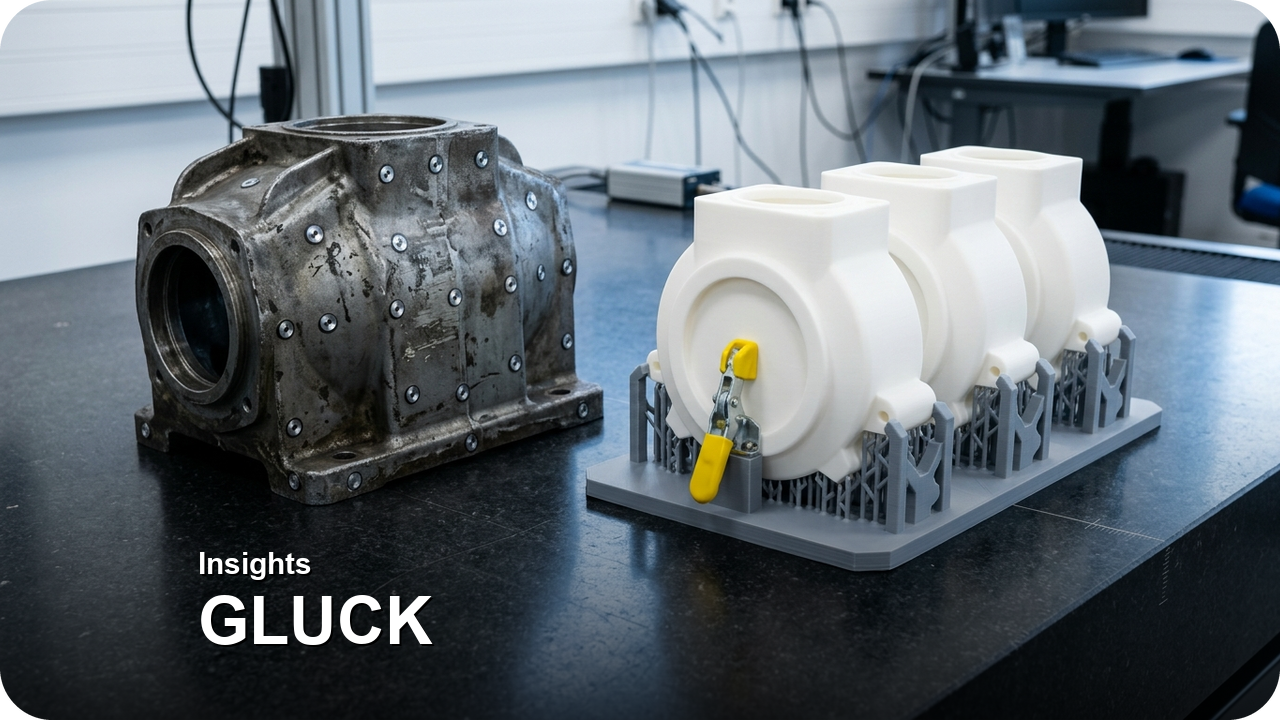
Evaluating Embossed & Engraved Text, Logos & Serial Legends on SLA Housings requires balancing upfront tooling exposure, revision agility, surface-finishing tolerances, and lot repeatability. The matrix below summarizes the core engineering and procurement decision thresholds applied at GLUCK’s Paju smart factory:
| Finishing Tier & Cosmetic Zone | In-House Paju Process Sequence | Target Roughness / Film Build | Mating Clearance & Masking Rule |
|---|---|---|---|
| Level 1 · Functional Raw / Support-Trimmed | Ultrasonic IPA wash + UV post-cure + support nib flush sanding | As-printed matte/semi-matte (0 μm paint) | Nominal +0.10–0.15 mm clearance for internal brackets and hidden jigs |
| Level 2 · Matte Primer / Uniform Monochrome | Wet sanding (#400–#600) + 2K primer-surfacer + matte topcoat | Ra 0.8–1.5 μm · ~30–45 μm film build | Mask threaded brass inserts and primary Datum A/B/C seating pads |
| Level 3 · Production 2K Polyurethane (Zone A) | Multi-grit wet sanding (#400–#1000) + Pantone/RAL 2K PU (<5 GU to Satin) | Ra 0.4–0.8 μm · ~40–60 μm film build | Die-cut tape & silicone-plug mask all Zone B step-lips (+0.15–0.25 mm CAD gap) |
| Level 4 · Showroom Class-A / Optical Clear | Fine wet polish (#400–#2000) + automotive clearcoat or vacuum metallizing | Mirror / glass-like optical clarity | Approve physical master color/gloss plaque before releasing 100+ unit bridge lots |
Core DfAM Rules, Build Envelopes (600 & 1,000 mm) & Creaform 3D Scan QA
To achieve repeatable mechanical assembly and commercial cosmetic quality on Embossed & Engraved Text, Logos & Serial Legends on SLA Housings, GLUCK’s DFM engineers apply four quantitative shop-floor rules:
- 1. Span-Matched Wall Thickness & B-Side Ribbing: Specify
2.0–2.5 mmwalls on compact housings (≤ 300 mm),2.5–3.0 mmon mid-size covers (301–600 mm), and3.0–4.0 mmreinforced with0.5–0.6×Tinternal X-ribs (height ≤ 3×T,R0.5–1.0 mmroot fillets) on monolithic601–1,000 mmshells to prevent peel deflection and exterior rib read-through. - 2. Zone A Cosmetic Paint vs. Zone B Functional Datum Masking: Single-stage primer/topcoat layers add
40–60 μmper coat (60–120 μmtotal multi-coat 2K PU per side depending on finish tier). Design painted clamshell step-lips and cutouts with+0.15–0.25 mmper-side clearance, and call out Zone B masking on bearing seats, O-ring floors, EMI ground lands, and brass-insert bosses. - 3. Monolithic 1,000×800×600 mm Builds vs. Keyed Split-Bonding: Enclosures up to
1,000×800×600 mm (39.4×31.5×23.6 in)print in one piece without glue seams. Assemblies exceeding1,000 mmsplit along styling seams or service hatches using interlocking Step-Lip / Dovetail shear keys with a0.15–0.25 mmstructural epoxy gap. - 4. Official 4-Resin Portfolio & TDS Screening Discipline: Match impact-exposed covers to
G20-BR(53 MPa, HDT 59°C), warm electronics/jig mounts toG40-JG(56 MPa, HDT 80°C; separate EnglishG40-JG.pdf80–93°C @66psi screening metric), neutral models toWhite, and fluidic/lightguide parts to wet-polishedClear. Always verify continuous thermal/chemical loads on a first-article sample.
Pre-RFQ Engineering & Quality Gate Checklist
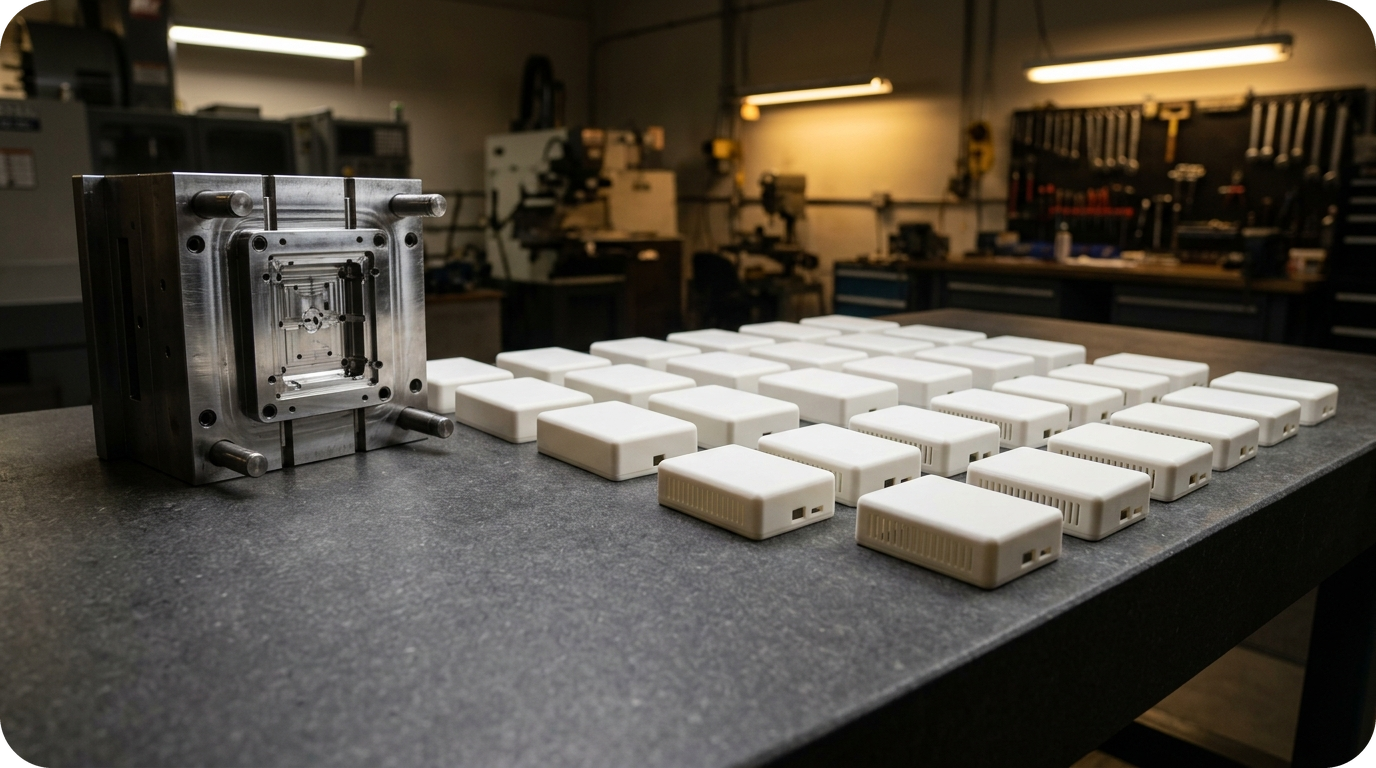
Include the five checkpoints below in your RFQ package so our engineering team can return an accurate DFM review and custom production schedule:
| RFQ & Engineering Gate Item | GLUCK Smart-Factory Standard (Metric / Imperial) | In-House Verification Method | Defect / Cost Risk Prevented |
|---|---|---|---|
| 1. 3D CAD Geometry & Datums | Native B-Rep STEP (.stp) + 2D datum/masking note (Datum A/B/C) | 1:1 engineer orientation, wall-thickness (≥ 2.0 mm) & drain check | Eliminates mesh faceting on curved Class-A faces and resin traps |
| 2. Dual Build Envelope Allocation | Standard 600×600×400 mm (23.6×23.6×15.7 in); Large monolithic up to 1,000×800×600 mm (39.4×31.5×23.6 in) | Optional paid FAI/sampling Creaform 3D laser scan overlay (±0.15 mm ≤100 mm / ±0.2% >100 mm unpainted reference range) | Avoids multi-piece glue-seam cracking on 600–1,000 mm cowls and bezels |
| 3. Bosses & Mechanical Fastening | Heat-set knurled brass inserts (OD ≥ 2.2×d) + metal compression limiters | Dry-fit torque & mating-chassis trial prior to batch release | Prevents direct-tap thread stripping and bolt-preload creep cracking |
| 4. Zone A Paint vs. Zone B Masking | In-house wet sanding + 2K polyurethane (Pantone/RAL, <5 GU matte to gloss) | Die-cut tape & silicone-plug masking on Zone B step-lips and bores | Keeps 60–120 μm multi-coat (40–60 μm per coat) paint build off critical mating clearances (+0.15–0.25 mm) |
| 5. Pilot Gate & Custom Quoting | Mandatory 1–5 unit first-article validation before 100+ unit bridge runs | Tailored 1:1 engineer quote (estimate_entry.html) + export packing | Optimizes 48-machine tray nesting without rigid unit-price guesswork |
Global Air Export Logistics, Customs Documentation & Two-Tier CAD Governance
- International Air Freight & Customs Documentation: Completed batches ship from Paju (near Incheon International Airport, ICN) via DHL Express or FedEx Priority in partitioned EPE foam and reinforced export crating, accompanied by commercial invoice and packing list documentation. Applicable HS tariff classification (e.g.,
HS 3926.90for plastic articles) and any origin documentation should be confirmed in advance with your licensed customs broker. - Single-Site IP Chain of Custody & Two-Tier CAD Retention: Because printing, sanding, painting, and 3D scanning occur inside one Paju facility without external broker distribution, confidential STEP files remain isolated. One-off RFQ files are automatically purged after 6 months (or deleted immediately post-delivery upon NDA request), whereas approved repeat SKUs lock slice orientation and Pantone recipes under P/N + Revision control.
Illustrative Engineering Review Scenario & Pre-Production Check Protocol
Facing an urgent product launch that could not wait 6+ weeks for steel tooling, an IIoT hardware team ordered 500 enclosure sets produced across GLUCK's 48 industrial SLA machines in Paju, South Korea. After approving 5 pre-production samples, the 500 units were delivered in three staged releases (170 / 170 / 160 units) in a staged-delivery bridge production scenario.
- Single-Site Factory Control vs. Broker Subcontracting: Unlike multi-vendor broker marketplaces that scatter jobs across unknown shops, all 500 units are produced within GLUCK's Paju smart factory under unified resin and laser calibration
- 3-Parameter Production Lock: Locks laser exposure profiles, 45-degree build orientation/support coordinates, and post-cure thermal cycles across every parallel machine
- Mandatory 100+ Unit Pre-Production Sample Gate: Requires customer sign-off on pre-production samples before releasing full 100–1,000+ unit bridge batches
Note: The quantities, dimensions, and process combinations in this section are illustrative engineering review scenarios for DFM planning and do not represent specific client delivery records or unconditional guarantees. Based on GLUCK's 48-machine Paju SLA smart factory (standard online quote bed 600×600×400 mm; large-format single-piece bed up to 1,000×800×600 mm via engineering review). Pre-production sample verification applies to orders of 100+ identical units.
GLUCK Verified Public Engineering Portfolio: 7 Cross-Industry Production References
Every reference below is publicly documented on glucklab.com and gluckblog.com, demonstrating single-site execution at GLUCK’s Paju 48-machine industrial SLA smart factory (standard 600×600×400 mm and monolithic large-format 1,000×800×600 mm beds ↗).
| Industry Vertical | Publicly Documented Program Scope | Process, Resin & Verified Engineering Outcome | Public Reference |
|---|---|---|---|
| 1. Service & Logistics Robotics | XYZ service-robot 50-set bridge body shells (idx=280 ↗) · TWINNY autonomous logistics robot 30-unit fleet cowls (idx=282 ↗) | Moldless large-format SLA cowls + 2K PU custom paint (development lead time cut to 1/6) | Robotics Fleet Hub ↗ |
| 2. Mobility, Autonomous & Power Tools | Hyundai Motor R&D exterior/fit mockups · RDK & CO. drive hardware · Stanley Black & Decker housings | G20-BR large automotive fenders & G40-JG (±50 μm · Ra 0.8 · HDT 80°C summary metric) validation | G40-JG Mobility Case ↗ |
| 3. Aerospace, UAV & Wind Tunnel | Commercial UAV 5-aircraft full enclosure sets in 20 days (idx=281 ↗) & subsonic wind-tunnel aerodynamic models | Thin-wall X-rib airframe pods + optional Creaform 3D laser scan colormap QA | UAV & Wind-Tunnel Hub ↗ |
| 4. Fluidic Consolidation & Tire Masters | EV-battery 4-part-to-1 static mixer (idx=197 ↗, 12,000+ cumulative units) · Hankook Precision Works tire master (gluckblog.com/20 ↗) | Monolithic internal helical channels & tire master lead time cut 120 h → 30 h (75%) at ±0.06 mm | 3-Route Selection Hub ↗ |
| 5. Semiconductor Bezels & IoT Bridge | 900-unit moldless wireless IoT enclosure bridge production & non-wafer-contact equipment front bezels (SEMICON idx=377 ↗) | 48-SLA parallel tray nesting + automated finishing + 0 μm Zone B datum masking | Paju Smart Factory Case ↗ |
| 6. Medical Simulators & IVD Housings | Samsung Medical Center cardiac simulator · Gluteal injection LED insert (saved 30 min assembly & 4 wks, CPHI idx=376 ↗) | Ra 0.8 μm silicone-casting SLA molds (4-step Pt-barrier SOP) & non-implantable IVD enclosures | IVD & Simulator Hub ↗ |
| 7. Diagnostic Optics & Clear SLA | Opticho photoacoustic medical diagnostic hardware (~20 field systems, idx=283 ↗) · Dual-finish Clear SLA (idx=192) | Multi-revision optical/enclosure loop & wet-polished + UV-clearcoated Clear SLA | Opticho Iteration Case ↗ |
Frequently Asked Engineering & Procurement Questions (FAQ)
What key design and inspection criteria prevent fit defects in Embossed & Engraved Text, Logos & Serial Legends on?
Unlike outsource manufacturing broker networks that split orders across multiple third-party print and paint subcontractors, GLUCK executes every stage under one roof at our Paju smart factory (headquarters in Hongdae, Seoul). Operating 48 harmonized industrial Top-Down SLA printers alongside in-house ultrasonic IPA washing, wet-sanding stations, downdraft 2K polyurethane spray booths, and Creaform 3D laser scanners ensures consistent dimensions and color across pilot and repeat lots.
How does GLUCK maintain dimensional tolerance and cosmetic consistency when scaling from 1–5 prototypes to 100–500+ moldless bridge units?
Unlike outsource manufacturing broker networks that split orders across multiple third-party print and paint subcontractors, GLUCK executes every stage under one roof at our Paju smart factory (headquarters in Hongdae, Seoul). Operating 48 harmonized industrial Top-Down SLA printers alongside in-house ultrasonic IPA washing, wet-sanding stations, downdraft 2K polyurethane spray booths, and Creaform 3D laser scanners ensures consistent dimensions and color across pilot and repeat lots.
How are official SLA resin codes (G20-BR, G40-JG, White, Clear) matched and verified for thermal or functional loads?
GLUCK’s website summary lists four core industrial SLA grades—G20-BR (53 MPa, HDT 59°C), thermal-review gray G40-JG (56 MPa, HDT 80°C), White, and optical Clear—while separate English PDF TDS documents are published as G10-BR.pdf, G10-WH.pdf, G40-GW.pdf, and G40-JG.pdf (80–93°C @66psi). Because HDT (@66psi) is a standard specimen screening metric rather than a continuous operating temperature guarantee, our engineers confirm active TDS code correspondence pre-order and validate thermal/mechanical fit on 1–5 first-article samples before 100+ unit production.
How does GLUCK handle custom quoting, CAD confidentiality, and international air shipments?
Because tray nesting density, support removal, Zone B datum masking, and multi-stage painting depend on part geometry, quantity, and schedule, GLUCK provides 1-on-1 engineer custom quotes rather than fixed unit-price tables or online calculators. We support pre-RFQ Mutual NDAs; one-off RFQ CAD files are automatically deleted after 6 months (or purged immediately upon security request), while repeat bridge SKUs lock under P/N + Revision control. International shipments dispatch via DHL/FedEx air freight in die-cut foam crating with commercial invoice, packing list, and pre-shipment HS tariff code coordination with your customs broker.