Biennales, Art Fairs and Touring Shows — Shipping, Storage and Remaking: A 3D Sculpture Guide Starting with Modular Works Designed for Shipping — Advantages over FRP, Editions, Finishing and Installation
Modular works designed for shipping made with 3D sculpture: advantages over frp and hand sculpting. Parts are sized to the crates, and alignment pins at joints let local teams assemble easily. Easy guidance for exhibition planners, gallerists and artists from GLUCK and Sculpia.
Series Guide: Biennales, Art Fairs and Touring Shows — Shipping, Storage and Remaking
A large single-piece work needs special freight and carries high breakage risk. That is why many artists gave up on modular works designed for shipping or simplified their forms. 3D sculpture offers a different answer to this old dilemma; here is how it looks from the angle of advantages over frp and hand sculpting.
Sculpture that thinks beyond opening night: modular works for shipping, identical touring remakes, art-fair booth staging, and digital archives for restoration
Can a large work be split to fit shipping crates for an overseas show?
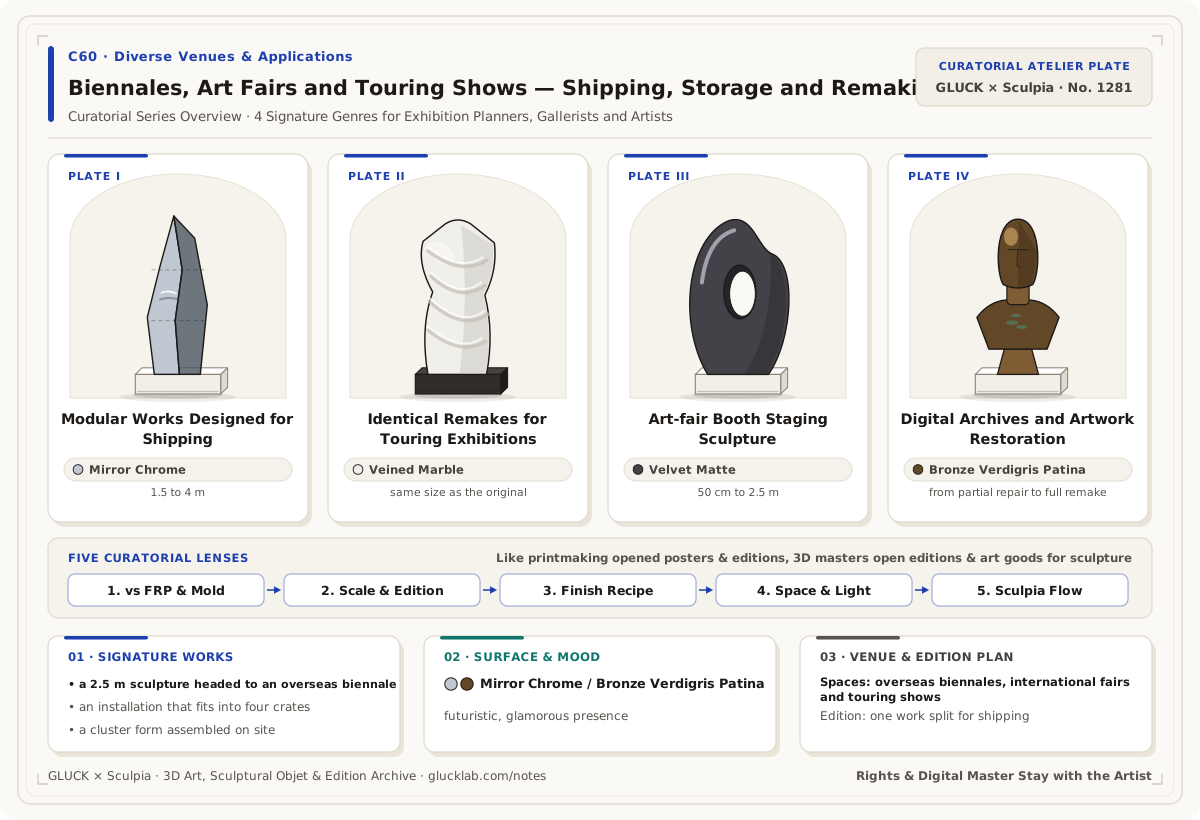
How This Four-Genre Series Fits Together
Sculpture that thinks beyond opening night: modular works for shipping, identical touring remakes, art-fair booth staging, and digital archives for restoration. Anchored in our Diverse Venues & Applications pillar for exhibition planners, gallerists and artists, this flagship guide connects all four sculptural genres in the Biennales, Art Fairs and Touring Shows — Shipping, Storage and Remaking series so you can compare form, scale, surface and edition strategy in one place.
| Genre in Series | Signature Work | Recommended Finishes | Scale & Venue |
|---|---|---|---|
| Modular Works Designed for Shipping | A 2.5 m sculpture headed to an overseas biennale | Mirror chrome / Bronze verdigris patina | 1.5 to 4 m · overseas biennales |
| Identical Remakes for Touring Exhibitions | The same work in exhibitions running in two cities at once | Veined marble / Airbrushed gradient | same size as the original · touring shows |
| Art-fair Booth Staging Sculpture | A signature sculpture at the booth's center | Velvet matte / Iridescent aurora pearl | 50 cm to 2.5 m · international fairs |
| Digital Archives and Artwork Restoration | Restoring missing parts of a broken sculpture | Bronze verdigris patina / Terracotta clay | from partial repair to full remake · museum conservation studios |
Scale, Surface and Edition Synthesis Across This Series
Across modular works designed for shipping (1.5 to 4 m) and identical remakes for touring exhibitions (same size as the original), a single verified digital master lets artists bridge intimate maquettes and architectural centerpieces without mold seams or fiberglass dust. Meanwhile, art-fair booth staging sculpture and digital archives and artwork restoration show how pairing velvet matte or bronze verdigris patina turns one sculptural language into collector editions such as "two identical touring sets" and "restoration parts with a digital record" through GLUCK and Sculpia.
FRP and Plaster Hand Work vs 3D Sculpture: What Differs — Modular Works Designed for Shipping
The biggest hidden cost of hand modeling and FRP is time: original, mold, laminating, demolding and cleanup each demand hands and waiting. With modular works designed for shipping in particular, a large single-piece work needs special freight and carries high breakage risk.
Making the form straight from a digital master removes the molding and demolding steps. Parts are sized to the crates, and alignment pins at joints let local teams assemble easily. The artist can spend the saved time on surface feel and finish choices.
In short, 3D sculpture brings four changes to modular works designed for shipping. You no longer have to simplify the form. Proportions stay true when the size changes. Remaking the same work becomes easy. And hollow construction keeps it light. In places like overseas biennales, international fairs and touring shows, those four translate directly into breathing room for schedules and installation.
The Master Recording Analogy for Modular Works Designed for Shipping
Just as studio master tapes let musicians share one performance across vinyl, touring shows and archives, a 3D digital master safeguards modular works designed for shipping permanently. Whenever an overseas show or collector commission calls for a 2.5 m sculpture headed to an overseas biennale, the form returns with zero drift in proportion.
Atelier Checklist: Practical Boundaries to Know
- When modular works designed for shipping scales up toward 3.1 m (beyond roughly 1 m in a single piece), we print clean sections over an internal stainless or steel frame and blend every seam under putty, sanding and mirror chrome.
- Finishes like mirror chrome and bronze verdigris patina are artisan surface coats rather than solid cast metal or quarried stone; if a 2.5 m sculpture headed to an overseas biennale requires true foundry bronze, the 3D print can instead serve as the casting master.
From Maquette to modular works designed for shipping Edition
From a single exhibition piece around 3.1 m to "one work split for shipping", GLUCK and Sculpia help exhibition planners, gallerists and artists move smoothly from test print to installation.
Global Art Fair & Biennale Air-Freight (ATA Carnet) Customs & 30-Minute Tool-Free Modular Assembly Matrix
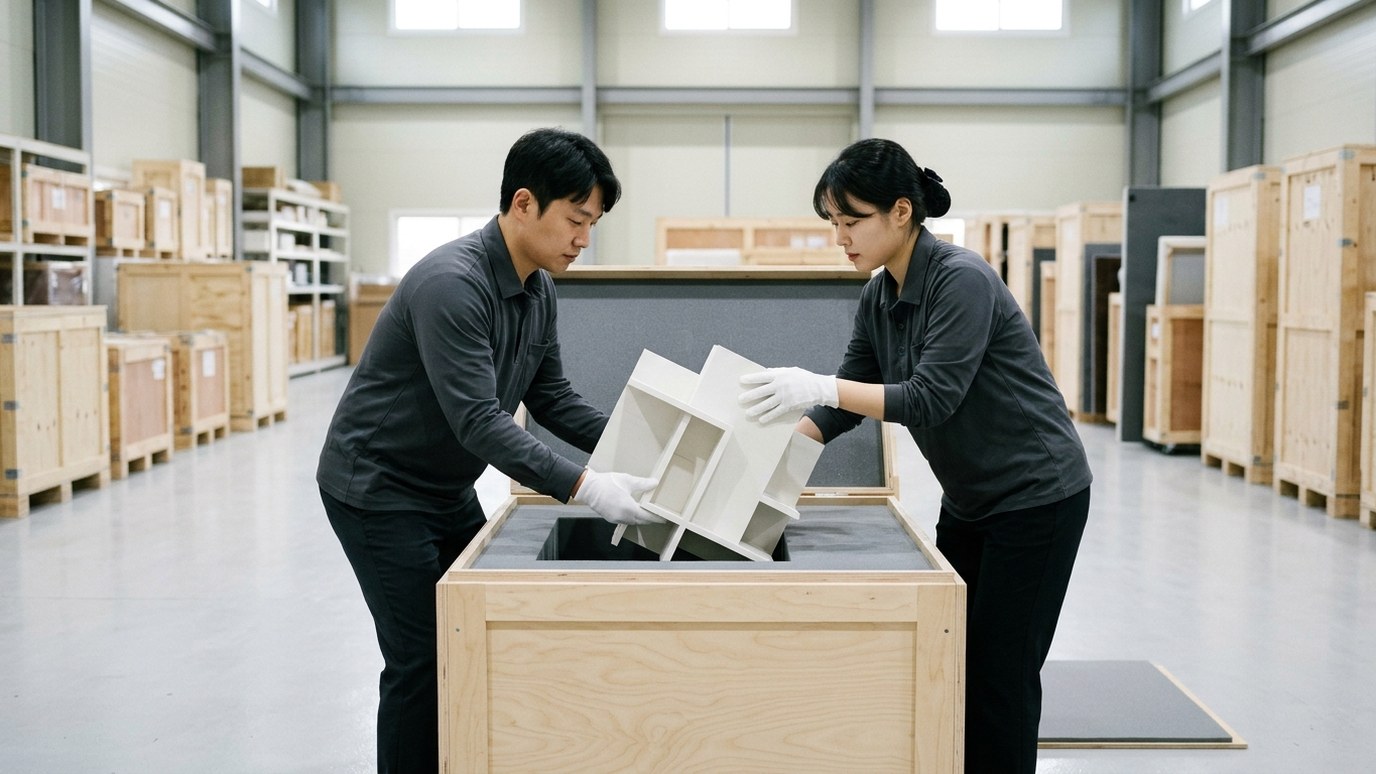
When shipping monumental sculptures and exhibition centerpieces overseas to Art Basel, Frieze, the Venice Biennale, or global pop-up tours, sculptures must be engineered around air-cargo door clearances, ATA Carnet temporary import/export customs inspections, and 30-minute tool-free on-site assembly.
| Global Exhibition Logistics Criterion | International Air Cargo & Customs Standard | Conventional Monolithic Wooden Crate | Sculpia & GLUCK Modular Flight-Case Solution |
|---|---|---|---|
| Air-Freight Module Sizing & Shock Damping | Cargo height under 1,500mm with multi-axis transit vibration isolation | Oversized monolithic crates rejected by passenger/cargo bellies or damaged during handling | 700–1,100mm modular blocks (15–28kg per module) housed in 3D contour-cut EVA foam flight cases |
| ATA Carnet Customs Documentation | Engraved part IDs matching exact net weight, dimensions, and exploded photo manifests | Unlabeled parts and weight discrepancies trigger customs holds and manual uncrating | Engraved module IDs paired with certified packing lists showing exact weights, dimensions, and photos |
| Hidden Alignment Pin & On-Site Assembly | Two handlers must complete assembly within 30 minutes without adhesives or repainting | Requires on-site gluing, puttying, and touch-up painting that delay opening reception | 0.05–0.1mm slip-fit stainless alignment pins, neodymium magnets, and quick-lock bolts for 30-minute assembly |
- ATA Carnet Temporary Customs Passport Readiness: Every detachable module features a permanent serial mark matched to an illustrated customs manifest for seamless round-trip clearance.
- Multi-City Tour Reusability: Embedded metal bushings and tapered locator pins allow repeated assembly and disassembly across international tour stops without joint wear.
Questions Artists & Curators Ask About Modular Works Designed for Shipping
Can a large work be split to fit shipping crates for an overseas show?
Yes. Parts are sized to the crates, and alignment pins at joints let local teams assemble easily. A small test print confirms proportion and a palm-sized sample confirms the finish before production.
How does 3D fabrication compare with plaster or FRP molds for modular works designed for shipping?
Traditional work faces a large single-piece work needs special freight and carries high breakage risk. Mold-free 3D building keeps your studio free of fiberglass dust and preserves inward folds on pieces like a 2.5 m sculpture headed to an overseas biennale.
Which finish suits modular works designed for shipping best?
Pairing mirror chrome (futuristic, glamorous presence) with bronze verdigris patina (weight, memory and a quietly monumental mood) covers two distinct moods; bronze verdigris patina shines especially on figurative bodies, commemorative pieces and garden sculpture.
Can modular works designed for shipping become an edition or goods?
Yes. From one digital master you could plan a numbered 9 at 45 cm and an open edition of about 150 at 15 cm, starting from "one work split for shipping". All rights stay with the artist.
What lighting and anchoring work best when installing modular works designed for shipping?
Aim low-heat LEDs from a 30 to 45 degree side angle to sculpt shadows across a cluster form assembled on site, keep a weighted plinth with concealed base pins, and follow simple care: Handle with gloves because fingerprints show; clean only with a soft cloth.
How are edition numbers and artist rights managed on modular works designed for shipping?
Every digital file and copyright stays 100% with the artist. Whether you cap a signed run at 9 pieces (45 cm) or connect online sales via Sculpia, production only happens with artist sign-off.
How do you support ATA Carnet customs clearance and 30-minute on-site modular assembly for international exhibitions?
We divide large works into 15–28kg air-cargo modules inside contour-milled EVA foam flight cases, engrave serial IDs matched to an illustrated ATA Carnet packing manifest, and integrate 0.05–0.1mm tapered alignment pins with quick-lock fasteners so two handlers can assemble the piece in 30 minutes without tools.