Optical Clear SLA 3D Printing Polishing (400–3,000 Grit Wet Sanding), Fluid Manifold Flushing & HALS UV Coating Specification
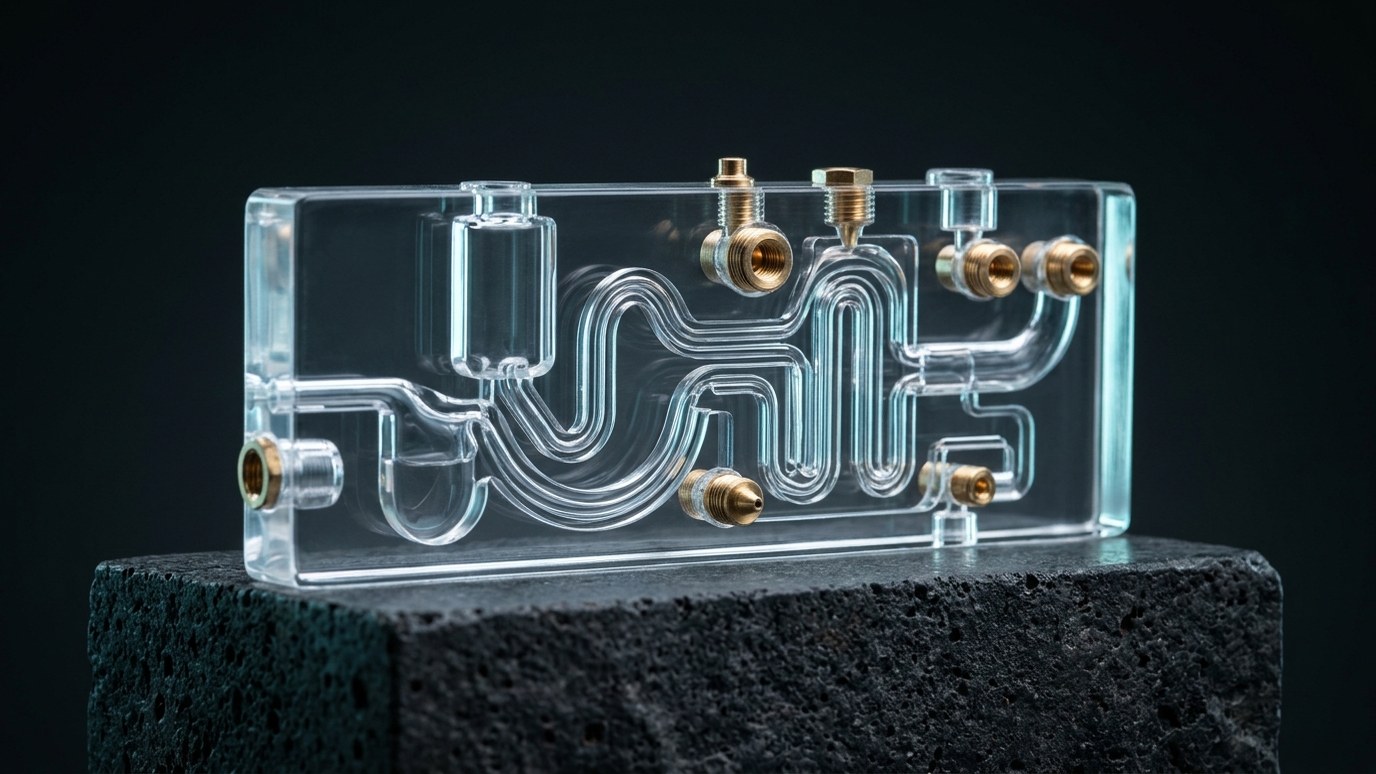
GLUCK's industrial optical clear SLA 3D printing protocol produces monolithic watertight fluid manifolds and flow-visualization blocks without bonded PMMA seams by combining support-free internal channel orientation, pressurized IPA flushing, 400–3,000 grit exterior wet sanding, and HALS anti-yellowing 2K UV clear coating.
1. Optical-Clear SLA Monolithic Fluid Manifold vs. Split CNC PMMA Bonding
In IVD reagent manifolds, semiconductor wet-bench blocks, and thermal-fluidic visualization rigs, solvent-bonding split-machined acrylic plates frequently introduces seam leaks and stress crazing. GLUCK’s 48-machine Paju SLA facility prints complex 3D internal routing as a single watertight solid.
| Criterion | Monolithic Optical-Clear SLA Manifold (GLUCK Standard) | Split CNC-Machined PMMA / Polycarbonate + Bonding |
|---|---|---|
| 3D Internal Routing Freedom | Helical mixers, multi-branch manifolds, and smooth radii in one seam-free block | Restricted to straight cross-drilled holes requiring Lee plugs and adhesive seams |
| Internal Channel Cleaning | Recommended ID ≥ 1.5–2.0 mm; pressurized IPA circulation + dry nitrogen purge | Tool-accessible straight bores only |
| Exterior Optical Clarity | 400 → 800 → 1,500 → 2,000 → 3,000 grit wet sanding + optical compounding | Vapor polishing or buffing (risk of solvent micro-crazing) |
| Anti-Yellowing Protection | HALS UV-absorber 2K polyurethane clear topcoat retards photo-oxidation | High native transmittance, but bond lines degrade under reagent cycling |
2. Support-Free Internal Channel Orientation, Pressurized IPA Flushing & Port Thread Design
Internal support structures inside curved fluidic channels cannot be mechanically removed and create flow turbulence or particulate traps. GLUCK’s DfAM engineers orient manifold axes above self-supporting overhang angles to eliminate internal supports, followed immediately by closed-loop pressurized IPA circulation, ultrasonic cleaning, and dry nitrogen purging.
- Minimum Channel Bore & Drain Architecture: Design straight bores at
Ø1.5 mmminimum and multi-bend manifold branches atØ2.0–2.5 mmminimum with unobstructed inlet-to-outlet flushing paths. - Crack-Free Pneumatic & Fluidic Port Bosses: Specify at least
3.0 mmwall thickness aroundM5,UNF 1/4-28, orG1/8ports and use straight tapped threads with elastomer O-ring face seals rather than tapered NPT threads. - Optical Exterior Polishing & Optional Creaform 3D Scan QA: Viewing windows are progressively wet-sanded from 400 to 3,000 grit and sealed with a HALS UV-stabilized 2K clear coat while mating datum faces remain masked for leak-tight sealing, with optional paid Creaform 3D scan QA (Verified Production Reference · Fluidic Manifold Part Consolidation Guide · Optical-Clear Vascular Flow Phantom Guide).
Frequently Asked Engineering & Procurement Questions (FAQ)
Can curved internal channels inside an optical clear SLA 3D-printed fluid manifold be made clear enough for bubble and flow visualization?
GLUCK orients optical clear SLA 3D-printed manifolds at self-supporting angles so zero internal supports form inside curved passages, then flushes residual resin with pressurized IPA. Exterior walls receive 400–3,000 grit wet sanding plus HALS anti-yellowing 2K UV clear coat, while internal channels clear optically via lacquer flushing and working-fluid refractive index matching.
How do you achieve clear flow visibility inside curved internal manifold channels where sandpaper cannot reach?
Curved internal channels are oriented to build without internal supports, flushed under pressure with fresh IPA to remove 100% of uncured resin, and optionally refractive-index coated via controlled clear-varnish flushing—delivering crisp meniscus and bubble visibility once filled with working fluid.
How does GLUCK prevent optical-clear SLA parts from turning yellow over time?
Residual photoinitiators in standard clear resins yellow under ambient UV light. GLUCK prints with low-yellowing optical SLA formulations, applies controlled thermal/UV post-cure profiles, and seals the polished exterior with a HALS-stabilized 2K UV-blocking polyurethane clear coat.
What port wall thickness and thread design prevent cracking when installing pneumatic or fluidic fittings?
Because optical-clear SLA resins have lower elongation at break than tough ABS-like resins, we recommend ≥ 3.0 mm boss wall thickness around M5, UNF 1/4-28, or G1/8 ports, using precision-tapped straight threads with O-ring face seals rather than tapered NPT pipe threads.