Celadon & Porcelain Heritage Non-Contact 3D-Scan Exhibition Facsimiles: Pierced Relief Reconstruction and Jade Glaze Finish
Celadon & Porcelain Heritage Non-Contact 3D-Scan Exhibition Facsimiles: Pierced Relief Reconstruction and Jade Glaze Finish — Printing double-shelled pierced celadon and porcelain exhibition facsimiles directly from archival 3D scans with multi-layer translucent jade glaze finishing. Key specification: Flush-plugged hidden drain ports · Concealed anti-tip seismic base bolt sockets · Color-matched under 3000K museum showcase lighting.
1. Engineering Scope & Design Objective
Core Focus: Printing double-shelled pierced celadon and porcelain exhibition facsimiles directly from archival 3D scans with multi-layer translucent jade glaze finishing.
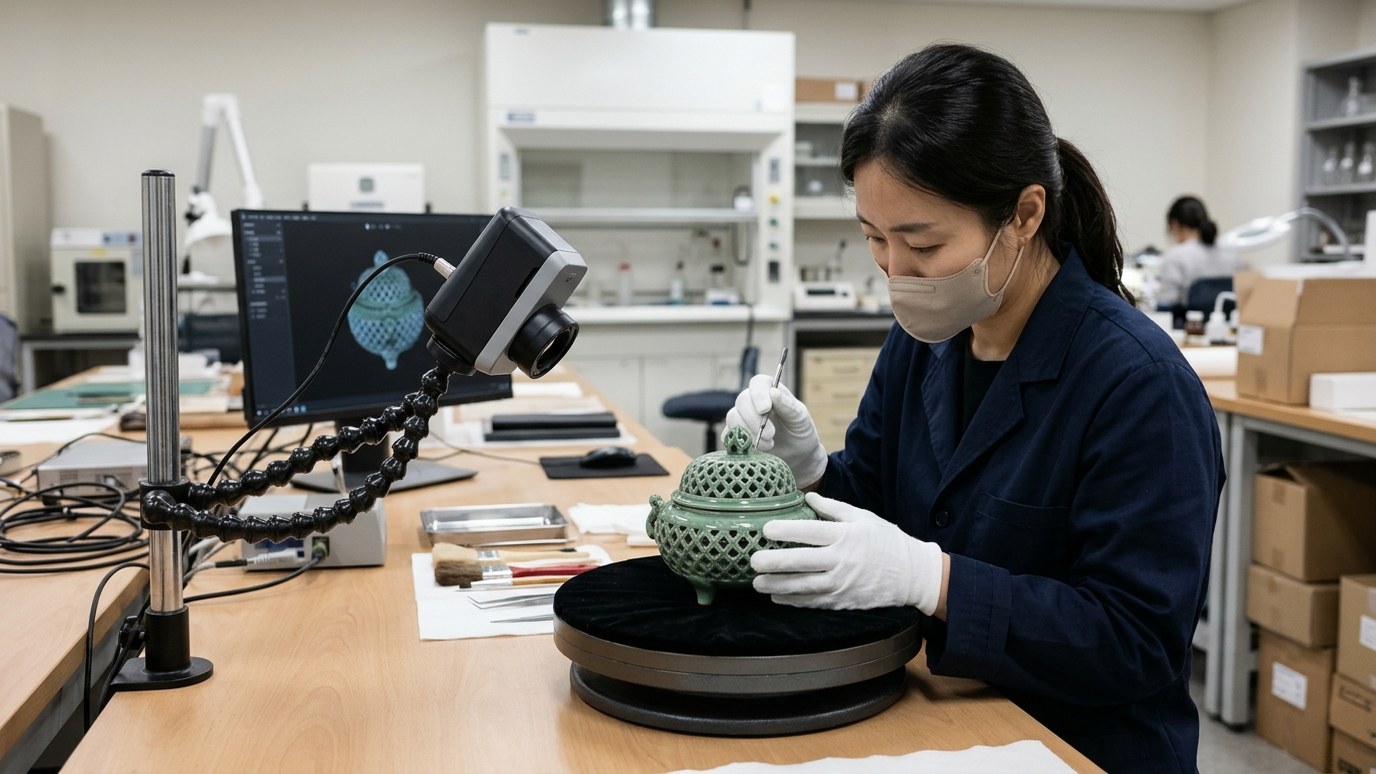
Standard Spec: Flush-plugged hidden drain ports · Concealed anti-tip seismic base bolt sockets · Color-matched under 3000K museum showcase lighting. Optical 3D scan meshes are healed into watertight solids for museum facsimiles, while barrier-free tactile panels print the baseplate, 2.5D relief, and domed braille dots as a single monolithic solid with zero pin detachment.
How should engineering and curatorial teams specify Celadon & Porcelain Heritage Non-Contact 3D-Scan Exhibition Facsimiles to achieve both geometric fidelity and schedule certainty?
2. Build Envelope, Material Pairing & Structural / Optical Protocol
Optical 3D scan meshes are healed into watertight solids for museum facsimiles, while barrier-free tactile panels print the baseplate, 2.5D relief, and domed braille dots as a single monolithic solid with zero pin detachment. At GLUCK's Paju single-site smart factory (48 industrial SLA systems), every build is scheduled with deterministic datum control and Creaform 3D laser scan verification.
| Design Parameter | Conventional Bottleneck | GLUCK Paju 48-SLA Standard | Verification Method |
|---|---|---|---|
| Application Scope | Manual fabrication or high mold cost | Printing double-shelled pierced celadon and porcelain exhibition facsimiles directly from archival 3D scans with multi-layer translucent jade glaze finishing | 1:1 engineer CAD/mesh review |
| Core Spec & Jointing | Uncontrolled seam drift | Flush-plugged hidden drain ports · Concealed anti-tip seismic base bolt sockets · Color-matched under 3000K museum showcase lighting | Step-Lip datums & Zone B masking |
| Bed & Scale | Small segmented hobby beds | 600x600x400 mm std & 1,000x800x600 mm large beds | Creaform 3D laser scan QA |
3. Finishing, Assembly Fit-Check & Delivery Governance
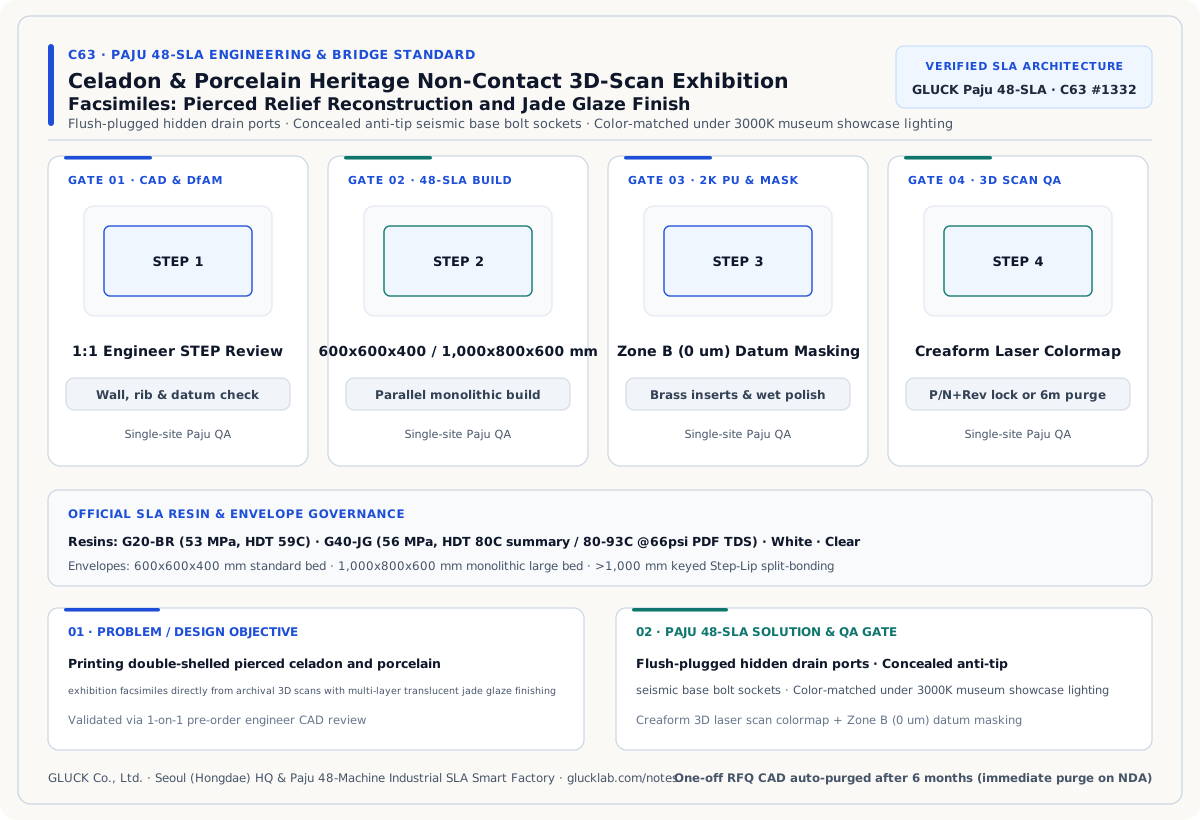
For Museum Non-Contact 3D-Scan Exhibition Facsimiles & Monolithic Barrier-Free Tactile Models, surface sheen, internal subframes, and transit protection are engineered concurrently before topcoat application.

Request a 1:1 Engineer Custom Quote ↗ · Download Open AP203 STEP DfAM Kit ↗
Frequently Asked Engineering Questions
What is the primary engineering specification for Celadon & Porcelain Heritage Non-Contact 3D-Scan Exhibition Facsimiles?
Printing double-shelled pierced celadon and porcelain exhibition facsimiles directly from archival 3D scans with multi-layer translucent jade glaze finishing. Specifically, GLUCK applies: Flush-plugged hidden drain ports · Concealed anti-tip seismic base bolt sockets · Color-matched under 3000K museum showcase lighting.
How are oversized assemblies (>1,000 mm) and structural loads handled?
Optical 3D scan meshes are healed into watertight solids for museum facsimiles, while barrier-free tactile panels print the baseplate, 2.5D relief, and domed braille dots as a single monolithic solid with zero pin detachment. Standard beds are 600x600x400 mm and large monolithic beds reach 1,000x800x600 mm, with keyed Step-Lip joints and internal steel/aluminum frames for larger spans.
How do we request a 1:1 engineer review and turnaround schedule?
Upload your 3D STEP/Rhino/scan data through GLUCK's quote portal with target dimensions, quantity, and venue/exhibition deadline for a 1-on-1 engineering review.
Illustrative Engineering Review Scenario & Pre-Production Check Protocol
Transforms non-contact optical 3D scan archives of fragile collection items into touring-exhibition facsimiles with hand-toned ceramic, bronze, or stone surface artistry, paired with barrier-free 2.5D relief tactile stations whose domed braille dots and raised contours are printed monolithically with the base substrate.
- Exhibition & Educational Replica Scope: Dedicated to non-contact exhibition facsimiles, touring displays, dioramas, and tactile learning aids rather than invasive conservation treatment on statutory originals
- Monolithic Braille Dots & Finger-Safe Fillet Radii: Integrates braille domes and raised contours directly into the SLA solid to eliminate glued-pin detachment under heavy visitor touch
- Abrasion-Resistant Matte Protective Topcoat Coupon Testing for Repeated Handling and Mild Disinfectant Wiping
Note: The quantities, dimensions, and process combinations in this section are illustrative engineering review scenarios for DFM planning and do not represent specific client delivery records or unconditional guarantees. Based on GLUCK's 48-machine Paju SLA smart factory (standard online quote bed 600×600×400 mm; large-format single-piece bed up to 1,000×800×600 mm via engineering review). Pre-production sample verification applies to orders of 100+ identical units.
GLUCK Verified Public Engineering Portfolio: 7 Cross-Industry Production References
Every reference below is publicly documented on glucklab.com and gluckblog.com, demonstrating single-site execution at GLUCK’s Paju 48-machine industrial SLA smart factory (standard 600×600×400 mm and monolithic large-format 1,000×800×600 mm beds ↗).
| Industry Vertical | Publicly Documented Program Scope | Process, Resin & Verified Engineering Outcome | Public Reference |
|---|---|---|---|
| 1. Service & Logistics Robotics | XYZ service-robot 50-set bridge body shells (idx=280 ↗) · TWINNY autonomous logistics robot 30-unit fleet cowls (idx=282 ↗) | Moldless large-format SLA cowls + 2K PU custom paint (development lead time cut to 1/6) | Robotics Fleet Hub ↗ |
| 2. Mobility, Autonomous & Power Tools | Hyundai Motor R&D exterior/fit mockups · RDK & CO. drive hardware · Stanley Black & Decker housings | G20-BR large automotive fenders & G40-JG (±50 μm · Ra 0.8 · HDT 80°C summary metric) validation | G40-JG Mobility Case ↗ |
| 3. Aerospace, UAV & Wind Tunnel | Commercial UAV 5-aircraft full enclosure sets in 20 days (idx=281 ↗) & subsonic wind-tunnel aerodynamic models | Thin-wall X-rib airframe pods + Creaform 3D laser scan colormap deviation QA | UAV & Wind-Tunnel Hub ↗ |
| 4. Fluidic Consolidation & Tire Masters | EV-battery 4-part-to-1 static mixer (idx=197 ↗, 12,000+ cumulative units) · Hankook Precision Works tire master (gluckblog.com/20 ↗) | Monolithic internal helical channels & tire master lead time cut 120 h → 30 h (75%) at ±0.06 mm | 3-Route Selection Hub ↗ |
| 5. Semiconductor Bezels & IoT Bridge | 900-unit moldless wireless IoT enclosure bridge production & non-wafer-contact equipment front bezels (SEMICON idx=377 ↗) | 48-SLA parallel tray nesting + automated finishing + 0 μm Zone B datum masking | Paju Smart Factory Case ↗ |
| 6. Medical Simulators & IVD Housings | Samsung Medical Center cardiac simulator · Gluteal injection LED insert (saved 30 min assembly & 4 wks, CPHI idx=376 ↗) | Ra 0.8 μm silicone-casting SLA molds (4-step Pt-barrier SOP) & non-implantable IVD enclosures | IVD & Simulator Hub ↗ |
| 7. Diagnostic Optics & Clear SLA | Opticho photoacoustic medical diagnostic hardware (~20 field systems, idx=283 ↗) · Dual-finish Clear SLA (idx=192) | Multi-revision optical/enclosure loop & wet-polished + UV-clearcoated Clear SLA | Opticho Iteration Case ↗ |