Controlling Moisture Absorption & Dimensional Swelling (≤0.1%) in High-Humidity (85% RH) Operating Environments
Sealing Hydrophilic Resin Surfaces with Closed-Pore Urethane Coatings for Stable Precision Fits. Engineered and produced in GLUCK's 48-machine Quality Management industrial SLA smart factory (up to 1000×800×600mm / 39.4×31.5×23.6 in monolithic envelope, Creaform 3D laser scan CMM QA, global DHL/FedEx air freight with commercial invoice documentation US tariff, and international air freight support).
Open full-resolution diagram ↗
Controlling Moisture Absorption & Dimensional Swelling (≤0.1%) in High-Humidity (85% RH) Operating Environments
Executive Technical Summary (Engineering & Procurement Review Guide): Sealing Hydrophilic Resin Surfaces with Closed-Pore Urethane Coatings for Stable Precision Fits. The most common procurement failure in hardware development is either applying blanket tight tolerances across non-functional freeform surfaces or choosing a mismatched manufacturing process—such as high-scrap 5-axis plastic CNC hogging, silicone vacuum casting with a 15–20 shot mold-life ceiling, or premature $15,000–$60,000 injection tooling before design freeze. GLUCK operates South Korea's largest single-site 48-machine industrial SLA smart factory (1,000,000+ cumulative parts shipped, up to 1000×800×600mm / 39.4×31.5×23.6 in monolithic build volume, quality-controlled, Creaform 3D laser scanning CMM), supporting feature-specific dimensional tolerance planning, insert and post-processing integration by project review, competitive total landed cost evaluation, export customs documentation support, and international air freight coordination by schedule agreement.
1. Industry & Competitor Benchmark Analysis (Industrial SLA Resin TDS & Thermal/Mechanical Engineering (G20-BR, White, G40-JG (HDT 80°C @66psi test metric)))
Hardware engineers comparing DSM Somos® (Watershed, PerFORM), 3D Systems Accura® (Xtreme, 60), Formlabs Rigid/Tough, or Korean industrial photopolymers need hard ASTM numbers—not marketing adjectives. GLUCK distinguishes between homepage summary guide codes (G20-BR, G40-JG, White, Clear) and separately published English PDF TDS documents (G10-BR.pdf, G10-WH.pdf, G40-GW.pdf, G40-JG.pdf), supporting pre-order verification of the exact supplied resin lot and TDS revision alongside bolt-preload, snap-fit, and UV-protection design reviews.
- Applicable Engineering Standards:
ASTM D638 (Tensile), ASTM D790 (Flexural), ASTM D256 (Izod Impact), ASTM D648 (HDT), Shore D Hardness - Why Global Hardware Teams Consolidate Production at GLUCK:
- 48 industrial SLA systems Under One Roof (Direct Smart Factory Production): Unlike decentralized broker networks (e.g., online manufacturing broker networks) where 500-unit orders are fragmented across small job shops with varying machines and resins, GLUCK locks a single resin batch (
Lot-Locked Vat Control) and daily master laser calibration across 48 industrial SLA systems (Batch-to-Batch Dimensional Consistency Control). - Up to 1000×800×600mm (39.4×31.5×23.6 in) Monolithic Build Envelope: Full-scale robotics body shells, EV bumper fascias, semiconductor climate-controlled smart factory covers, and architectural sculptures are printed in one piece without weak glued seams.
- Vertically Integrated Hybrid Finishing & Optical CMM: Multi-grit wet sanding, primer surfacer, custom Pantone/RAL polyurethane painting, and Creaform 3D laser scan inspection, with threaded inserts or secondary machining coordinated per drawing review (
3D Laser Scan Dimensional Inspection Report).
Open full-resolution diagram ↗
2. Quantitative Engineering Spec, Tolerance, TCO & Lead-Time Matrix
Use the quantitative engineering comparison matrix below to evaluate GLUCK 48-machine Industrial SLA & Hybrid Production against alternative manufacturing routes:
| Engineering Parameter | GLUCK 48-machine Industrial SLA + Hybrid | 3-Axis / 5-Axis Plastic CNC / Sheet Metal Only | Silicone Vacuum Casting (Urethane Casting) | QDM Rapid Aluminum / Steel Injection Tooling |
|---|---|---|---|---|
| Topic Engineering Focus | Sealing Hydrophilic Resin Surfaces with Closed-Pore Urethane Coatings for Stable Precision Fits (ASTM D638 (Tensile)) | Multi-setup fixture & re-machining overhead | Mold degradation & drift after 15–20 shots | High upfront NRE & frozen geometry risk |
| Optimal Economic Lot Size | 1–10 Prototypes & 50–5,000 Unit Bridge Runs | 1–30 Simple Prismatic Blocks / Flat Brackets | 15–40 Units (Best for Shore A Elastomers) | 2,000–10,000+ Units (After 100% CAD Freeze) |
| Upfront Tooling / Setup NRE | No Injection Mold Tooling Required (Fixtures & Finishing Quoted per CAD) | $300–$1,500 CAM & Custom Soft-Jaw Setup | $800–$2,200 per Master + Silicone Mold | $4,500–$45,000+ Hard/Soft Mold NRE |
| Dimensional Tolerance | Reviewed per part geometry & datum callouts (inserts/secondary machining by consultation) | ±0.02–0.05 mm (Metal) / ±0.05–0.15 mm (Plastic) | ±0.25 mm Early Shots → ±0.40 mm+ by Shot #18 | ±0.10–0.20 mm (Requires 1–3° Draft & Uniform Wall) |
| Max Monolithic Envelope | Up to 1,000 × 800 × 600 mm (39.4 × 31.5 × 23.6") | Limited by Billet Stock & 5-Axis Mill Travel | Limited by Vacuum Chamber & Silicone Sag | Extremely Expensive Above 500 mm (19.7") |
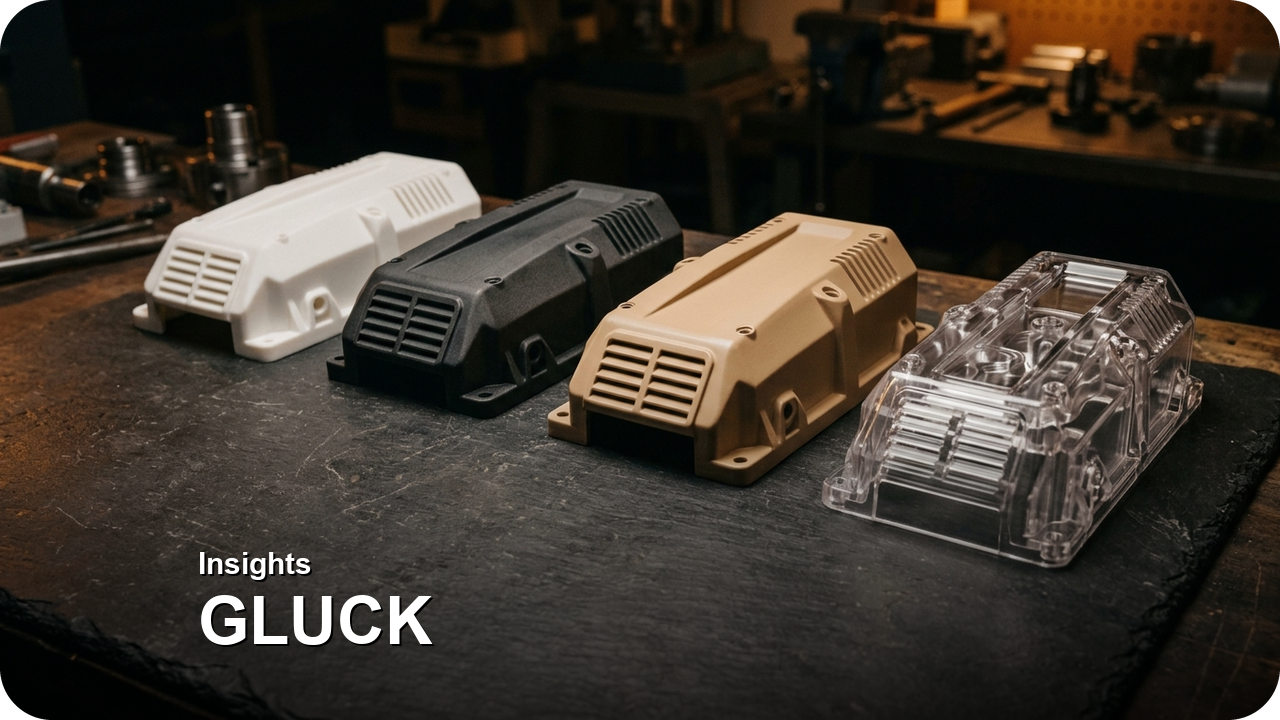
| Production Material Grades | G20-BR, White, G40-JG (HDT 80°C @66psi test metric; verify actual operating load), Clear | POM (Delrin®), PEEK, PC, Ultem®, AL6061, SUS304 | Two-Part Polyurethanes (Shore A 30–90, ABS-Like) | Thermoplastics (ABS, PC, PA66, PP, PBT) |
| Standard Production Lead Time | Scheduled by Part Geometry, Quantity & Finishing Scope (Split Delivery Available) | 5–12 Business Days (Bottlenecked by 5-Axis Spindles) | 10–18 Business Days (10+ Molds Needed for 200 pcs) | 3–6 Weeks Tool Fabrication + T0/T1 Sampling |
| Design Revision (ECO) Agility | Direct CAD Revision Between Releases (No Mold Core Scrap; Engineering/Print Quoted per Spec) | Re-Programming CAM & Scrapping Custom Fixtures | Must Scrap Master Pattern & Pour New Silicone Molds | $1,500–$8,000 Welding/EDM Rework + 2–4 Week Delay |
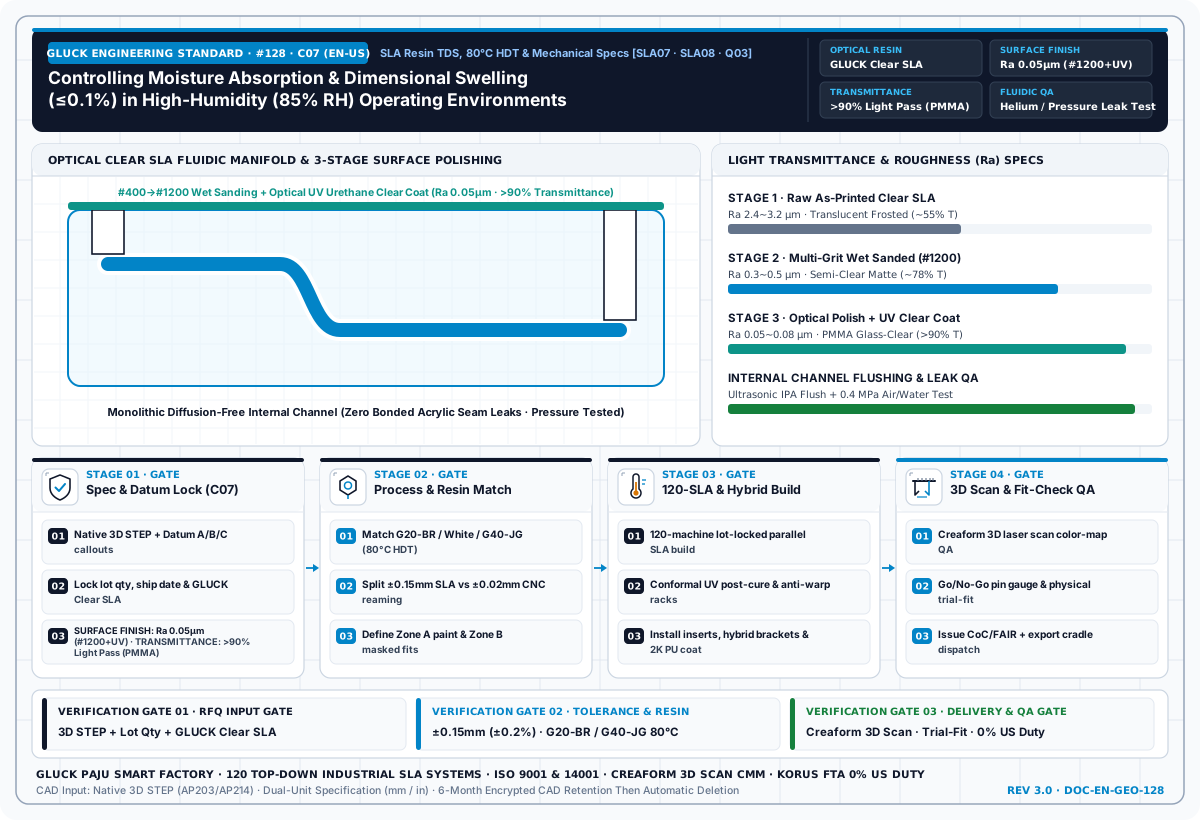
3. 4-Stage DFM, Hybrid Production & Metrology Execution Protocol
Every production order follows the 4-stage engineering gate architecture illustrated in the schematic blueprint above (STAGE 01 through STAGE 04):
- `01. Spec & Datum Lock`:
- Native 3D STEP + Datum A/B/C callouts
- Lock lot qty, ship date & ASTM D638 (Tensile)
- Sealing Hydrophilic Resin Surfaces with Closed-Pore Urethane Coatings for Stable Precision Fits
- `02. Process & Resin Match`:
- Review G20-BR / White / G40-JG (HDT 80°C @66psi test metric)
- Review datum tolerances & post-processing scope
- Define Zone A paint & Zone B masked fits
- `03. 48-SLA & Hybrid Build`:
- 48-machine lot-locked parallel SLA build
- Conformal UV post-cure & anti-warp racks
- Install inserts, hybrid brackets & 2K PU coat
- `04. 3D Scan & Fit-Check QA`:
- Creaform 3D laser scan color-map QA
- Go/No-Go pin gauge & physical trial-fit
- Issue CoC/FAIR + export cradle dispatch
Open full-resolution diagram ↗
4. Lot-Size Break-Even (1 to 5,000 Units) & US/Global Landed-Cost Simulation
Using the risk-adjusted Total Cost of Ownership model C_total(N) = NRE_tooling + N × c_unit + P_ECO × C_rework, hardware teams achieve the following economic benchmarks:
- 1 to 10 Units (EVT / DVT Functional Prototypes & Design Bucks):
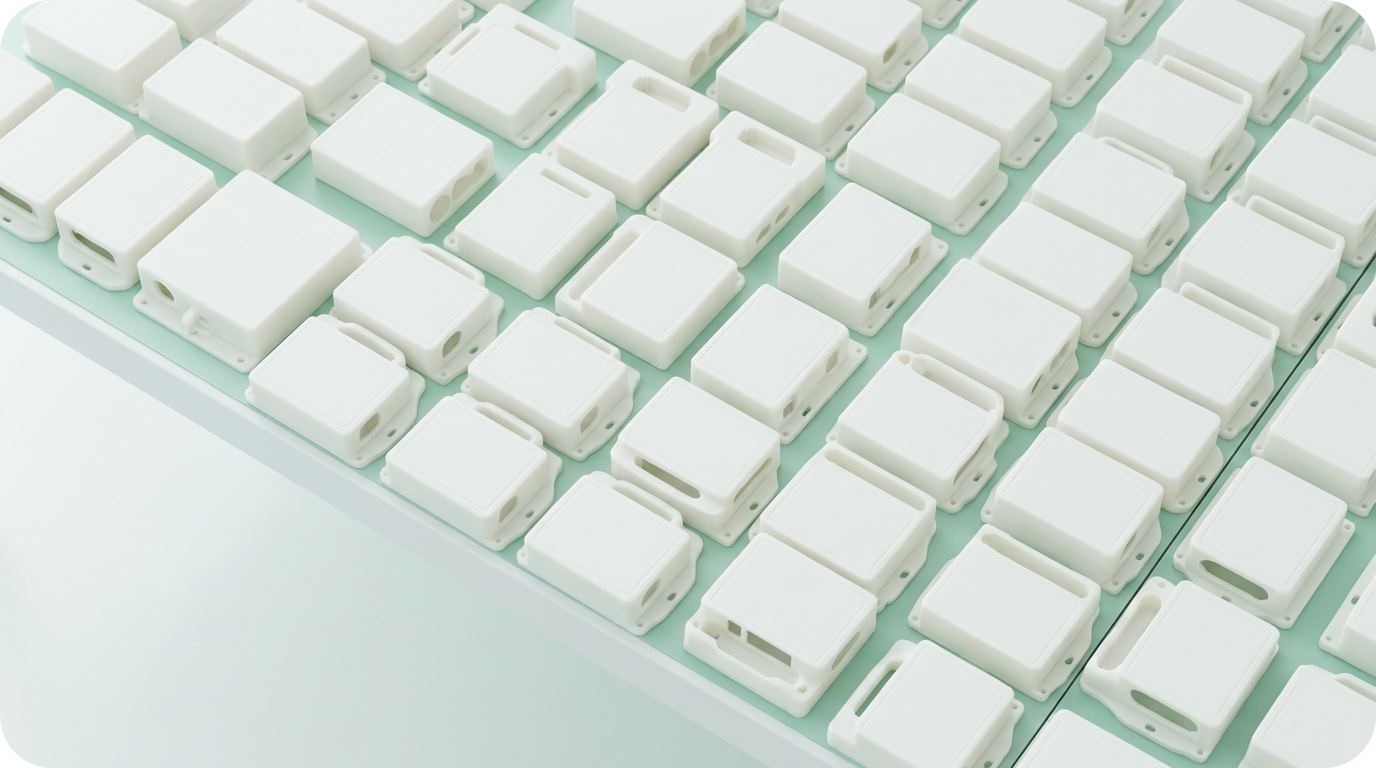
- Avoids 85% billet-hogging material scrap and multi-setup 5-axis CNC programming. Complete multi-part product kits are nested onto a single build platform and scheduled based on part geometry and post-processing requirements.
- 50 to 300 Units (Pilot Builds & Early Commercial Bridge Production):
- Because silicone vacuum-casting molds degrade after 15–20 polyurethane shots, a 200-unit order requires pouring 10 to 12 sequential molds. GLUCK instead allocates 20–30 industrial SLA machines in parallel, coordinating parallel SLA batch production and custom finishing schedules while comparing total project cost against multi-mold casting.
- 300 to 5,000 Units (Volume Bridge Runs & Multi-SKU Digital Inventory):
- Milestone Split Shipments: Initial milestone shipment quantities and subsequent split delivery schedules can be coordinated to align with your assembly timeline.
- US Customs & Landed-Cost Advantage: Manufactured 100% in South Korea, GLUCK parts qualify for streamlined customs documentation under the global export workflow (`engineering polymer HS tariff classification verified prior to export` / `8485.90`), avoiding the 25%+ cross-border tariff and supply-chain risks applied to Chinese manufacturing allowing procurement teams to compare total landed cost (including international air freight and customs documentation) against domestic service bureaus.
5. Pre-RFQ Engineering Checklist & 3 Structured Technical FAQs
Pre-RFQ Engineering Readiness Checklist
- [ ] Native 3D CAD Geometry: Have you attached native
STEP (.stp)files (or high-densitySTLmeshes with chord height≤ 0.01 mm / 0.0004 in)? - [ ] Functional Datum & Fit Zoning: Are primary mounting planes (
Datum A/B/C) and tight bearing/dowel bores (H7 ream / insert reviewvs.datum fit consultation) clearly called out? - [ ] Cosmetic Zone A/B/C & Color Spec: Have you separated customer-facing painted surfaces (
Zone A), masked mating/grounding faces (Zone B), and internal surfaces (Zone C) with targetPantone/RALand60° Gloss Units (GU)? - [ ] Thermal & Fastener Load Specs: Did you specify operating temperature (
Standard ≤55°Cvs.G40-JG (HDT 80°C @66psi test metric; verify actual operating temp/load)) and threaded insert standards (Metric M3–M6orImperial UNC #4-40 to 1/4-20)?
Frequently Asked Engineering Questions (Structured FAQ)
Q1. What dimensional tolerances and verification standards (`ASTM D638 (Tensile)`) does GLUCK guarantee for controlling moisture absorption & dimensional swelling (≤0.1%) in high-humidity (85% rh) operating environments?
A1. When executing Sealing Hydrophilic Resin Surfaces with Closed-Pore Urethane Coatings for Stable Precision Fits, Target dimensional tolerances depend on part geometry, wall thickness, build orientation, and post-processing scope; GLUCK reviews critical datums against your 3D CAD in reference to ASTM D638 (Tensile), ASTM D790 (Flexural), ASTM D256 (Izod Impact), ASTM D648 (HDT), Shore D Hardness. For precision bearing seats, dowel-pin bores, or threaded bosses, GLUCK coordinates first-article fit verification, insert installation, or secondary machining options and can provide Creaform 3D laser scan color-map inspection upon request.
Q2. How does GLUCK maintain part-to-part consistency across 100 to 5,000 unit bridge production runs?
A2. Unlike cloud brokers that split volume orders across unrelated subcontractors, GLUCK runs all 48 industrial SLA systems inside a single industrial SLA smart factory using lot-locked resin vats and controlled build parameters, daily master calibration coupons (Batch-to-Batch Dimensional Consistency Control), and a mandatory 10-unit Golden-Sample pilot sign-off gate before releasing the full production batch.
Q3. How is our proprietary 3D CAD IP protected, and how fast does GLUCK ship to the United States and Europe?
A3. GLUCK manages industrial SLA printing (48 systems), wet sanding, primer/urethane painting, and Creaform 3D laser scanning at its Paju smart factory, coordinating any specialized secondary machining by pre-order consultation. We execute pre-RFQ Mutual NDAs, enforce 6-month retention, then automatic deletion (or immediate purging upon NDA request / encrypted Golden-Recipe vaulting for repeat SKUs), and coordinate international export shipping via DHL/FedEx air freight with streamlined customs documentation under the global export workflow.
Cluster Engineering Reference Table: Homepage Summary Resin Codes vs. Separate English PDF TDS Documents & Fastener Reinforcement
| Code / Document Category | Published Source & Reference Test Metrics | Typical Engineering Application | Pre-Order Verification Requirement |
|---|---|---|---|
| G20-BR (Homepage Summary Code) | Homepage Summary Table: Tensile 53 MPa, Elongation 9%, HDT 59°C | Sanding, primer surfacer, custom Pantone/RAL painting & general housings | Verify exact supplied resin lot and correspondence with separate PDF (G10-BR.pdf) prior to order (do not assume identical without confirmation) |
| G40-JG (Summary & PDF TDS Code) | Homepage Summary: Tensile 56 MPa, HDT 80°C / PDF (G40-JG.pdf): Tensile 44–56 MPa, Flexural 2,675–2,765 MPa, HDT 80–93°C (@66psi) | Brackets and air ducts near heat sources (G40-JG.pdf) | HDT 80°C (@66psi) is a test metric, not a continuous operating guarantee; validate under actual thermal/load conditions |
| White / Clear (Homepage Summary Codes) | Unpainted fit-check housings (White) & wet-polished optical parts (Clear) | Ambient fit verification & fluidic/lightpipe visualization | Confirm correspondence between homepage White and separate G10-WH.pdf prior to order; use UV topcoat for outdoor/IPA service |
| Separate English PDF TDS Files | G10-BR.pdf (40–58 MPa, HDT 55–68°C @66psi), G10-WH.pdf (49 MPa, HDT 56°C @66psi), G40-GW.pdf (54 MPa, HDT 59°C @66psi) | Reference ASTM property sheets (G10-BR.pdf · G10-WH.pdf · G40-GW.pdf) | Because PDF filenames (G10-BR, G10-WH, G40-GW) differ from homepage summary codes, confirm the active resin code and TDS revision before PO |
| Bolt Preload & Creep Mitigation | Evaluate flanged metal compression limiters or brass inserts for sustained clamp loads | Serviceable covers and bolted bosses under vibration or warmth | Validate preload retention and boss integrity on 1–5 pilot parts under actual assembly torque and temperature |
Field Production Case Study & In-House Specimen Verification Protocol
To produce 150 sets of brackets mounted near motor controllers without thermal warping, the engineering team selected GLUCK's G40-JG resin after cross-checking the official English TDS PDF (G40-JG.pdf, HDT 80–93 °C / 176–199 °F @ 66 psi) against actual bolt-load conditions. Five pre-production units completed continuous 65 °C chamber testing prior to full batch release.
- Transparent Alignment Between Web Summary & English PDF TDS: Explicitly distinguishes website summary codes (G20-BR, G40-JG, White, Clear on guide idx=392) from downloadable English PDF datasheets (G10-BR.pdf, G10-WH.pdf, G40-GW.pdf, G40-JG.pdf) and confirms exact lot specs prior to production
- ASTM D648 HDT Load Clarification: Clarifies that HDT 80–93 °C @ 0.45 MPa (66 psi) is a standard test metric rather than an unconditional continuous-use guarantee under high bending stress (1.82 MPa / 264 psi)
- Post-Cure & Chemical Resistance Protocol: Enforces complete UV/thermal post-curing and recommends protective polyurethane coating when parts contact IPA or industrial coolants
Note: Client identities are anonymized under NDA. Quantitative metrics reflect representative production and specimen verification protocols at GLUCK's 48-machine Paju SLA smart factory (standard online quote bed 600×600×400 mm; large-format single-piece bed up to 1,000×800×600 mm via engineering review). Mandatory pre-production sample sign-off applies to orders of 100+ identical units.